Trains get all the attention when people talk about slow travel. But ferries offer something trains can't quite match: the particular magic of moving across water, watching a landscape unfold from a deck chair, and arriving somewhere new without the blur of speed.
These ten routes prove that sometimes the best part of a trip is the crossing itself.
The dramatic arrivals
The Wellington–Picton crossing in New Zealand's Cook Strait has earned its reputation. The journey starts in Wellington's harbor, then opens into the Marlborough Sounds—a network of sheltered waterways carved into the South Island's edge. Most travelers who've done it mention the same thing: grab a spot on the outside deck early, and dress for wind that actually means business.
We're a new kind of news feed.
Regular news is designed to drain you. We're a non-profit built to restore you. Every story we publish is scored for impact, progress, and hope.
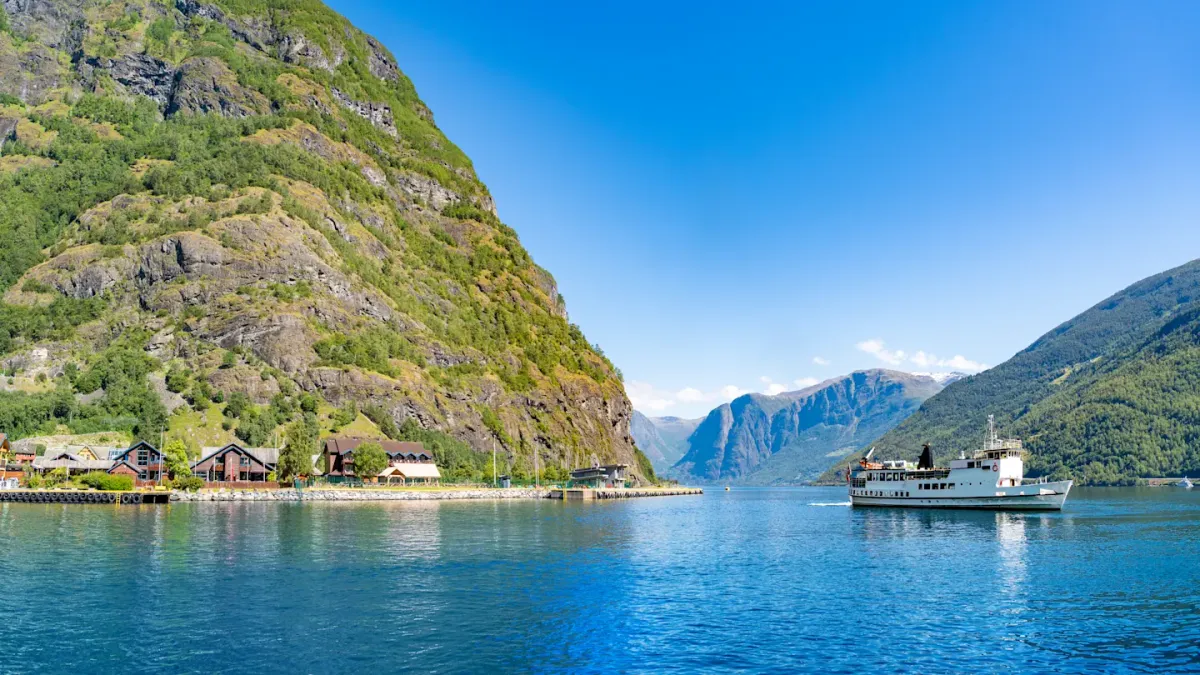
Start Your News DetoxNorway's Nærøyfjord offers a different kind of drama. The fjord route (technically a scenic cruise, but it functions like a passenger ferry) delivers that particular Norwegian feeling of being genuinely small in the presence of something vast. Steep rock faces rise directly from the water. Waterfalls appear without warning. A thermos of something warm makes the experience complete.
The Bosphorus crossing in Istanbul does something few ferries manage: it literally takes you from one continent to another. You pass Ottoman domes and minarets, waterfront neighborhoods stacked on hillsides, and enough seabirds to make you wonder where they're all going. The longer routes—ones that don't just point-to-point across the strait—give you time to actually absorb the geography.
The working routes that happen to be beautiful
Hong Kong's Star Ferry is short, cheap, and runs constantly between Tsim Sha Tsui and Central. It's a commuter ferry that millions of people use without thinking twice. But if you're visiting, take it at late afternoon into evening. The skyline catches the light in a way that photographs almost don't capture. You'll understand why people who live there never seem to get tired of it.
The Helsinki–Tallinn crossing is similarly efficient—a quick Baltic Sea hop that works perfectly for a day trip or a two-city itinerary. The approach to each city gives you the best views: Helsinki's shoreline and Tallinn's medieval profile coming into focus as you get closer.
The island-hopping possibilities
The Seattle–Victoria Clipper takes you through Puget Sound with the soft greens of the Pacific Northwest as your backdrop and, on clear days, the Olympic Mountains sitting in the distance like a painting someone hung on the horizon. It's a practical way to combine a U.S. city with a visit to Vancouver Island.
The Anacortes to San Juan Islands ferry system is popular for a reason: the islands themselves are the scenery, and depending on the season, you might see marine wildlife en route. Timing it for golden hour—that stretch of light just before sunset—transforms an already good journey into something memorable.
The Split–Dubrovnik route along Croatia's Dalmatian Coast gives you a steady stream of islands and historic towns. If you're willing to structure your itinerary around ferry schedules, it becomes a framework for island hopping rather than just a single crossing.
The shortcuts that feel like escapes
Buenos Aires to Colonia del Sacramento is the one-day-and-another-country option. Colonia is walkable and charming, and the crossing itself—a river journey with a gorgeous view—makes it feel less like you're taking a ferry and more like you're slipping away.
The Belize City to Caye Caulker water taxi is similarly short but immediate. You get coastal and island scenery without the long crossing, and Caye Caulker has that particular laid-back energy that feels medicinal. Sitting outside on the water taxi, watching the Caribbean do what it does best, is the whole point.
What these routes share isn't a particular geography—they span continents and climates. It's the understanding that getting somewhere slowly, by water, with time to actually look around, changes what arrival feels like. The ferry isn't a way to get to the destination. It's often the best part of being there.