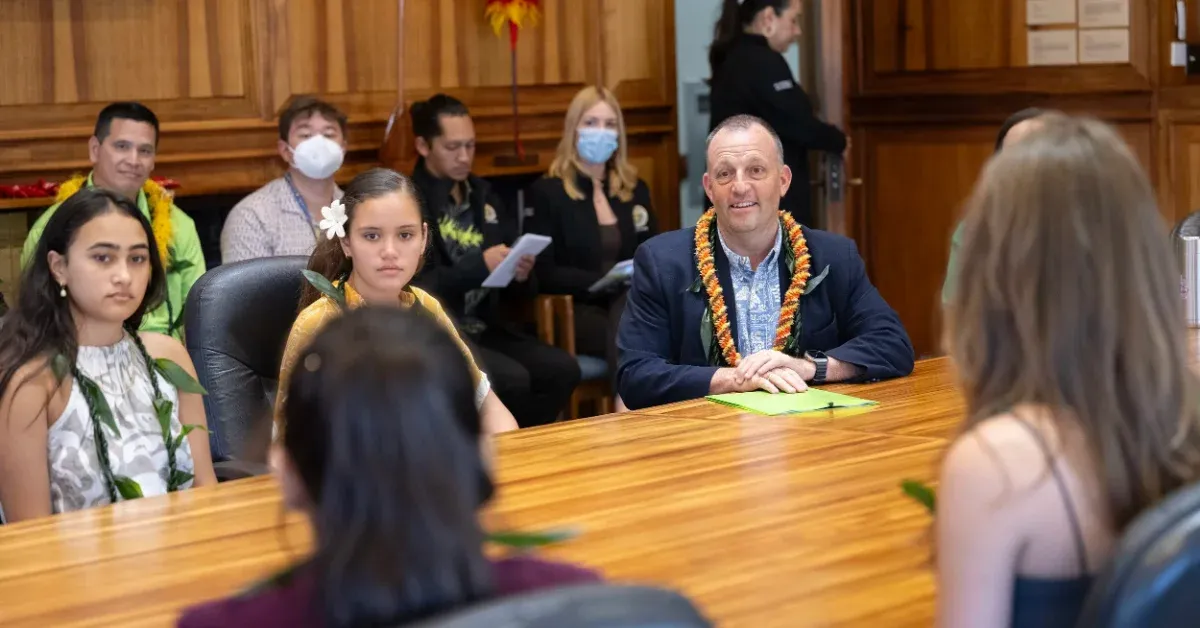
Thirteen young people in Hawaii just did something pretty remarkable: They sued the state's Department of Transportation (DOT) over climate change, and they won. Or, more accurately, they settled. And now the DOT has to actually listen to them.
Because apparently, that's where we are now. Teenagers are teaching state agencies how to be better environmental stewards. The Navahine v. Hawai‘i DOT lawsuit, brought by 13 young plaintiffs, claimed the DOT wasn't doing enough to meet Hawaii's climate goals, violating their constitutional right to a clean and healthy environment.
The result? A new Hawai‘i Youth Transportation Council, where these young people regularly meet with the DOT to offer input on everything from bike lanes to public transit. Because who better to plan for the future than the ones who will actually inherit it?
We're a new kind of news feed.
Regular news is designed to drain you. We're a non-profit built to restore you. Every story we publish is scored for impact, progress, and hope.
Start Your News DetoxThe Kids Are Alright, The Planet, Less So
One of the plaintiffs, Charlotte Madin, saw firsthand the effects of a warming world. Born in Sydney, Australia, she remembers severe heat waves forcing her family to evacuate their home just to find air conditioning. Think about that for a second: leaving your house because it's literally too hot to stay.
After moving to Hawaii, Madin, whose parents are marine biologists, watched the coral reefs decline. Then, in 2021, ash rained from the sky during a massive wildfire on the Big Island. Her grandmother even got a concussion and couldn't get to a hospital because the roads were blocked. When a friend told her about the lawsuit, Madin, then 12, saw her chance to do something.
It wasn't all fun and games. Madin was questioned by DOT lawyers for several hours when she was 13 or 14. Intimidating, yes. But also, she says, a point of pride for telling the truth.
A Legal Win, A Breath of Fresh Air
Joanna Zeigler, a staff attorney at Our Children’s Trust who led the case, explained the legal backbone: Hawaii's public trust doctrine requires the state to protect natural resources for all generations, and its constitution guarantees the right to a clean and healthy environment. Transportation, historically focused on expanding car infrastructure, is Hawaii's largest source of greenhouse gas emissions.
Now, the DOT has to decarbonize transportation by 2045. That means zero emissions from ground, marine, and inter-island air travel. They'll also create a greenhouse gas reduction plan with targets for 2030, 2035, and 2040, finish the pedestrian, bicycle, and transit network within five years, and boost EV infrastructure. All of this is legally binding, not just a suggestion.
And that youth council? It's not just a token gesture. It's a direct line for young Hawaiians to influence transportation planning. This is the first youth-led climate change lawsuit to reach a settlement, making it a potential blueprint for other states.
Madin's message to other young people is simple: "You always have a voice, and you always have a choice with how you use that." Sometimes, that means telling the grown-ups they're doing it wrong. And sometimes, the grown-ups actually listen.