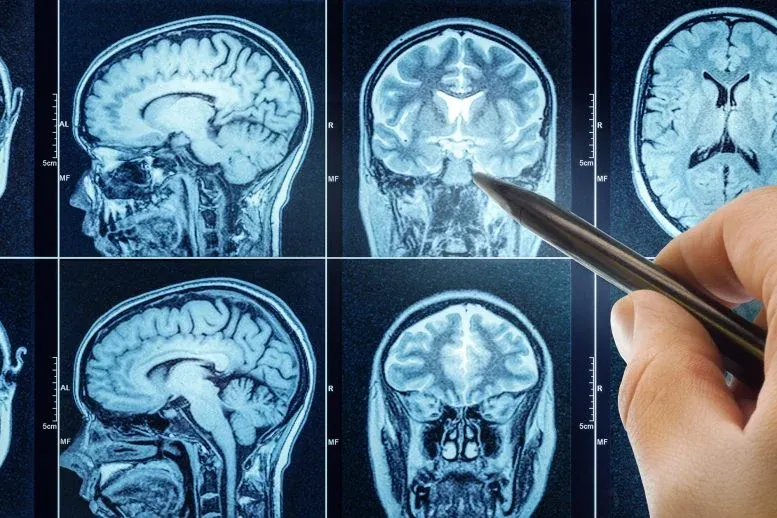
Scientists at Brown University have identified a measurable shift in brain electrical activity that signals whether someone with mild cognitive impairment will develop Alzheimer's disease within the next two and a half years. It's the kind of early warning system that could transform how doctors approach the disease — catching it before symptoms fully take hold.
The discovery came from analyzing brain waves in a specific frequency band linked to memory. Patients who later developed Alzheimer's showed a distinct pattern: their beta-frequency brain signals were firing less often, lasting shorter, and with less power. The finding is significant because it's the first time researchers have connected these particular electrical patterns to Alzheimer's progression.
"Two and a half years prior to their Alzheimer's disease diagnosis, patients were producing beta events at a lower rate, shorter in duration, and at a weaker power," explains Danylyna Shpakivska, the study's lead author. "To our knowledge, this is the first time scientists have looked at beta events in relation to Alzheimer's disease."
We're a new kind of news feed.
Regular news is designed to drain you. We're a non-profit built to restore you. Every story we publish is scored for impact, progress, and hope.
Start Your News DetoxA Better Way to Read the Brain
The breakthrough required a new tool. Traditional methods for analyzing magnetoencephalography data — the technique that measures brain electrical activity — tend to smooth out signals, missing the fine details that matter. Stephanie Jones and her team at the Carney Institute developed something called the Spectral Events Toolbox, which breaks brain activity into distinct moments instead. This lets researchers see precisely when signals fire, how often, how long they last, and how strong they are.
The approach has proven so useful that it's already been cited in over 300 scientific publications. When they applied it to patients with mild cognitive impairment, the difference between those who'd later develop Alzheimer's and those who wouldn't became clear.
What makes this advance particularly promising is that it measures brain activity directly — not just the toxic proteins (amyloid plaques and tau tangles) that accumulate in Alzheimer's. Those protein markers show damage is happening. This electrical signal shows how neurons are actually responding to that damage. "A biomarker from brain activity itself represents a more direct method of assessing how neurons respond to this toxicity," says David Zhou, a postdoctoral researcher leading the next phase of work.
The researchers are already moving forward. With new funding from the Carney Institute, Jones's team will investigate the mechanisms behind these brain signals — essentially, what's going wrong at the neural level to produce this pattern. If they can understand the mechanism, they can start testing whether specific treatments might correct it.
For people living with cognitive concerns, the path forward is becoming clearer. A clinician could eventually use this toolkit to identify who's most at risk before Alzheimer's takes hold, and to track whether new interventions are actually working.