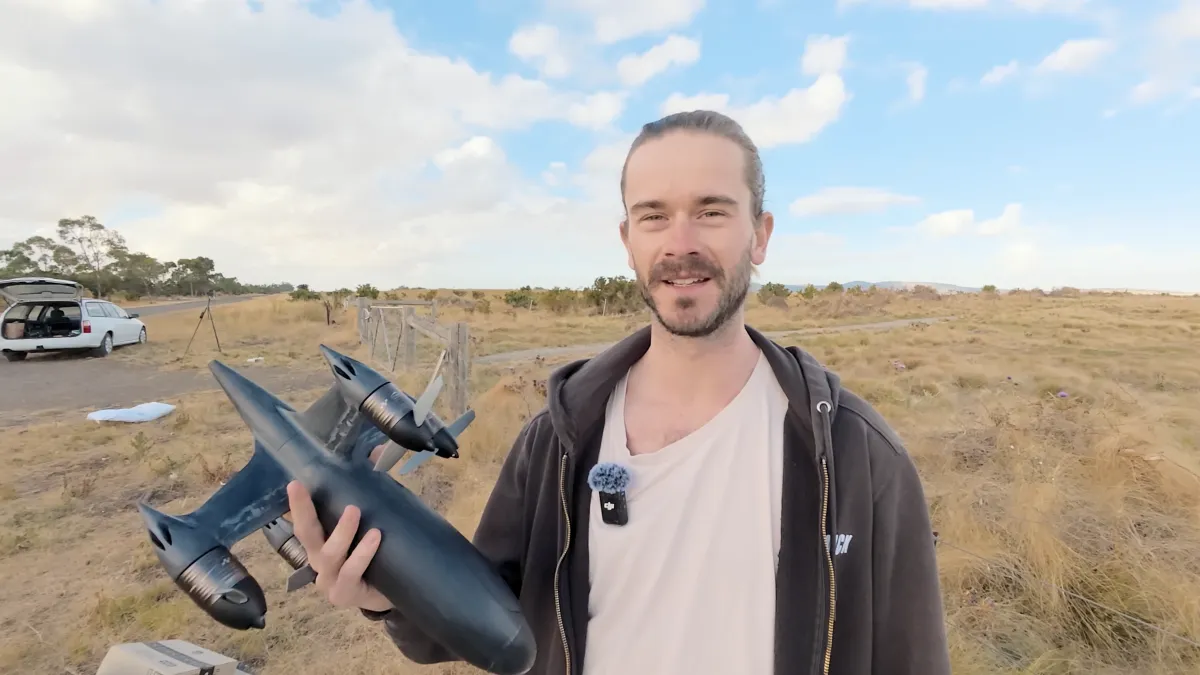
Australian aerospace engineer Benjamin Biggs just flew a custom drone faster than a Formula 1 car. At 411 mph (661 km/h), his battery-powered remote-control aircraft has edged out the current official record held by South African father-son team Mike and Luke Bell — but there's a catch that keeps this from being final.
Biggs ran two passes following Guinness guidelines: one downwind at 395 mph, one upwind at 429 mph, averaging 411 mph across the mandatory measurement zone. The problem was purely logistical — he couldn't get certified professional drone pilots on-site in time to make it official. So for now, his Blackbird sits in unofficial territory, waiting for the paperwork to catch up to the engineering.
The Engineering Behind the Speed
The real story here is how Biggs squeezed this performance out of a battery-powered machine. The challenge isn't just raw power — it's balancing motor output and battery discharge without cooking the electronics, while cutting every possible gram of weight and smoothing every edge of aerodynamic drag.
We're a new kind of news feed.
Regular news is designed to drain you. We're a non-profit built to restore you. Every story we publish is scored for impact, progress, and hope.
Start Your News DetoxBiggs runs two SMC 7S 6,000-mAh batteries wired in series (a 14S configuration), overcharging them to 4.35 volts per cell to maximize output. But the design choices matter more than the specs. He ditched the conventional "pusher" setup (motors in back) for a "puller" configuration, so the propellers bite into clean air instead of the turbulent wash created by the frame itself. The custom-wound AAX 2826 Competition motors have extra-long coil leads soldered directly to the speed controllers, eliminating unnecessary wiring and keeping the drone's arms paper-thin. Even the propellers were trimmed down specifically for top-end speed.
During the record run, those motors spun at 34,000 RPM while the batteries held steady at 3.1 volts per cell. When Biggs landed, the batteries still had 8% charge and the whole system was only at 76°C (169°F) — cool enough that he figured the motors could have kept going.
The Rivalry That Keeps Pushing
What makes this interesting is the escalation. The Bells' Peregrine 2 hit 300 mph in May 2024. By October 2025, they'd pushed it to 363 mph. December brought 389 mph. Early January 2026: 408 mph. Now Biggs has answered with a from-scratch design that clears 411 mph.
The question isn't whether records will keep falling — it's whether they can fall much further. Lithium-ion batteries and propellers have physical limits. The Blackbird's 3 mph gain over the Bells' January run might look small, but it represents the narrowing margin of what's possible with current technology at low altitude in dense air. The next record, whenever it comes, will be harder earned.
For now, Biggs is chasing official certification while the Bells presumably sketch out Peregrine V5. Either way, two teams are pushing the boundaries of what a remote-controlled aircraft can do — and proving that speed records aren't just about raw horsepower anymore.