Survival stories of castaways have always fascinated people. Robinson Crusoe, a 1719 novel by Daniel Defoe, was so popular it led to many similar books. More recently, Tom Hanks's role in Cast Away (2000) even made audiences emotional about a volleyball named Wilson.
In real life, castaways often don't survive. However, some people throughout history have beaten the odds after being stranded. These five stories include a man who asked to be left on an island and a woman who gave birth while a castaway.
Alexander Selkirk
Alexander Selkirk was the real-life inspiration for Robinson Crusoe. Unlike the fictional character who was shipwrecked by a storm, Selkirk actually asked to be left on an island.
We're a new kind of news feed.
Regular news is designed to drain you. We're a non-profit built to restore you. Every story we publish is scored for impact, progress, and hope.
Start Your News DetoxSelkirk, born in Scotland, became a buccaneer under Captain William Dampier in 1703. These buccaneers were essentially pirates, but they had English government permission to attack Spanish ships.
His ship, the Cinque Ports, was damaged during these fights. In September 1704, Selkirk doubted the ship's safety and asked to be put ashore on the nearest large island. This was one of the Juan Fernández Islands, about 400 miles off Chile's west coast.
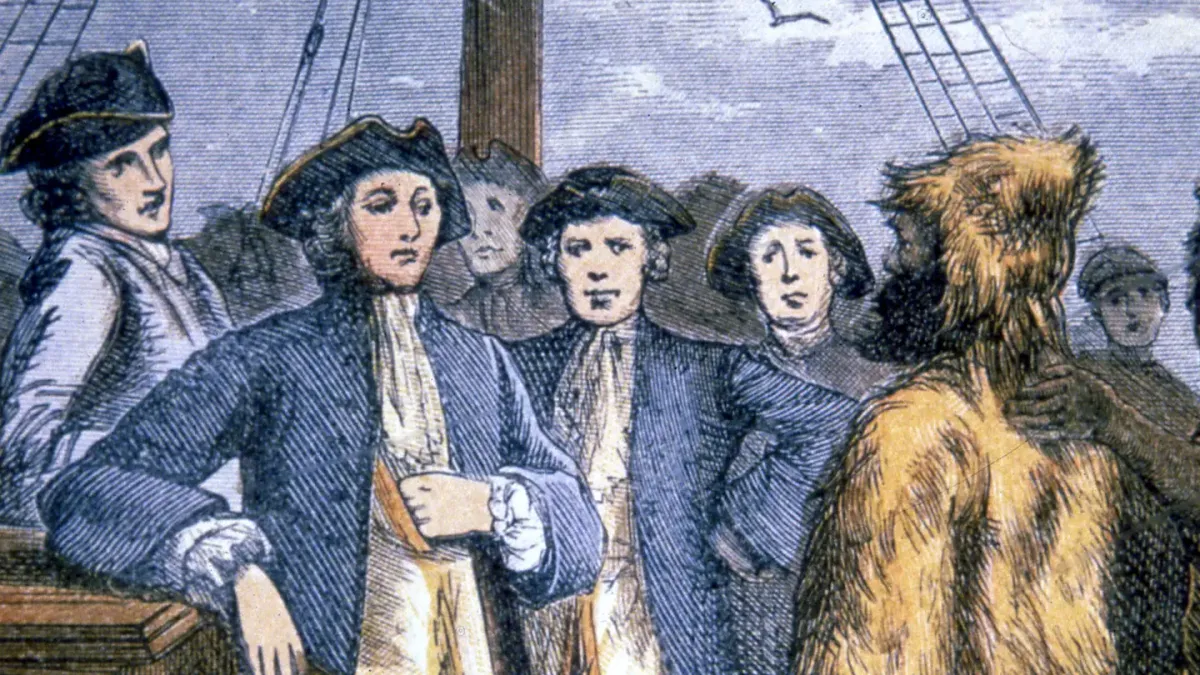
Selkirk quickly regretted his choice after the Cinque Ports sailed away. He had plenty of food and made life easier by taming goats for food and clothing, and cats to keep rats away. But the isolation affected his mental health. Captain Woodes Rogers, who later rescued him, noted that Selkirk "had much ado to bear up against Melancholy and the Terror from being left alone in such a desolate place."
Before Captain Rogers arrived, two Spanish ships anchored at the island. Selkirk hid from them, fearing attack. He was finally rescued on February 2, 1709, by Rogers's ship, the Duke. Dampier, his former captain, was piloting the Duke. Selkirk learned his fears about the Cinque Ports were right; it sank soon after he was left, and most of the crew drowned.
Philip Ashton
In the early 1720s, Philip Ashton faced a tough choice: pirates or a desert island. In June 1722, pirates captured Ashton while he was fishing off Nova Scotia. He was from Massachusetts. He refused to join the crew and became a prisoner of Captain Edward Low, a pirate known for torturing captives.
Ashton always looked for an escape. His chance came in March 1723 when the pirate ship Rebecca anchored at Roatán, an uninhabited Caribbean island.
On land, Ashton pretended to collect freshwater and coconuts. He then ran into the trees and hid. The pirates eventually gave up searching and left without him. For the first few months, he survived on fruit and turtle eggs. Later, he got tools like a knife and flint from an Englishman who arrived on the island but then disappeared while hunting.
In June 1724, Ashton saw other people again. These were 18 men from the Gulf of Honduras seeking refuge from the Spanish and Native Americans. By this time, island life had changed him into "a Poor, Ragged, Lean, Wan, Forlorn, Wild, Miserable Object," in his own words.
Ashton was finally rescued in March 1725 by the Diamond, a ship from his home state of Massachusetts. He returned home safely a little over two years after arriving on Roatán.
Marguerite de La Rocque
In the spring of 1542, French noblewoman Marguerite de La Rocque sailed on the Valentine. This was one of three ships taking colonists to New France, now Canada's Newfoundland and Nova Scotia. During the Atlantic journey, she started a relationship with another passenger.
Jean-François de La Rocque de Roberval, the Lieutenant-General of New France and Marguerite’s relative, was furious. He had her, her lover, and her handmaiden marooned on the Isle of Demons in the Gulf of St. Lawrence. They were left with only a few supplies, including a gun and a Bible.
Soon after being left on the uninhabited island, Marguerite discovered she was pregnant. Sadly, the baby died shortly after birth. Marguerite’s lover and handmaiden also died on the island. Two and a half years after being stranded, Marguerite was rescued by fishermen. They took her to Newfoundland before she returned to France.
The Tongan Castaways
In the mid-1960s, six teenage boys lived a real-life version of William Golding’s Lord of the Flies (1954). But instead of fighting, they worked together to survive.
In June 1965, the boys ran away from their boarding school on Tongatapu. They planned to steal a boat and sail to Fiji. On their first night at sea, a storm destroyed their sail, leaving them drifting southwest. They had only a small amount of raw fish and collected rainwater to drink.
After eight days, they saw the island of ‘Ata. They reached it after a difficult 36-hour swim, using planks from their broken boat. The boys survived on shellfish, papaya, and coconuts. They managed to build a fire and a shelter from palm fronds. They also built a raft to escape, but it wasn't safe for the sea.
Sione Filipe Totau, known as Mano, recalled, "I tried to not think about how long we were there." He added, "I lived in the hope that something would happen; that something good would come tomorrow."
That day came on September 11, 1966, 15 months after they arrived on the island. Australian fishermen on the Just David spotted them. The boys were safely returned to their families in Tonga, though they were briefly arrested for stealing the boat.
Steven Callahan
Steven Callahan faced an especially tough situation because he didn't even have an island. On January 29, 1982, the experienced sailor left the Canary Islands for Antigua in his self-built boat, the Napoleon Solo.
A week into the trip, his boat hit something, possibly a whale or a large shark, during a storm and began to sink. Callahan got into a six-foot inflatable life raft, grabbing as many supplies as he could, and was then set adrift.
"I spent the next two and a half months learning to live like an aquatic caveman," he later told People. He used solar stills to collect drinking water and a spear to hunt fish that gathered around his raft. This marine ecosystem saved his life, though it also attracted sharks. Callahan saw many ships, but none spotted him.
He was finally saved when two fishermen saw birds flying above his raft and investigated, hoping to find fish. He had drifted 1,800 miles across the sea to the Caribbean island of Marie Galante.
Callahan lost one-third of his body weight during his 76 days at sea and was covered in salt sores, but he made a full recovery. His ordeal inspired him to design a better life raft with a sail and rigid exterior. He also worked as a consultant on Ang Lee’s Life of Pi (2012).