Cars are common around the world today. But some towns have chosen to be car-free. This can be for practical reasons or to create a peaceful atmosphere.
Here are six places where cars are not allowed.
Mackinac Island, Michigan
Visiting Mackinac Island in Michigan feels like stepping back in time. You might hear horse-drawn carriages or bicycles, but no cars. Motor vehicles have been banned since 1898. Carriage drivers convinced the village council to ban "dangerous horseless carriages."
The ban became a key part of the island's tourism. Today, Mackinac is a popular summer spot. It has the only state highway in the U.S. where cars are not allowed, except for emergency vehicles.
We're a new kind of news feed.
Regular news is designed to drain you. We're a non-profit built to restore you. Every story we publish is scored for impact, progress, and hope.
Start Your News DetoxMonhegan Island, Maine
Monhegan Island in Maine is surrounded by the Atlantic Ocean. It has rugged cliffs, pine trees, and wildflowers. The island has a unique charm and has drawn artists and writers for over 150 years.
Cars are not allowed on the island, except for some emergency and supply trucks. The island is only about a mile wide. Much of it is untouched nature, perfect for walking and finding inspiration.
Hydra, Greece
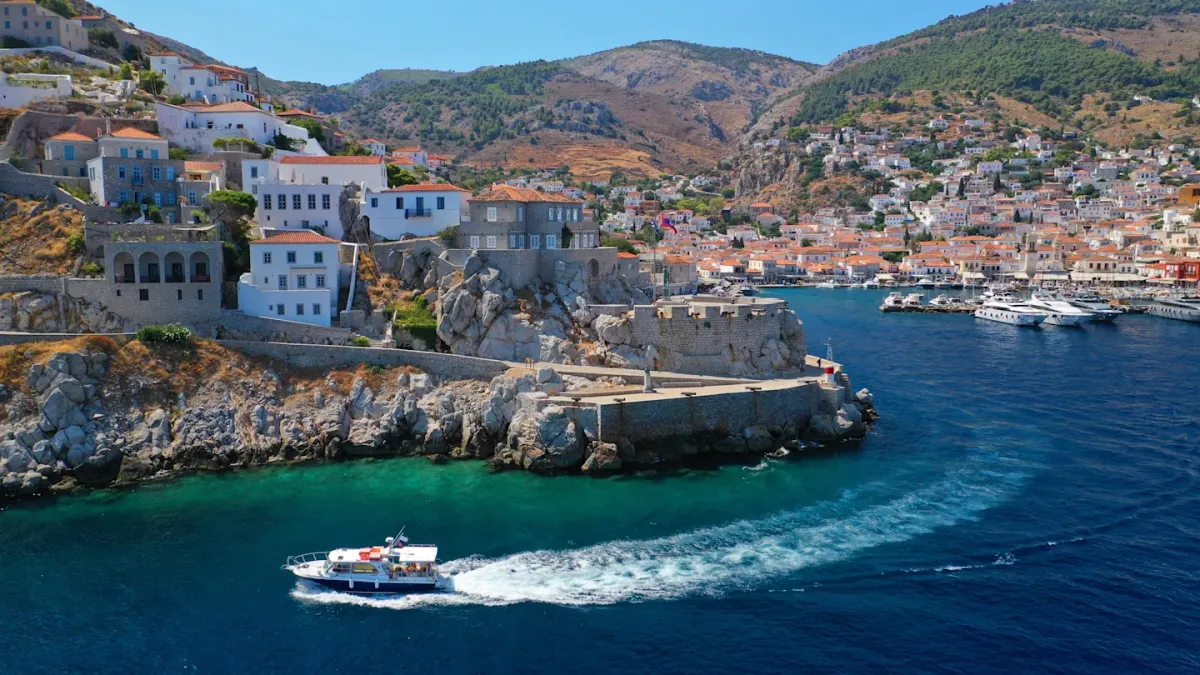
Hydra is a Greek island with a rich history. It was a shipbuilding center in the 18th and 19th centuries. In the 20th century, it became popular after the movie Boy on a Dolphin was filmed there.
The island became a bohemian spot in the 1960s. Songwriter Leonard Cohen lived there and wrote famous songs like "Bird on a Wire."
Hydra is about a two-hour ferry ride from Athens. It has no real roads and few bicycles. Donkeys transport most goods. This adds to the island's timeless feel.
Daufuskie Island, South Carolina
Daufuskie Island is a thirty-minute boat ride from Hilton Head, but it feels far away. Native Americans lived here for thousands of years. The Spanish colonized it in the 1500s, and plantations developed. Many enslaved people lived there until the Civil War.
Union forces captured the island in 1861. After the war, freed slaves made up most of the population. They created a haven for the Gullah, African Americans known for keeping elements of African culture and language.
Today, the island remains a peaceful place. Many residents work as oystermen or fishermen. Its history, beautiful beaches, starry skies, art galleries, and restaurants make it an attractive destination. The island is almost completely car-free. There is no bridge to the mainland. Most people use golf carts or bicycles to get around.
Giethoorn, Netherlands
Giethoorn is often called the "Dutch Venice." It has four miles of canals winding through a car-free city center.
The town is about an hour and a half drive from Amsterdam. Giethoorn feels like a fairytale with its traditional Dutch houses, calm canals, and quiet atmosphere. It has become popular with tourists. Visiting early in the morning or in April, May, June, or September might offer a more relaxing experience.
Zermatt, Switzerland
Zermatt is a beautiful village in the snowy Swiss Alps. It looks like something from a fantasy. Fans of Sarah J. Maas's A Court of Thorns and Roses series even compare Zermatt to the fictional Night Court city of Velaris.
This charming alpine village offers many activities. You can take scenic train rides through winter landscapes or hike for stunning views of the Matterhorn. What you won't find, for the most part, are cars.
Private vehicles are banned in Zermatt. People mostly use trains, electric buses, and electric taxis. The main reason for this ban is to reduce air pollution. This helps keep the views of the Matterhorn and the surrounding mountains crystal clear.