More than a century after the Titanic sank, scientists at the University of Rochester have figured out something the ship's designers couldn't: how to make metal tubes that stay afloat no matter how much water they take on.
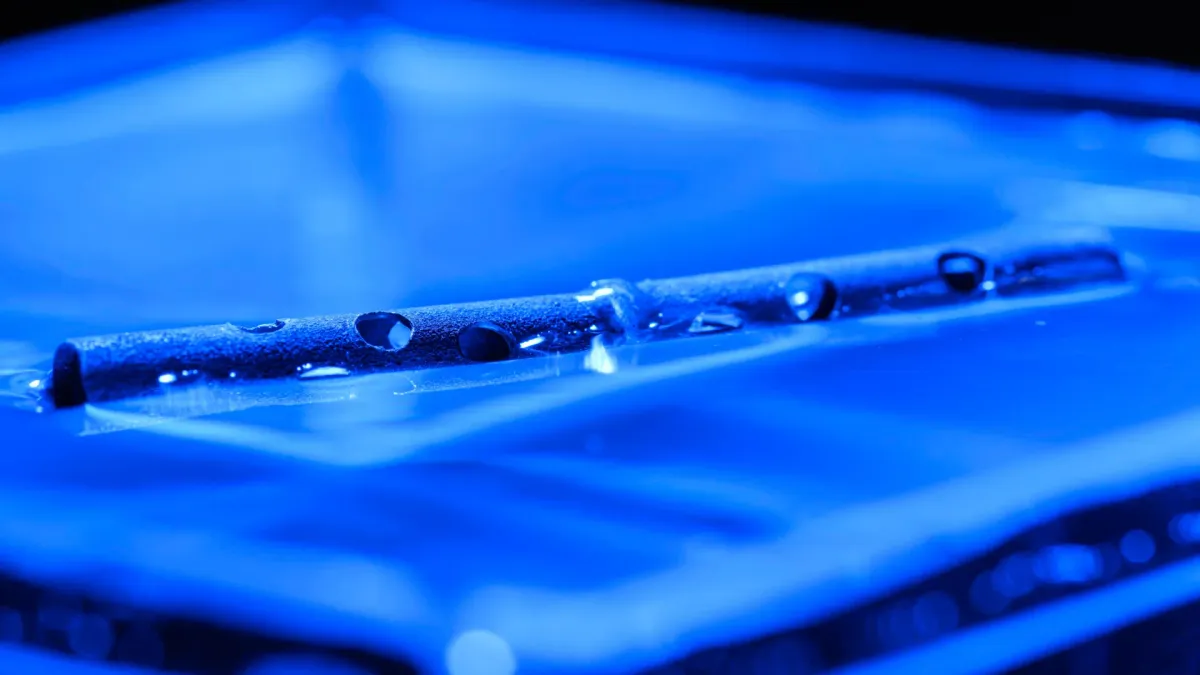
The breakthrough hinges on a counterintuitive idea. Researchers etched the inside surface of aluminum tubes with microscopic pits, creating a texture so water-repellent that it actively traps a pocket of air. That trapped air is the secret. As long as the bubble stays inside, water can't fill the tube — and a tube that isn't waterlogged won't sink.
"Importantly, we added a divider to the middle of the tube so that even if you push it vertically into the water, the bubble of air remains trapped inside and the tube retains its floating ability," says Chunlei Guo, a professor of optics and physics at Rochester's Laboratory for Laser Energetics. The divider acts like a safety wall: if one section gets damaged, the other compartment keeps the air pocket intact.
We're a new kind of news feed.
Regular news is designed to drain you. We're a non-profit built to restore you. Every story we publish is scored for impact, progress, and hope.
Start Your News DetoxSurviving What the Ocean Throws at It
What makes this different from older flotation methods is durability. The team tested their tubes in rough water conditions for weeks and found no loss of buoyancy. They even punched holes — lots of them — and the tubes still floated. That resilience matters for real-world use. Ships don't sink because of a single leak; they sink because damage compounds and water accumulates faster than pumps can remove it. These tubes sidestep that problem entirely.
Multiple tubes can be connected to form rafts, which means the technology scales from small rescue platforms to larger floating structures. The researchers have already demonstrated that these rafts can do double duty: they float reliably and they can harvest energy from moving water, potentially generating electricity from wave motion.
The work was funded by the National Science Foundation, the Bill and Melinda Gates Foundation, and Rochester's Goergen Institute for Data Science and Artificial Intelligence — a mix of public research money and philanthropic support that suggests the technology is being taken seriously beyond the lab.
The practical applications could range from emergency flotation devices to offshore platforms for renewable energy. The next step is moving from proof-of-concept to engineering a system that shipbuilders and maritime operators can actually use.