For decades, solid-state batteries have promised the dream: safer, faster-charging, and far more powerful than the lithium-ion batteries in your phone right now. But they keep cracking. Literally. Solid crystal electrolytes develop microscopic fractures during use, and those cracks spread until the battery dies. Now Stanford researchers think they've found a fix: a vanishingly thin layer of silver.
The problem isn't new. Scientists have known for years exactly why this happens — tiny flaws on the electrolyte surface expand under pressure, especially during fast charging when lithium forces its way into the cracks like water finding a leak. But knowing the problem and solving it are different things. You can't realistically manufacture a battery with zero surface imperfections. It's too expensive, too fragile, too unrealistic.
A protective surface instead
Wendy Gu, a mechanical engineer at Stanford, put it plainly: "On an incredibly small scale, it's not unlike ceramic plates or bowls you have at home that have tiny cracks on their surfaces." Rather than trying to eliminate every flaw, her team asked a simpler question. What if you just protected the surface.
We're a new kind of news feed.
Regular news is designed to drain you. We're a non-profit built to restore you. Every story we publish is scored for impact, progress, and hope.
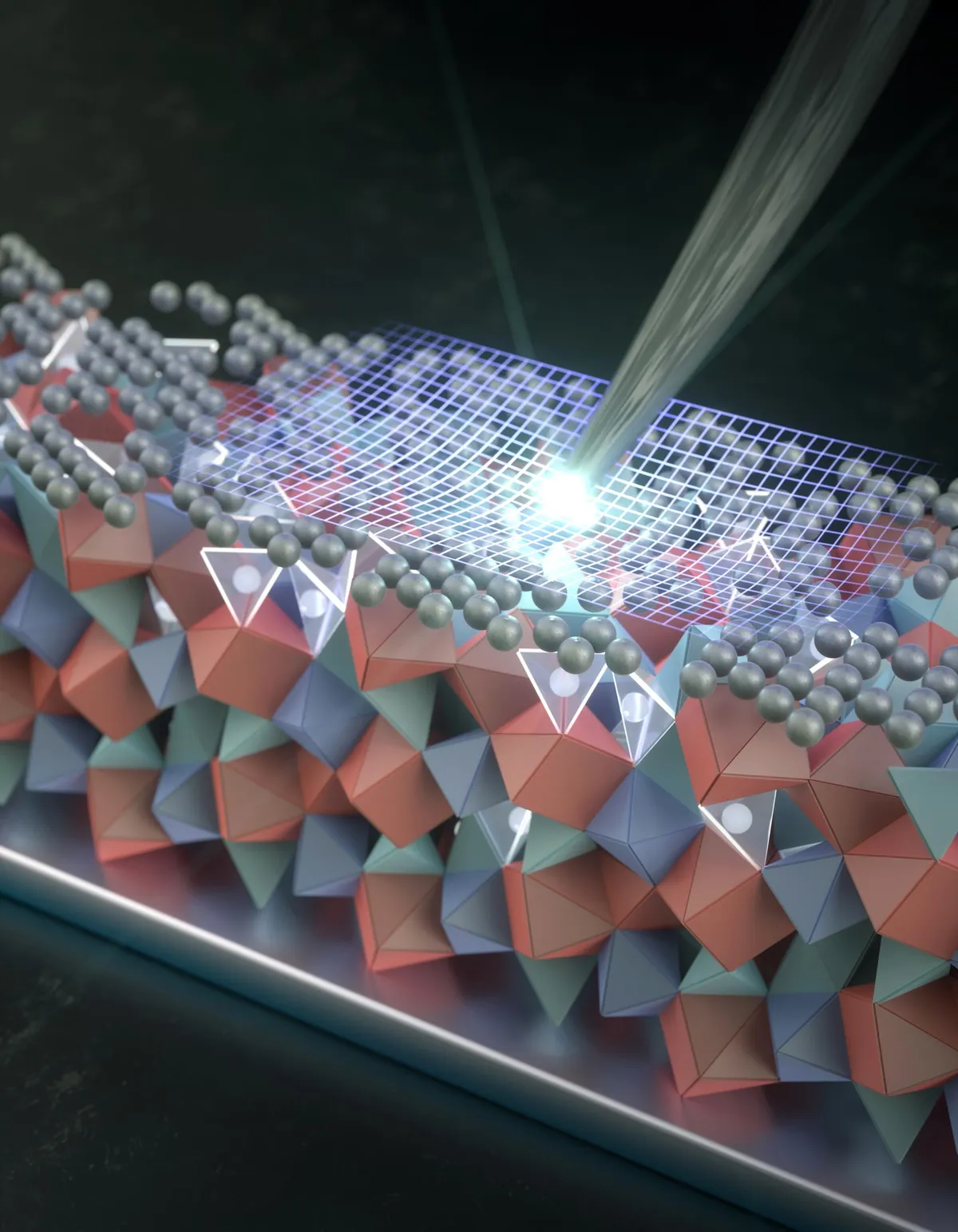
Start Your News DetoxThe answer, published in Nature Materials this month, is a heat-treated silver coating just 3 nanometers thick. When applied to the solid electrolyte material (known as LLZO) and heated to 300 degrees Celsius, the silver atoms diffuse into the surface, replacing lithium atoms within the crystal structure. The result: a surface that withstands nearly five times more pressure before fracturing.
But here's the clever part. The team didn't use metallic silver. They used silver ions — silver atoms that had lost an electron, carrying a positive charge. These Ag+ ions are what actually do the work, strengthening the ceramic structure from within. The silver doesn't just sit on top like a coat of paint. It becomes part of the material, and in doing so, it blocks lithium from forcing its way into existing defects and creating those destructive internal branches.
Xin Xu, who led the research and is now at Arizona State University, described the mechanism clearly: "Nanoscale silver doping can fundamentally alter how cracks initiate and propagate at the electrolyte surface." The treatment works on a microscopic scale — the silver diffuses roughly 20 to 50 nanometers below the surface — but the effect is measurable and significant.
Still early, but promising
The research so far has focused on small samples tested in a scanning electron microscope. Full battery cells with thousands of charging cycles remain untested. The team is now building complete lithium metal solid-state batteries and testing how mechanical pressure affects long-term performance. They're also exploring other solid electrolyte materials, including sulfur-based versions that might pair well with lithium and help ease supply-chain pressures tied to lithium demand.
Silver isn't the only candidate. Other metals with larger ions than lithium showed promise in early tests — copper, for instance, though it was less effective. The principle is simple: replace the tiny lithium atoms with something bigger, and you change how the material behaves under stress.
If this scales, solid-state batteries could finally move from lab promise to real products. Safer, denser, faster-charging batteries aren't theoretical anymore. They're just waiting for the surface to hold.