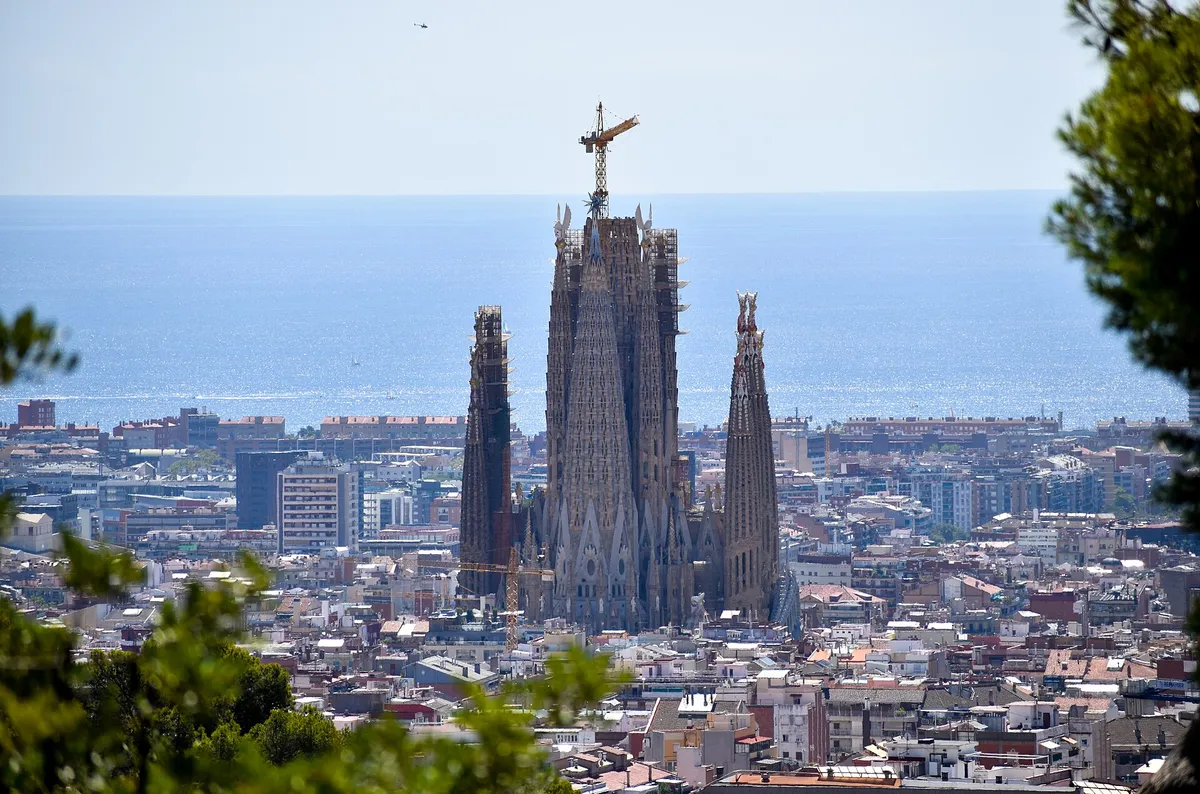
On February 20, 2026, workers hoisted a glowing cross onto the Sagrada Família's central spire, and Antoni Gaudí's unfinished masterpiece finally touched the sky he'd imagined. At 172.5 meters tall, the Tower of Jesus Christ became the world's tallest church tower—a moment that felt less like an ending and more like a long breath finally exhaled.
For 144 years, Barcelona lived with cranes in its skyline. Construction began in 1882, when Spain was still a monarchy and the Wright brothers hadn't yet flown. Gaudí took over the project a year later and bent it into something that had never existed before: a building where theology, geometry, and nature spoke the same language.
He designed 18 towers—12 for the Apostles, four for the Evangelists, one for the Virgin Mary, and at the center, one for Jesus. The central tower was always meant to be the tallest, the anchor point for everything else. But Gaudí did something unusual for someone building a monument to faith: he refused to let it dominate the landscape. He deliberately kept the basilica just below Montjuïc hill, insisting that human creation should never exceed what nature had already made. Ambition, he seemed to say, is most powerful when it knows its limits.
We're a new kind of news feed.
Regular news is designed to drain you. We're a non-profit built to restore you. Every story we publish is scored for impact, progress, and hope.
Start Your News DetoxThe Light That Built It
The cross that now crowns the tower is made of glass and steel—sculptural by day, glowing from within at night. But light in Gaudí's work was never decoration. It was structure, symbol, and theology made visible. Throughout the basilica, perforated stone and geometric openings reduce weight while letting air and sun pour through. The tower's textured surface shifts with the light, casting shadows that move across its face like a sundial. It's a building that changes with the weather, responsive to time in a way most architecture simply isn't.
Gaudí died in 1926, having seen only a fraction of his vision built. The Spanish Civil War damaged many of his models, leaving architects a puzzle of complex geometries they'd need to solve without him. For decades, the project relied on intuition and interpretation. Now it relies on something else entirely: digital scanning, parametric modeling, precision stone fabrication. What Gaudí once calculated with string and plaster, architects now refine through algorithms. Yet the logic remains his. Inside, columns branch like trees. Curves serve both physics and beauty. The building still whispers that nature is the ultimate engineer.
There's something remarkable about this collision of old and new. Gaudí's faith in organic form—the idea that a tree knows how to distribute weight better than any blueprint—was proven right by the very technologies he couldn't have imagined. His intuition about how stone should flow, how light should move through space, held up under mathematical scrutiny.
For Barcelona residents, the Sagrada Família has always represented becoming rather than completion. Its cranes were as iconic as its spires. Now, with the central tower finished, something shifts in the city's skyline. The eye no longer searches for what's missing. It meets the cross.
Other elements of the basilica continue toward completion, and debates about preservation and tourism persist. But the Tower of Jesus Christ's completion isn't just an engineering milestone. It's a rare example of a vision that survived 144 years—through war, dictatorship, democracy, and technological revolution—without losing what made it matter. Gaudí's faith in nature, refined by generations of architects, carried forward by patience. Now it stands where he always imagined it would: not towering defiantly over Barcelona, but rising in conversation with it.