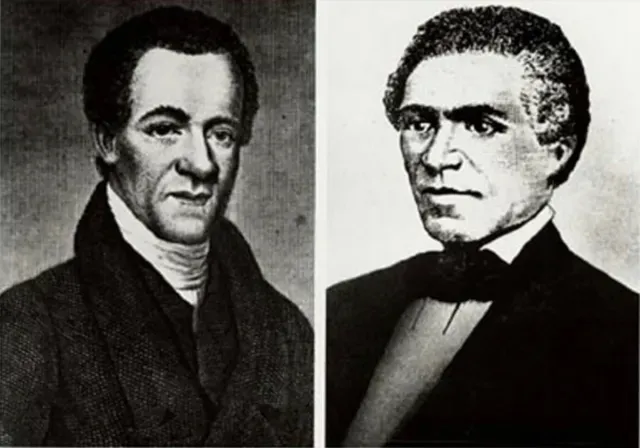
In 1827, Rev. Samuel E. Cornish and John B. Russwurm were exhausted. They'd spent years reading their own lives and communities filtered through the racist lens of white-owned newspapers—distorted, demeaned, erased. So they decided to stop waiting for permission and start their own.
On March 16, 1827, the first issue of Freedom's Journal rolled off the press in New York City. Four pages. Weekly. Uncompromising. It was the first Black-owned newspaper in the United States, arriving the same year New York abolished slavery—a moment when the nation was theoretically moving toward freedom while still practicing its opposite.
What made Freedom's Journal radical wasn't just its existence. It was what it chose to cover. Yes, there was general news and current events, but the paper's real power lay in its refusal to let racist narratives stand unchallenged. Editors published searing editorials against slavery and lynching. They called out the dehumanizing attacks on Black people that appeared in mainstream publications. They advocated for voting rights. They celebrated Black achievement and published biographies of prominent African Americans. They even recorded the vital statistics—births, deaths, marriages—of the Black New York community, asserting that these lives mattered enough to be documented and remembered.
We're a new kind of news feed.
Regular news is designed to drain you. We're a non-profit built to restore you. Every story we publish is scored for impact, progress, and hope.
Start Your News DetoxThe circulation numbers tell you how hungry people were for this voice. At its peak, Freedom's Journal reached readers across 11 states, Washington D.C., Haiti, Europe, and Canada. In a moment before national news networks or the internet, a four-page weekly newspaper became a lifeline connecting diaspora communities.
A spark that caught fire
The paper only lasted two years. Russwurm emigrated to Liberia in 1829, and without its co-founder, Freedom's Journal couldn't sustain itself. But those two years mattered in ways the founders probably didn't fully anticipate. The paper didn't disappear from history—it sparked a movement. Over the next four decades, at least 40 similar Black-owned publications launched, each one building on the template Freedom's Journal had proven possible. What began as two men's exhaustion with being misrepresented became the foundation of the Black Press in America—a tradition that would shape how Black communities told their own stories for generations.
Today, all 103 issues of Freedom's Journal are digitized and available online through wisconsinhistory.org. You can read the actual words Cornish and Russwurm published, see the advertisements, witness the arguments they made when the country wasn't ready to listen. It's a reminder that the fight for representation isn't new, and neither is the solution: when existing institutions fail you, you build your own.