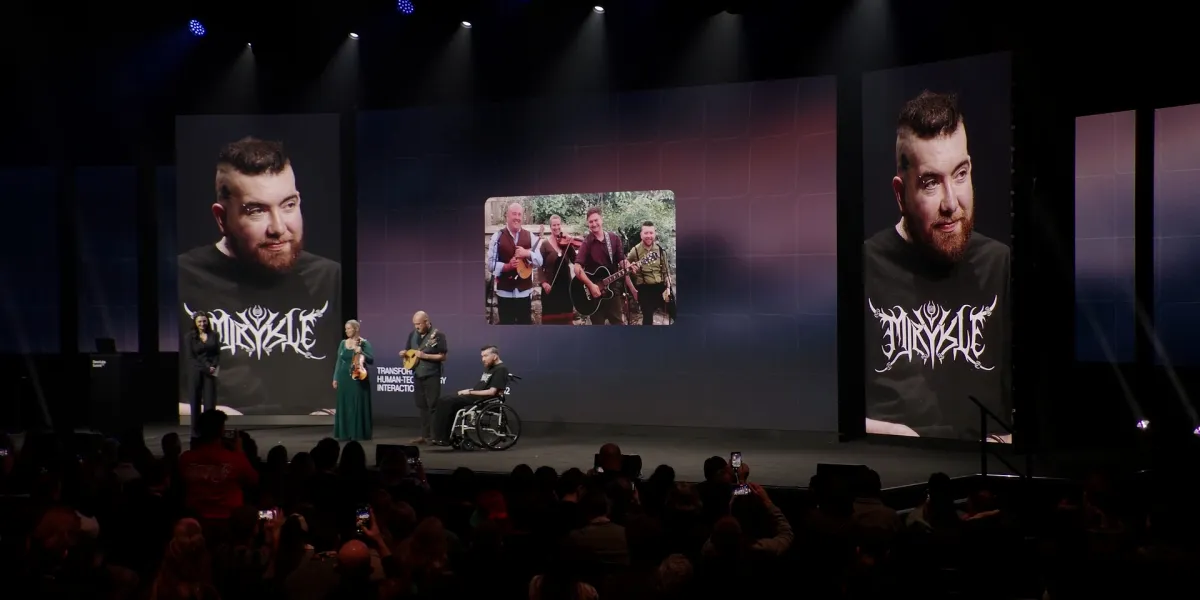
Meta's year included something genuinely unusual: glasses that understand what your muscles are telling them to do. The Ray-Ban Display—their most advanced AI glasses yet—uses an EMG wristband to translate muscle signals into commands, a feature that opens possibilities for people with disabilities who can't use traditional controls. It's one moment in a year where the company's biggest moves weren't just about scale, but about how AI actually gets used.
The muscle-reading glasses sit alongside a bigger shift happening at Meta: the infrastructure and AI models are moving faster than the consumer products. In March, Llama—Meta's open-source AI model—hit 1 billion downloads. That's not a headline-grabbing number because it's big; it's significant because it means developers and organizations outside Meta are building on it. National security teams, space exploration companies, agricultural researchers, healthcare systems—they're all using the same foundation. When an open-source model reaches that scale, you're watching the baseline of what's possible shift for everyone, not just one company.
On the research side, Meta released SAM 3, SAM 3D, SAM Audio, and V-JEPA—models that handle object recognition from text or images, 3D reconstruction from a single photo, and audio segmentation. These aren't consumer products yet. They're the kind of incremental advances that matter more to the people building things than to people scrolling. But they matter because they're moving the needle on what AI can actually perceive and understand.
We're a new kind of news feed.
Regular news is designed to drain you. We're a non-profit built to restore you. Every story we publish is scored for impact, progress, and hope.
Start Your News DetoxThe infrastructure story is less glamorous but more telling. Meta broke ground on three new data centers this year, including one in El Paso, Texas that can scale to 1 gigawatt. They also announced a deal with Constellation Energy for nuclear power to run their operations. This is what happens when a company's AI workload grows faster than existing power grids can handle—you end up negotiating with nuclear plants. It's a sign that whatever Meta is building next, they're betting serious resources on it.
On the product side, the updates were incremental: Instagram got reposts and Reels on TV, WhatsApp added message translation, Threads launched direct messaging and communities. These are the kind of features that make apps slightly more useful without changing how you use them. Meta also introduced Teen Accounts with stricter content settings modeled on movie ratings—a concrete response to the ongoing tension between giving teens access to social platforms and keeping them safe from the worst parts of them.
The company also launched Community Notes on Facebook, Instagram, and Threads, letting users add context to posts. It's an experiment in letting the crowd fact-check itself rather than relying entirely on company moderation—a quieter acknowledgment that platform governance at this scale can't work any other way.
What emerges from 2025 is a company moving in two directions at once: publicly launching consumer features that feel incremental, while privately building AI infrastructure and models that are reshaping what's possible. The glasses reading your muscles are the visible part. The nuclear power plants and billion-download open-source models are the foundation.