Turns out, you can't fly solo forever. At least, that's the vibe at the latest Carnegie International in Pittsburgh, an art bash almost as old as the Venice Biennale itself. This year, 61 artists are asking a simple question: what if we just... did things together? Because, apparently, even gravity-defying leaps are a team sport now.
The show, aptly titled "If the word we," borrows its wisdom from an essay by Haytham el-Wardany, who basically said you can't be an individual without being part of a group. Curators Ryan Inouye, Liz Park, and Danielle A. Jackson clearly took this to heart, showcasing artists from far beyond the usual Western art world.
The Absurdity of the Ascent
There's a recurring theme here: people flying. Or at least, attempting to. In Khalil Rabah's 1997 video Critical Interrogations: Renewed Belief, a man is literally hoisted over an olive tree – a Palestinian symbol of resilience. Then there's Shala Miller's Flight (2026), inspired by Toni Morrison's Song of Solomon, about an enslaved man who takes to the skies. Because, if you're going to escape, why not do it with flair?
We're a new kind of news feed.
Regular news is designed to drain you. We're a non-profit built to restore you. Every story we publish is scored for impact, progress, and hope.
Start Your News DetoxBut the real mic drop moment comes from Be Holding, a performance celebrating Julius Erving's legendary 1976 slam dunk. Performers realized his "Dr. J" leap wasn't just about one guy defying physics; it was about the collective energy, the unacknowledged assists. They repeated, almost like a mantra, "holding each other, which is a practice." Let that sink in: a slam dunk, a metaphor for solidarity.
And then there's Hong Lee Hyunsook, who, for her 35-foot-tall What You’re Touching Now—Insubong in 2025, literally climbed a South Korean mountain, rubbing a crayon on its peak. She needed a crew for that. Because even monumental art requires a helping hand, or several.
Weaving, Welding, and Wielding Art
Many artists here are blending their individual visions into something bigger. Near the entrance, Sámi artists Hans Ragnar Mathisen, Joar Nango, and Elle Márjá Eira created Buolvvaiguin (With Generations), an installation that tells Mathisen's life story through a mix of watercolors, wooden structures, and film. It's a testament to their shared homeland, Sápmi, which is currently fending off developers. Because nothing says "we" like protecting your land together.
Over at the Mattress Factory, Peruvian power couple Claudia Martinez Garay and Artur Kameya present La ceniza ya no recuerda qué causó el incendio. / The ash no longer remembers what caused the fire. (2026). This massive installation of paintings, textiles, and rubble is so intertwined you can't tell who did what. It's a genuine "mind meld" that also touches on Túpac Amaru II, an Indigenous leader who took on Spanish colonizers. Because collective creation can also be collective resistance.
This theme of collectivity as a survival strategy feels particularly poignant given what's happening in Palestine, Iran, Ukraine, Sudan, and the Democratic Republic of Congo. Turns out, the "we" isn't just a nice idea; it's a necessity.
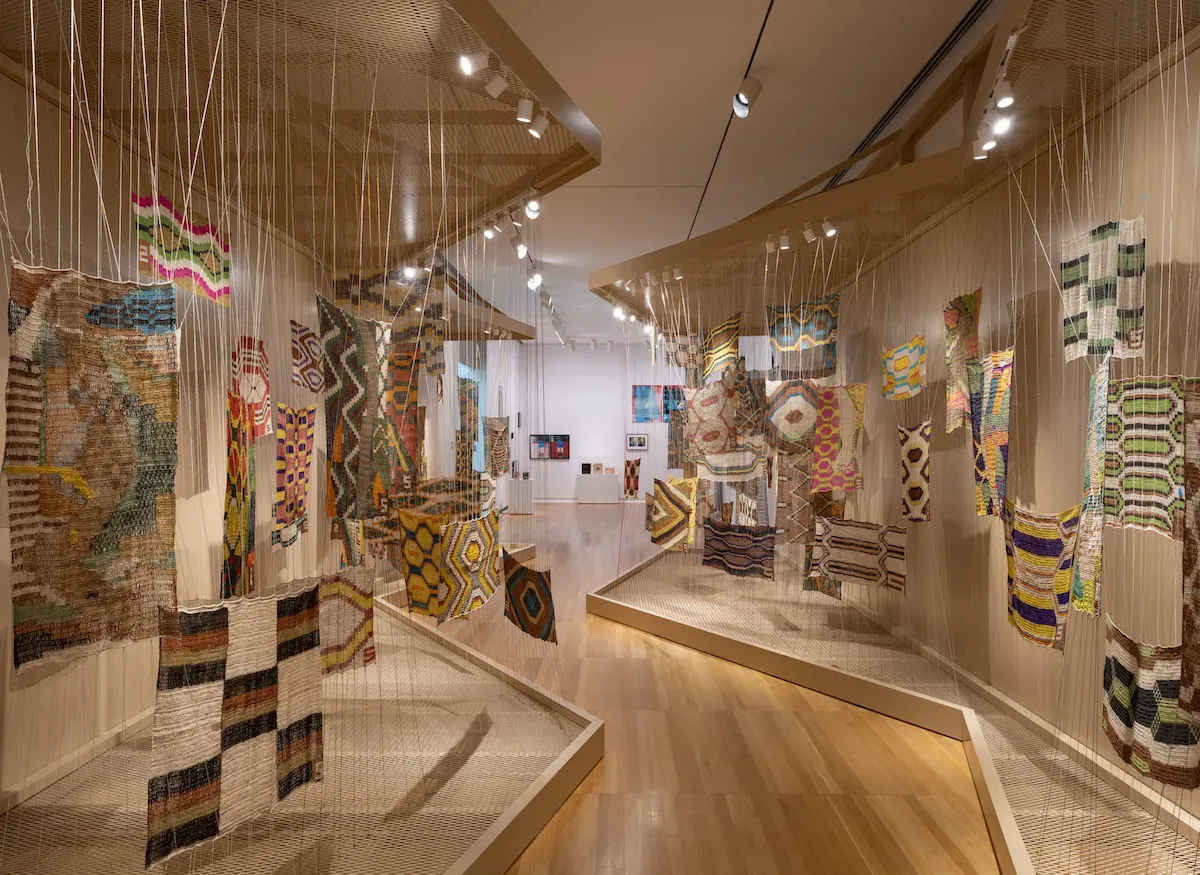
Even abstraction, typically seen as the realm of solitary geniuses, gets a communal makeover. Zhao Yao's paintings use eggshells bought online from across China, relying on a vast supply chain. RJ Messineo's abstractions are canvases held together by magnets, a network of art. And the Silät, an all-female collective of Wichí weavers from Argentina, present 102 weavings, tightly bound together, in Tewok: the river we weave (2026). It's a powerful statement: even the most personal art can be a community effort.
Perhaps the most striking piece is Untitled (Private Painting J1) (2019) by d harding and Jordan Upkett. This 35-foot-long painting has an underlayer of dry pigment and gum, recording their grandfather's memories of the land. Though mostly covered by white, that brownish underlayer still peeks through, a visual echo of the protest chant: "the people united will never be defeated." Because sometimes, the most important message is literally just beneath the surface.