Photographers travel to the most remote places to find dark skies. These spots allow the Milky Way to shine with amazing clarity. These photographers share their stunning pictures, along with their methods and adventures.
My Perfect Night
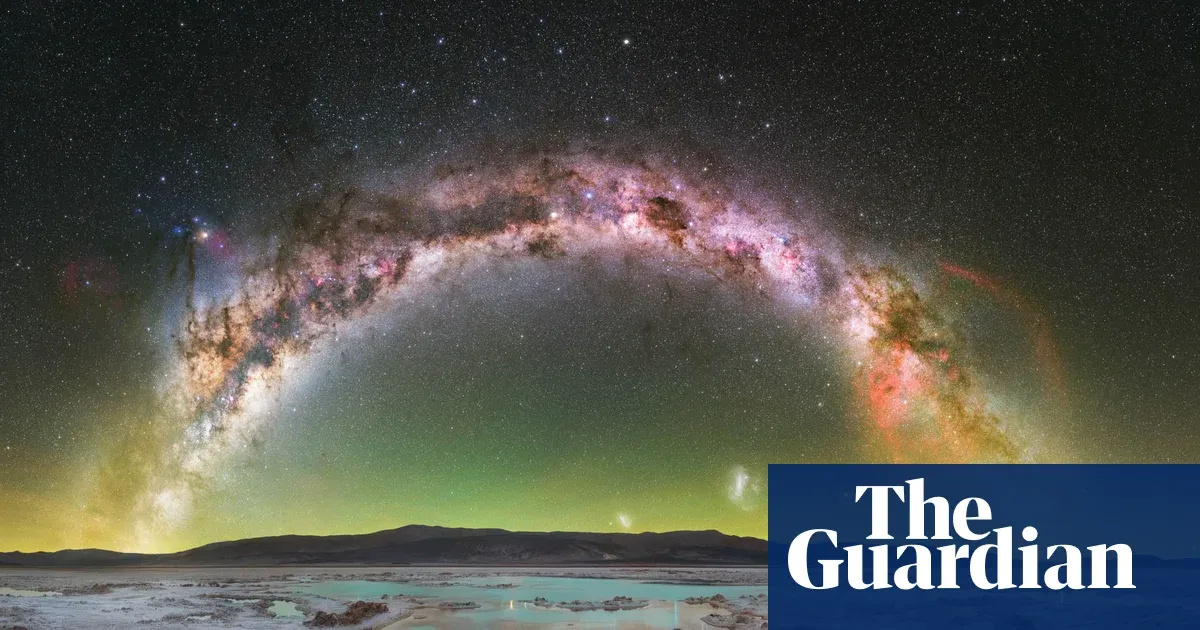
Daniel Viñé Garcia traveled deep into Argentina's Puna de Atacama. This remote area is only reachable by 4x4 vehicles on rough dirt tracks. It is far from any light pollution. The closest village, Antofalla, has about 60 people. Its electricity is turned off at night. Viñé Garcia had never seen photos of this salt flat before. Its untouched, minimalist landscape stood out immediately.
The Milky Way Over a Field of Lupines
This photo shows the Milky Way above a field of blooming lupines in New Zealand. This was taken in November when spring wildflowers change the landscape under the night sky. A fisheye lens makes the flowers frame the scene. This draws the viewer's eye to the sky above.
We're a new kind of news feed.
Regular news is designed to drain you. We're a non-profit built to restore you. Every story we publish is scored for impact, progress, and hope.
Start Your News DetoxGeminid Symphony Over La Palma’s Guardian of the Sky
This winter Milky Way panorama shows a sky full of Geminid meteors. They are above the Gran Telescopio Canarias in La Palma, Spain. This is the world's largest optical telescope. The final image combines meteor data from six cameras over five nights.
Aoraki Mount Cook
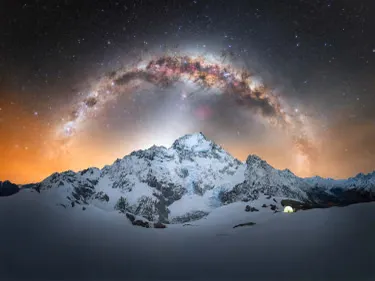
The Milky Way arches above Aoraki/Mount Cook in New Zealand. Reaching this spot meant navigating steep, rocky, and snow-covered slopes in winter. The route had challenges like washouts and unstable snow. As night fell, the Milky Way and zodiacal light were very clear. This was due to the cold, stable air at high elevation.
Sodium Milky Way
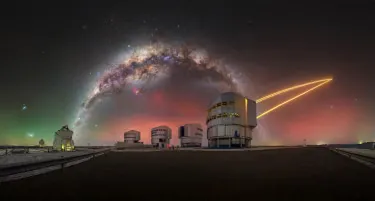
This image was taken at the Very Large Telescope (VLT) on Cerro Paranal. This is in Chile's Atacama desert. The conditions were very pure, making the line between Earth and sky seem almost seamless. The site is 2,635 meters above sea level. It has dry conditions, stable air, and little light pollution. This means over 300 clear nights each year.
Celestial Light Over Sea Cliffs
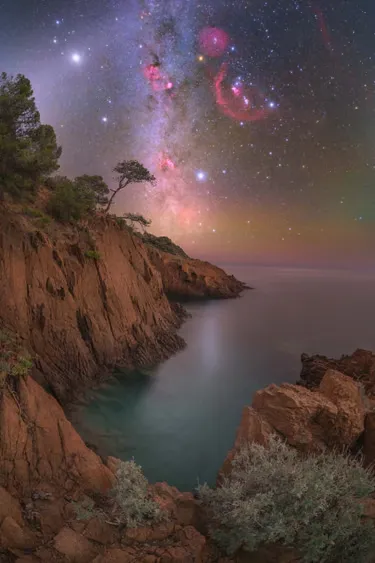
This photo was taken by sea cliffs in the south of France. The night sky looks different this time of year, especially with winter constellations. The colors are cooler, the air is sharper, and Orion rises clearly. This season brings a quiet, calm feeling to night photography.
Night at the Remarkables
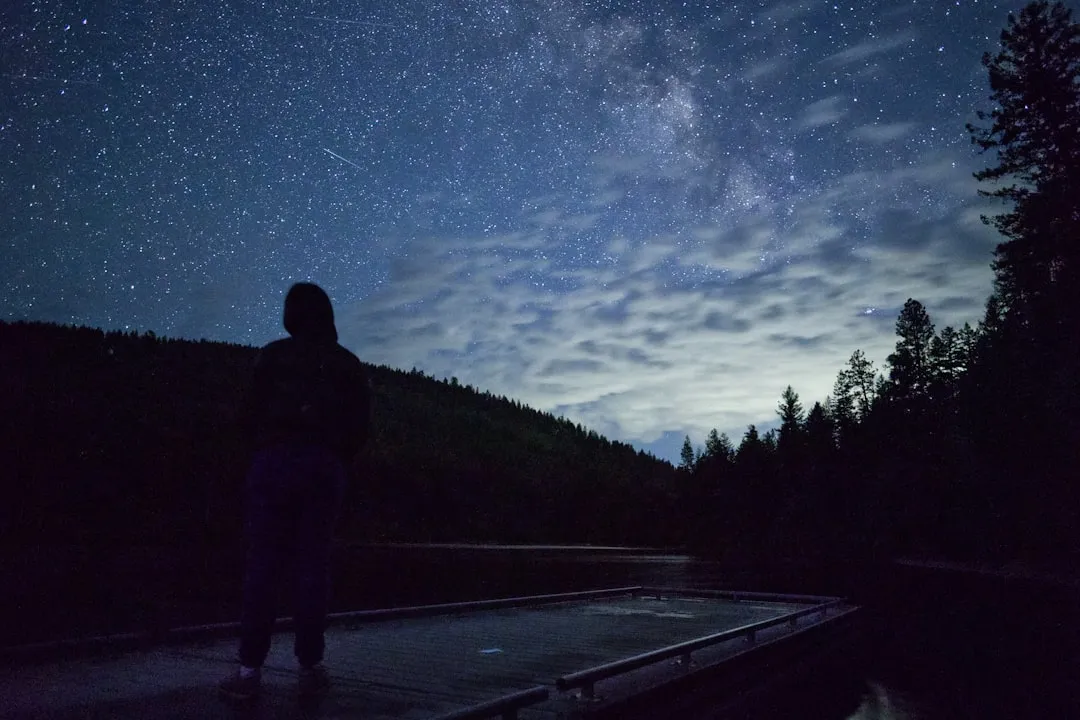
The Milky Way's galactic center rises over an icy landscape in Aoraki/Mount Cook National Park, New Zealand. This park is part of the world's largest Gold Tier Dark Sky Reserve. The photographer, Tom Rae, said this was one of the most remarkable scenes he had seen in seven years. The night's stillness and clarity were a strong contrast to the area's usual wild nature.
Firewater
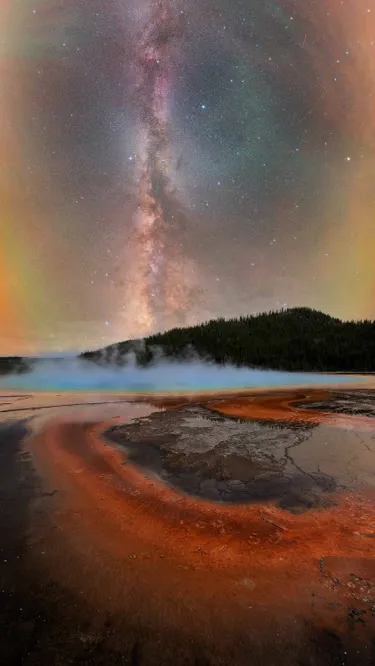
At the Grand Prismatic Spring in Yellowstone National Park, the Earth's energy meets the vast night sky. Shifting steam constantly changed the scene. It would briefly show the stars before hiding them again.
Lost in the Ripples of Space and Time
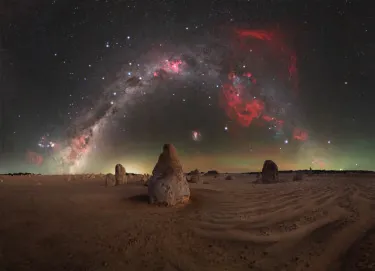
A calm, windless night in the Pinnacles desert is uniquely powerful. Western Australia has some of the best night skies. In this photo, the main limestone pillar lines up with the South Celestial Pole. This anchors the image under the rotating sky. To the right, the faint red glow of the Gum Nebula, a supernova remnant, adds depth.
Perseid Meteors Over Durdle Door
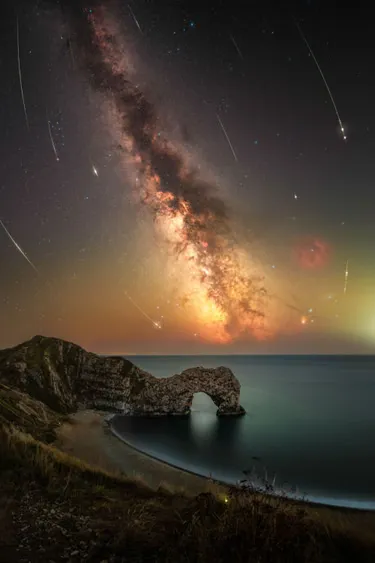
"Ancient fireworks" from Comet Swift-Tuttle shot through the atmosphere. This was captured with an ultra-wide angle lens. The natural limestone arch of Durdle Door in Dorset, UK, is in the picture. In the foreground, a single glow worm was seen among reeds by the sea cliff. As astrophotography grows, popular spots like Durdle Door are getting busy. Photographers need to protect these beautiful places and local wildlife.
Galaxy on the Rise
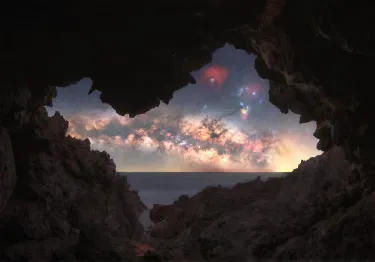
Anastasia Gulova spent nearly four hours finding this cave in Tenerife, Spain. It was only a few minutes from the parking area. Taking the picture was also hard. Composing the panoramic foreground needed careful placement. Lighting the upper part of the cave was especially tough. She used focus stacking across different areas in near-total darkness.
Divinity
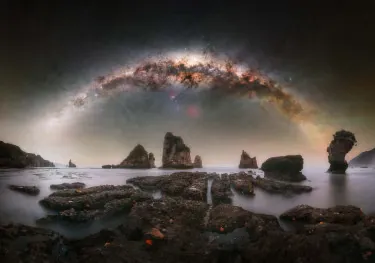
Kavan Chay had long wanted to photograph the Milky Way core setting from this New Zealand beach. The starfish-covered reef made a unique foreground. The terrain was dangerous, with gaps in the rocks and a fast-rising tide. Despite these issues, he got the shots and returned to shore just in time. He took the upper sky photos from the beach and the lowest row from the reef. This kept the final image aligned.
Milky Way Over Tatra Mountains
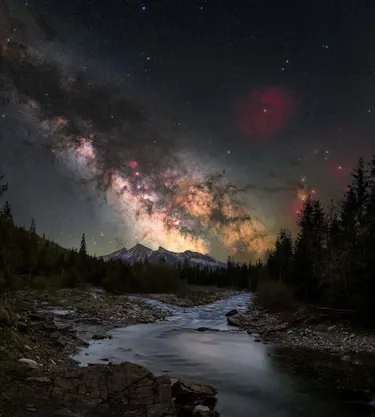
This image was taken in the Białka Gorge in Jurgów, Poland. The river in the foreground leads the eye from the Earth to the mountains and into the night sky. This connects the land and the cosmos. Astrophotography is also about the experience, often shared with others who love the night sky.
Double Milky Way Over Monfragüe National Park
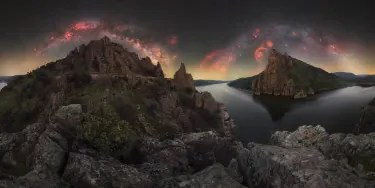
This photo was taken in Monfragüe National Park, Spain. It shows one of the few nights when both the winter and summer Milky Way are visible. The scene doesn't look this way to the naked eye. It's a composite image. It shows the Milky Way changing over several hours, combining the winter Milky Way after dusk with the summer Milky Way before dawn.
Salto del Agrio
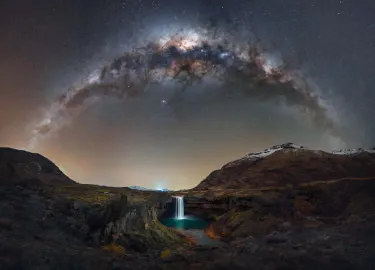
This image was taken at Salto del Agrio in Neuquén, Argentina. A 45-meter waterfall plunges into a canyon. This canyon was carved by old lava flows from the Copahue volcano. Basalt surrounds the scene. Minerals like iron and sulfur from the Agrio River add vivid colors. Alejandra Heis worked with her tripod low to the ground. She took many exposures to get the scene she imagined.
Galactic Spine
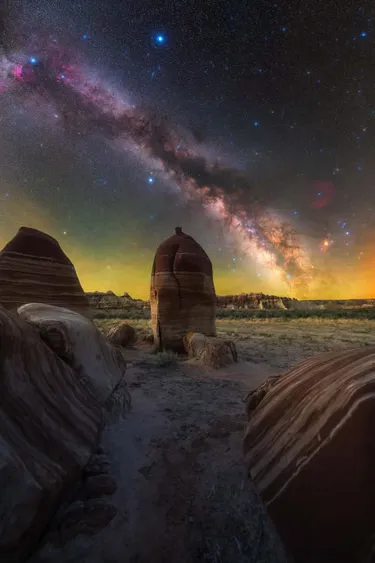
Andrew Imhoff is drawn to Milky Way photography because it sparks curiosity. It shows a different view of the world that many people haven't seen. His goal is to inspire curiosity with his images. He wants others to imagine standing under such a sky. This sense of wonder first drew him to the Milky Way and still guides his work.
Valle de la Luna, Universo Triassico Ischigualasto
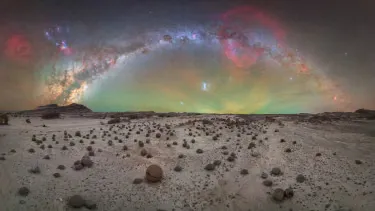
This photo was taken in Argentina, at a UNESCO World Heritage site. Cancha de bochas is important geologically. It's the only place on Earth where the full Triassic Period sequence can be seen. It holds key fossils from the earliest dinosaurs. Accessing the site needed extreme care, guided by local experts. Every move had to be careful to avoid damage. Places like this remind us to appreciate and preserve them.
Fireball in Paradise