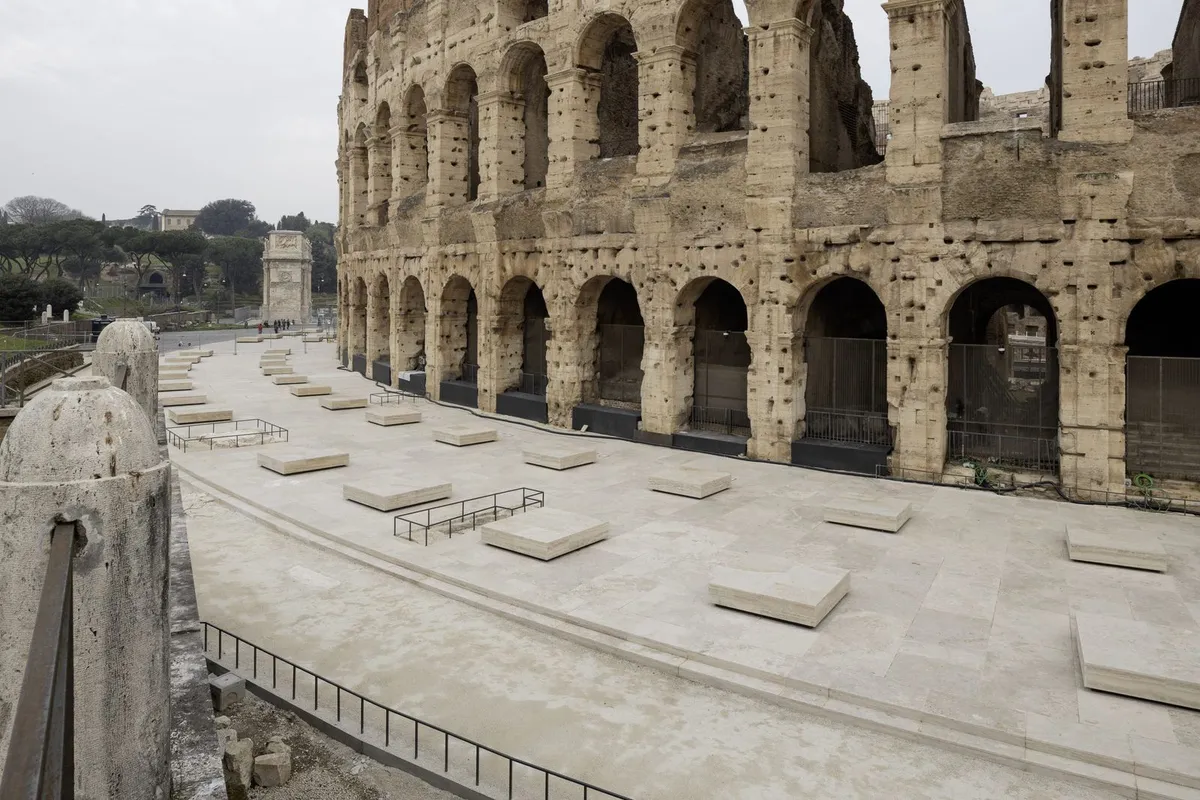
Thousands of years ago, people flocked to Rome's Colosseum to witness gladiator fights and other intense shows. Now, visitors can better imagine how ancient audiences experienced the amphitheater, which was built in the first century C.E.
Architects recently finished a project to bring back the feel of the tall columns that once stood outside the Colosseum's walls. Visitors will now see a piazza with short slabs of travertine marble, placed exactly where the original columns once towered.
Recreating Ancient Grandeur
This project highlights the history of the Flavian amphitheater's southern side. Spectators used to gather outside its exterior wall before finding their seats. They were protected from the Roman sun by two tall arcades, supported by massive columns that reached up to 164 feet high. People would then walk through these arches, following markers to their sections.
We're a new kind of news feed.
Regular news is designed to drain you. We're a non-profit built to restore you. Every story we publish is scored for impact, progress, and hope.
Start Your News DetoxOver time, earthquakes and unstable ground caused these arcades and columns to collapse. Working with archaeologists, architects aimed to give today's visitors a sense of what those crowds experienced.
Italian architect Stefano Boeri, who designed the piazza, explained that these travertine marble blocks are placed exactly where the original pillars stood. He told the Associated Press that the goal was to help the public understand the scale of the arcades and arches used to enter the Colosseum.
The new slabs are made from travertine marble from the same quarries that supplied the original Colosseum. Visitors can now rest on these slabs, which are next to engravings of Roman numerals marking seat sections.
Architect Giorgio Donà noted that this was a team effort involving archaeologists, researchers, architects, and technical partners. The project aims to offer a new public space and a fresh way to experience the monument and its history. Boeri sees the slabs as a resting place for visitors, creating a new public area connected to the Colosseum without changing its original features.
Connecting Past and Present
These restoration efforts happened alongside the construction of two new subway stations beneath the historic site. Funds from the metro project helped pay for the Colosseum's restoration. Building a subway in Rome is challenging because of the important historical discoveries found underground.
Before construction, archaeologists carefully dug up the sites for the new stations. Now, subway riders can see some of these discoveries on display, including military barracks, a thermal bath, and 28 ancient wells.
Visitors can also walk through a newly reopened tunnel once used by Roman emperors. The emperor Commodus may have even survived an assassination attempt in this passage in the second century C.E.