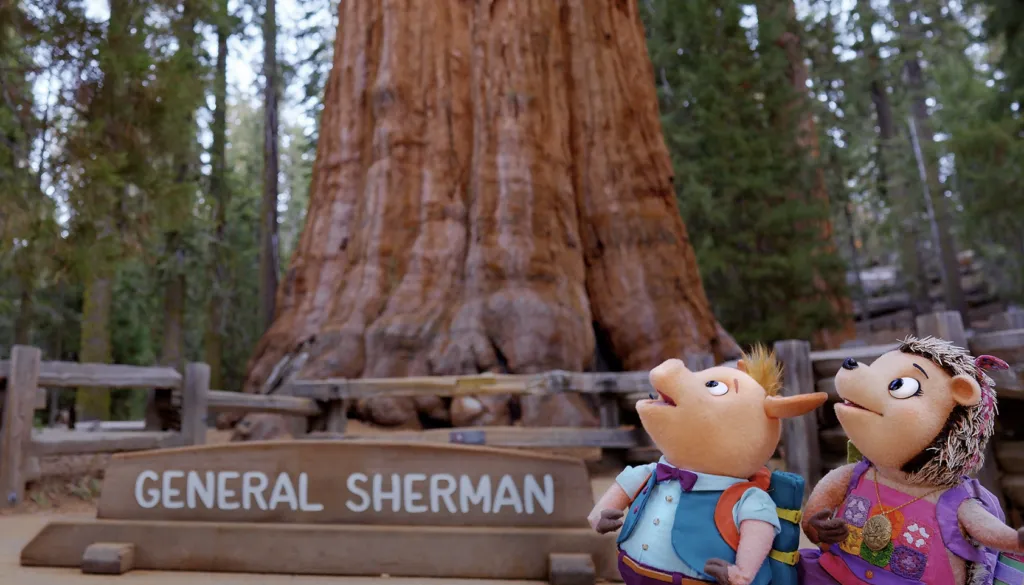
Imagine driving through a canyon, minding your own business, when suddenly, a hedgehog in pink hiking boots and a guitar pops into your head. Not just any hedgehog, mind you, but one on a quest for the "wows of the world."
That's exactly what happened to TV producer Halle Stanford. A few days later, the universe (or at least, the internet) delivered: research from UC Berkeley's Greater Good Science Center confirming that awe—that goosebump-inducing feeling you get from vast mysteries—actually makes us better humans. Suddenly, a hedgehog's journey felt less like a random thought and more like a PBS special.
The Puppet Power of Wonder
This rather serendipitous connection birthed Wowsabout, a new Jim Henson Company puppet special for preschoolers, now airing on PBS. Stanford teamed up with puppeteer Dorien Davies to create a 30-minute adventure starring Roxy, the free-spirited hedgehog, and Ronald, a fastidious city pig. Their mission? To explore Sequoia National Park and discover the profound power of wonder.
We're a new kind of news feed.
Regular news is designed to drain you. We're a non-profit built to restore you. Every story we publish is scored for impact, progress, and hope.
Start Your News DetoxPicture this: Roxy and Ronald standing dwarfed beneath colossal sequoia trees, or mesmerized by a flurry of migrating California tortoiseshell butterflies. They even encounter Pekan, a puppet representing an endangered southern Sierra Nevada fisher, who guides them to ancient pictographs. Because apparently, even puppets need a little help connecting with the ancestral vibes of the forest.
Why Awe Isn't Just for Grown-Ups
Dacher Keltner, a Berkeley psychology professor and founding director of the Greater Good Science Center, insists awe isn't some fluffy, optional extra. It's an evolutionary need. And for kids, it's a superpower. It makes them kinder, more creative, keeps their curiosity engines humming, and sparks a love for big ideas. Keltner, who's been studying awe for over a decade and even published a book on it (Awe: The New Science of Everyday Wonder and How It Can Transform Your Life), signed on as a science consultant and co-executive producer for Wowsabout.
He recently joined Stanford and Davies, along with other Greater Good Science Center experts, for a Berkeley Talks discussion. They dove into the surprisingly complex art of translating wonder into a children's show and why nurturing everyday curiosity is crucial in a world that feels increasingly disconnected. Because if a hedgehog and a pig can remind us to look up, maybe we all should.
You can catch the full Wowsabout special for free on PBS Kids. And perhaps, just perhaps, find your own "wow" today.