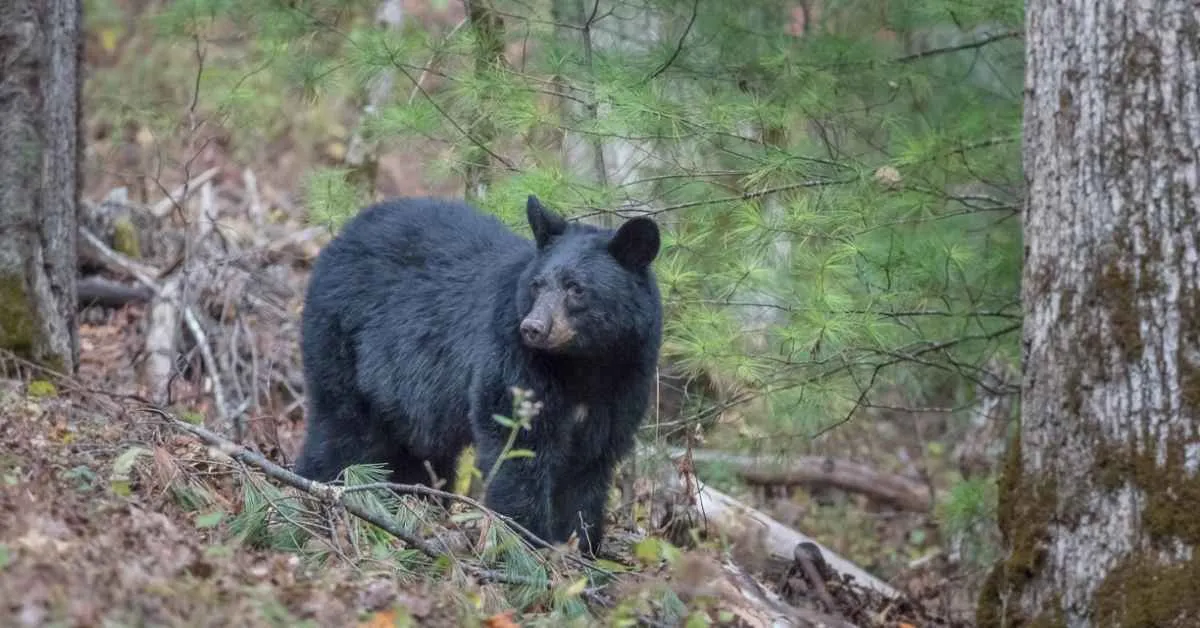
Black bear sightings are becoming more common in unexpected parts of the U.S. South. For example, a bear was seen in a Tennessee cornfield on the Fourth of July. Over the next month, more bears appeared in yards and on golf courses.
These sightings surprised many people because they were not in the usual mountain areas of East Tennessee. Instead, they were hundreds of miles away in the flatlands of West Tennessee.
Dan Gibbs, a black bear coordinator, was not surprised. He works for the Tennessee Wildlife Resources Agency. He says that while most bears are in East Tennessee, reports from other parts of the state have been increasing. These recent sightings likely involve several bears moving from neighboring states like Kentucky, Mississippi, Arkansas, and Missouri.
We're a new kind of news feed.
Regular news is designed to drain you. We're a non-profit built to restore you. Every story we publish is scored for impact, progress, and hope.
Start Your News Detox"Bears are going to recolonize Middle and West Tennessee," Gibbs said. "You can't stop it. They're going to be in Northern Mississippi, Eastern Arkansas, Eastern Missouri, Western Kentucky. That's just their historical range, and they're going to reclaim it."
Black Bears Reclaim Their Historical Home
Black bears used to live across most of the U.S., including the lower Mississippi River basin. However, in the 1800s and 1900s, their numbers dropped sharply due to habitat loss and overhunting. By the early 1970s, Tennessee's bear population was confined to only 10 mountain counties in the east.
In Mississippi, only about 12 bears were left when the state's Game and Fish Commission was formed in 1932.
Many people think black bears only live in mountains. But they are "generalists," meaning they can live in many different places, including swamps and wetlands. In Tennessee, human settlement and hunting pushed bears into the Great Smoky Mountains and Cherokee National Forest. These were large, protected areas that were harder for people to reach.
Wetlands are rich ecosystems that provide a lot of food for black bears. Anthony Ballard, who leads Mississippi's black bear program, explained that the Mississippi Alluvial Valley was once a "breadbasket" for bears in the Southeast. This area had historical floodwaters that spread for miles before levee systems were built.
Mississippi's main bear population lives along the Mississippi River in bottomland hardwood areas. These are low-lying, often flooded places with oak, hickory, and old cypress trees. Bears are also moving into the state's southeast corner, settling in pine forests with thick underbrush.
Another common belief is that bears den in caves. Janelle Musser, Tennessee's assistant black bear coordinator, says this is a myth. Caves are often damp and not appealing to bears. Bears are good at finding dens in their local habitat. In Southern Alabama, they might den in shallow ground depressions. In the Mississippi Delta, dens can be in cane thickets or even 50 feet high in old cypress trees.
It takes decades for black bear populations to grow again. Female bears don't have cubs until they are about three years old. They usually have a couple of cubs every other year if they eat natural foods. Young male bears leave their mothers around 18 months old. They can travel tens or hundreds of miles to find their own territory. This helps prevent inbreeding.
Male bears can have territories from 25 to over 60 square miles, depending on food and other bears. Female territories are much smaller and may overlap with their mothers'. These large territories and constant movement make it hard to count bear populations.
A bear population is considered "established" when breeding females are present. Tennessee has reports of cubs in counties east of Nashville. However, it will likely take another 10 to 15 years before Middle and West Tennessee have enough bears to survey.
From Near Extinction to Rebounding Populations
Hunting black bears was a common practice in the Southeast in the 1800s and early 1900s. Anthony Ballard noted it was as popular as deer hunting is today. Davy Crockett wrote about his love for bear hunting in his 1834 autobiography. He found many bears along the Obion River in western Tennessee.
President Theodore Roosevelt's 1902 hunting trip in Mississippi led to the creation of the Teddy Bear. He refused to shoot a bear that had been tied to a tree for him.
Mississippi stopped black bear hunting in 1932 when the population was only about 12 bears. Arkansas, once known as the "Bear State," had an estimated 50,000 black bears before settlement. The state banned hunting in 1927. By the 1950s, only 40 to 50 bears remained. In the 1960s, Arkansas brought over 250 bears from Minnesota and Canada to boost its population. Today, Arkansas has about 5,000 black bears.
Louisiana also closed its bear hunting seasons in 1956. From 1964 to 1967, the state relocated 161 bears from Minnesota. However, habitat loss due to agriculture continued to harm the population. Louisiana banned bear hunting in the late 1980s, and the Louisiana black bear became a federally threatened species in 1992.
Moving bears away from their home range is not considered effective now. Bears often try to return, increasing their risk of being killed. A 2003 study showed that bears in the Arkansas mountains are descendants of the reintroduced bears.
Thanks to population growth, the Louisiana black bear was removed from the threatened species list in 2016. The state opened a limited hunting season in 2024, issuing 26 tags to hunters. This number increased to 42 in 2025, and hunting areas expanded. Louisiana now estimates it has about 1,500 black bears.
In Missouri, black bears were almost gone by 1931. Sightings increased after Arkansas started its reintroduction program. Missouri opened a limited hunting season in 2021. The state now has about 1,000 black bears.
Tennessee closed its hunting season from 1970 to 1972. It also partnered with North Carolina and Georgia in 1976 to share management information. Tennessee's hunting rules focus on stopping poaching and protecting breeding females. Hunting is banned in over 450,000 acres of bear sanctuaries, including the Great Smoky Mountains National Park. Tennessee estimates its current population at about 6,000 bears.
Mississippi has not yet reopened a hunting season. The state has been studying its bear population since 2002. The most recent estimate from 2012 put the bear count between 150 and 300. Ballard expects the upcoming estimate to show a much larger number.
A bill to force a hunting season in Mississippi in 2027 passed the Senate but failed in the House. Ballard said there's no specific population number needed to allow hunting. He noted that a hunting season is a natural outcome of a sustainable population. However, he wants to ensure they don't over-harvest an animal that has just recovered.
Mississippi might have different hunting strategies for different areas. For example, they might not want to over-harvest the "core population" along the western edge. But in the southeast, where there are more human developments and less ideal habitat, a different approach might be considered.
Living Alongside Bears
Residents in areas with bear sightings should prepare to live with established bear populations. Musser warns that waiting to adjust will lead to more conflicts between humans and bears.
This means learning about black bears from resources like bearwise.org. It also means using bear-resistant trash cans in homes and public areas. Musser said that many people live safely with bears across the country by following a few simple rules.
One key rule is to prevent bears from eating human food. In Tennessee, it's now a misdemeanor to feed a black bear or fail to secure trash in prohibited areas. Ballard emphasized that bears have an excellent sense of smell, about seven times better than a bloodhound. Anything a dog can get into, a bear can smell and access more easily.
Farmers might see bears eating crops, especially corn. However, bear populations in West Tennessee and Mississippi are not dense enough to cause significant crop damage. Ballard noted that bears cause less crop damage than deer. Gibbs suggested that herd dogs can help keep bears, coyotes, and other animals away from livestock and crops. For smaller farms and chicken coops, electric fences can be a solution.
Another method is hazing, which involves using loud noises or paintball guns to scare bears away. Musser said this causes discomfort without long-term harm.
Chris Dowdy, 52, grew up in Paris, Tennessee. He is a descendant of Davy Crockett and welcomes the bears' return. He points out that local place names, like "Cub Creek" and "Bear Spring," show bears were once common in the area.
"It's not abnormal [for bears to coexist with people], it's just abnormal to us because it's not something we're used to having," Dowdy said.
Deep Dive & References
Louisiana Black Bear Management Plan - Louisiana Department of Wildlife and Fisheries