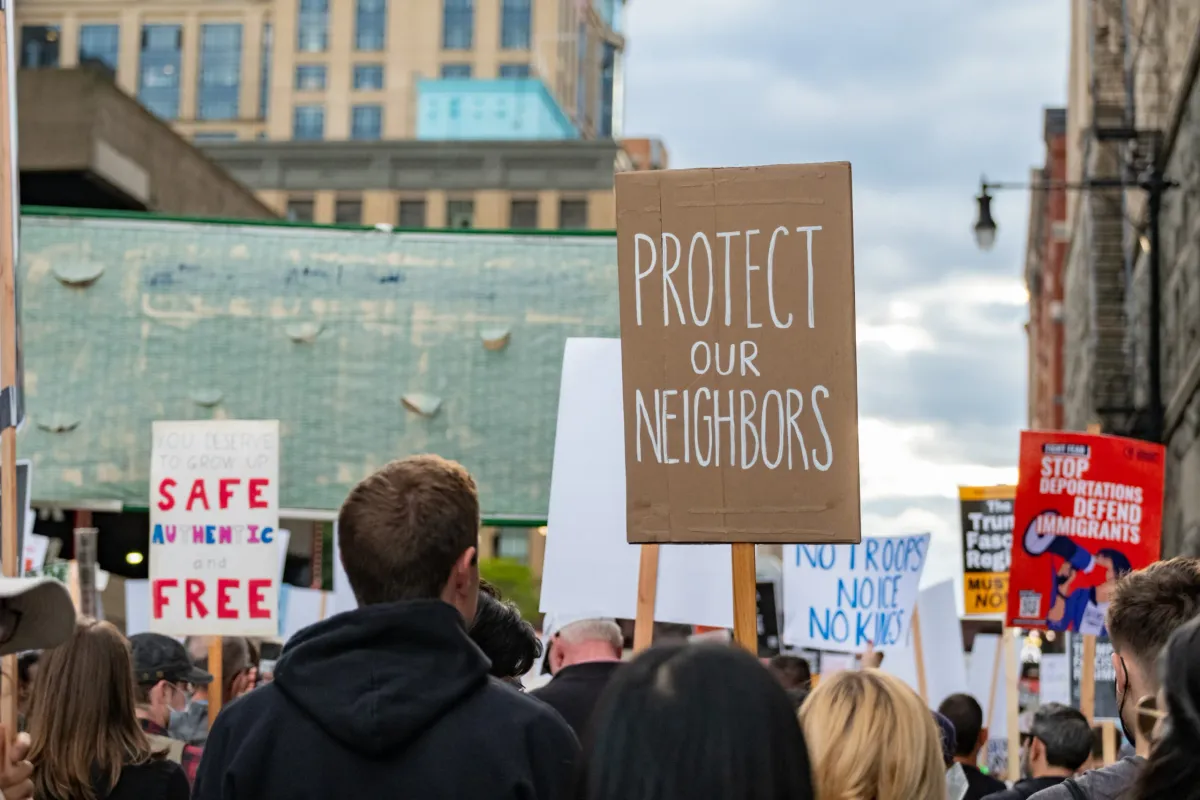
The stakes have shifted. Immigration enforcement is intensifying. Universities are handing over student records. Federal workers are losing jobs. The question isn't whether resistance is necessary—it's whether we're willing to pay the cost.
Fran Korten, former publisher of YES! Magazine, asked this directly back in 2017, and the question has only grown sharper: "What do we stand for? What do we care about enough to risk ridicule, funding, a job, our lives?"
Most of us have never had to answer this seriously. We march. We call our representatives. We donate. We show up. But we do it with the safety net mostly intact. That calculus is changing for many people, and it's forcing a different kind of organizing.
We're a new kind of news feed.
Regular news is designed to drain you. We're a non-profit built to restore you. Every story we publish is scored for impact, progress, and hope.
Start Your News DetoxWhat resistance actually looks like
When Donald Trump designated "antifa" as a domestic terror organization, the framing was deliberate—create a villain, crush opposition. But Barbara Roose, a Holocaust survivor, saw through it. In 2017, she counterprotested a hate rally and spoke directly to the young activists being vilified: "I feel gratitude to these young people for being our first line of defense, for being willing to stand up to the hateful actions of neo-Nazis and white nationalists."
Roose understood something crucial: resistance takes many forms, and sometimes it requires people willing to absorb risk that others can't or won't.
But one-off protests aren't enough. Arun Gupta, a journalist and long-time organizer, has been blunt about what actually wins: "Playing nice ain't going to cut it with people who want to kill you and your community. We need principles that build power now and for the long term."
That means infrastructure. It means organizations that last beyond a single march. It means people showing up consistently, connected to each other, building something durable enough to weather the pressure.
Real wins are happening
While the headlines scream crisis, some communities are actually winning. New Mexico became the first state in the nation to secure universal child care—not through federal legislation, but through grassroots organizing that built enough political pressure that it became inevitable. That victory came from people who understood that power isn't granted; it's built.
Similarly, journalists like Sonali Kolhatkar continue covering the people and movements that are actually solving problems—how universal basic income gave someone space to follow their dreams, how deportees' families are running for office, how surveillance is being resisted at the local level. These stories don't make the cable news rotation, but they're the texture of how change actually happens.
The interdependence part matters
What separates sustainable resistance from burnout is this: you can't do it alone. The people building power right now aren't heroes doing it solo. They're rooted in communities. They're connected to others. They check in. They share the weight.
That's not sentimental. It's practical. When the cost of resistance rises, isolation becomes dangerous. Connection becomes infrastructure.
The question Korten raised isn't rhetorical anymore for many people. It's daily. What they're discovering is that the answer isn't found in individual courage—it's found in collective action, in organizations that endure, in communities that hold each other up while taking real risks together.