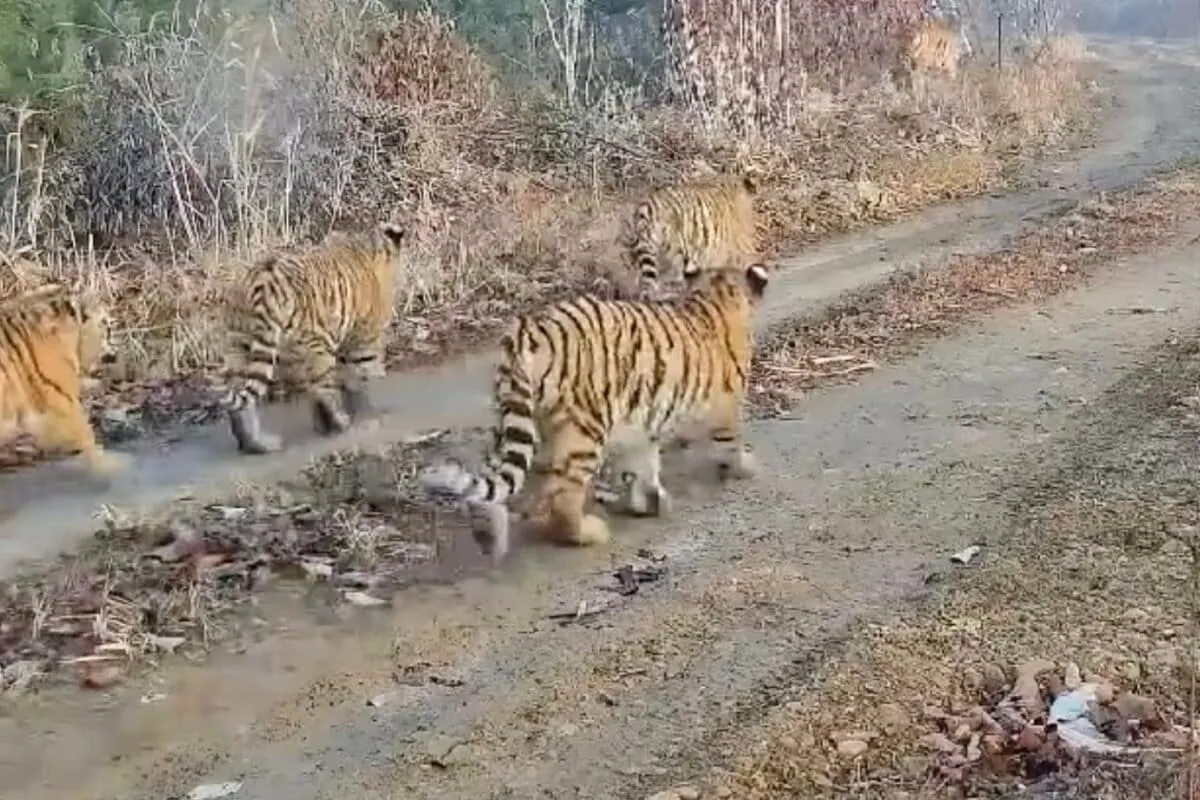
In November 2025, motion-activated cameras in Northeast China Tiger and Leopard National Park captured something scientists had never documented before: an Amur tigress walking a dirt road with five cubs in tow. Two of the young ones pause to investigate something on the ground. A fifth struggles to keep pace. It's the kind of moment that matters more than it might seem.
The tigress is around 9 years old. Her cubs are roughly 6 to 8 months old—old enough to follow their mother on patrol, young enough to still be learning. The footage is part of a larger story playing out across the world's largest tiger reserve, a 14,100-square-kilometer stretch of dense forest and snowy mountains where China's most significant population of Amur tigers now lives.
A Species Coming Back
Amur tigers, also called Siberian tigers, nearly vanished. By the 1930s, fewer than 30 roamed the wild across northeast China, Russia's far east, and parts of the Korean peninsula. Poaching, habitat loss, and dwindling prey populations pushed them to the edge of extinction. The latest international data puts the global population at somewhere between 265 and 486 tigers in Russia, with roughly 70 in China—most of them in this one national park.
We're a new kind of news feed.
Regular news is designed to drain you. We're a non-profit built to restore you. Every story we publish is scored for impact, progress, and hope.
Start Your News DetoxBut the numbers are moving in a direction that would have seemed impossible a generation ago. Last year, the park documented 35 tiger cubs born within its boundaries. The tigress with five cubs contributes to that momentum. Scientists tracking the population see the pattern repeating: more breeding females, more successful litters, more cubs making it to adulthood.
What changed? The national park itself—established to create a protected corridor where tigers could hunt, breed, and move without constant human threat. Prey populations have stabilized. Poaching enforcement has tightened. The reserve now functions as a genuine refuge, not just a name on a map.
The five-cub footage matters because it shows viability. A tigress raising that many cubs to this age suggests adequate food, manageable stress, and a habitat stable enough to support a growing family. It's one data point in a longer recovery arc, but it's a data point that counts. The next step isn't guaranteed—these cubs still need to survive to adulthood, find their own territory, breed successfully. But for the first time in nearly a century, that future doesn't feel like wishful thinking.