Fifty years is a long time for anything to stick around. Most products don't make it past a decade. Yet 1976 gave us a handful of things that are still sitting in our homes, our pockets, our arcade memories—sometimes barely changed, sometimes transformed beyond recognition, but unmistakably the same at their core.
The computer that started in a garage
Steve Jobs and Steve Wozniak built the first Apple computer in Jobs's Los Altos garage in 1976. The Apple 1 wasn't much to look at—a single pre-assembled motherboard in a desktop form—but it was novel enough to matter. A year later, the Apple II arrived with expansion slots, letting users add floppy drives and other components themselves. That was radical at the time.
Fast forward through the colorful iMacs of the late 1990s and the minimalist designs that followed, and you can still buy an Apple desktop computer today. The DNA is the same, even if the execution has evolved almost beyond recognition. What started as a garage experiment became the template for how personal computers would work.
We're a new kind of news feed.
Regular news is designed to drain you. We're a non-profit built to restore you. Every story we publish is scored for impact, progress, and hope.
Start Your News DetoxThe drink that redefined convenience
When 7-Eleven and Coca-Cola launched the Big Gulp on the West Coast in 1976, the standard soft drink came in 16 ounces. The Big Gulp was an audacious middle finger to moderation. It took until 1979 for the idea to roll out nationally, and by 1981, the Super Big Gulp—46 ounces of pure commitment—hit shelves.
Interestingly, the Big Gulp's predecessor, the Slurpee, had already been a 7-Eleven staple since 1966. But it was the Big Gulp that captured something about American convenience culture: bigger, faster, more. Half a century later, you can still walk into a 7-Eleven and order one, unchanged in concept if not always in size.
Candy that caught a president's attention
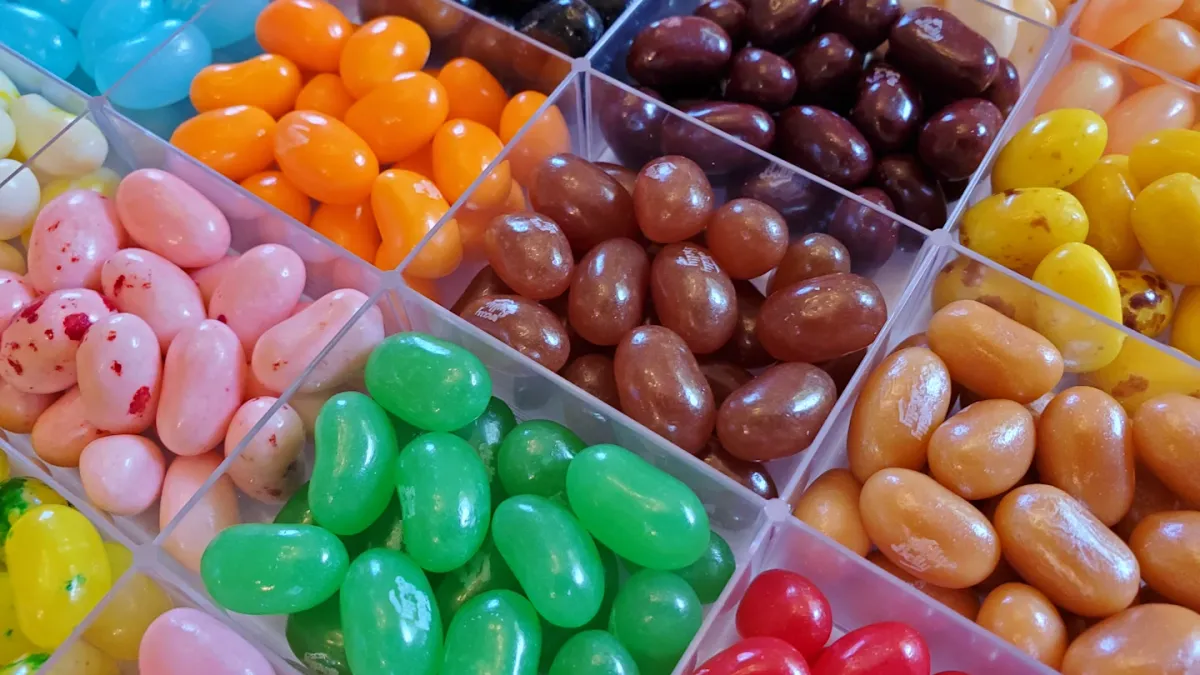
The Jelly Belly Candy Company traces its roots back to 1869, but the iconic Jelly Belly jelly bean itself arrived in 1976, created from David Klein's vision for a gourmet jelly bean with complex flavors. Buttered popcorn. Watermelon. Juicy pear. These weren't the simple sugar pellets of earlier generations.
The candy became famous enough that Ronald Reagan ordered 7,000 pounds of red, white, and blue Jelly Bellys for his 1981 inauguration. A candy created in the Bay Area became presidential. Today, Jelly Belly still occupies shelf space in candy shops and convenience stores, a small luxury that somehow never went out of style.
The arcade game that never got old
Whac-a-Mole debuted in Japan in 1975 as "Mole Killer," then crossed the Pacific to North America in 1976. The concept was simple: mallets, moles popping up, reflexes tested. A Florida-based arcade company refined it, and by 1977 it was everywhere—arcades, pizza restaurants, anywhere kids had quarters and competitive instincts.
Walk into an arcade or bowling alley today and Whac-a-Mole is still there, still working the same way, still triggering the same rush of focus and mild rage. Few games have that kind of staying power. It's not because it's sophisticated. It's because it works.
Why these survived
What ties these together isn't innovation for its own sake. It's that each one solved a real problem or fulfilled a genuine desire—personal computing, convenient size, flavor complexity, arcade fun—and did it well enough that the core idea didn't need replacing. They evolved in details. They adapted to new contexts. But the basic promise remained true.
That's rarer than you'd think. Most things from 1976 are footnotes now. These ones are still in the game.