Well, would you look at that. For the first time ever, low-emissions energy sources — think solar, wind, and a few others — met all new global electricity demand last year. This means fossil fuels didn't have to grow at all, according to energy think tank Ember. Let that satisfying number sink in.
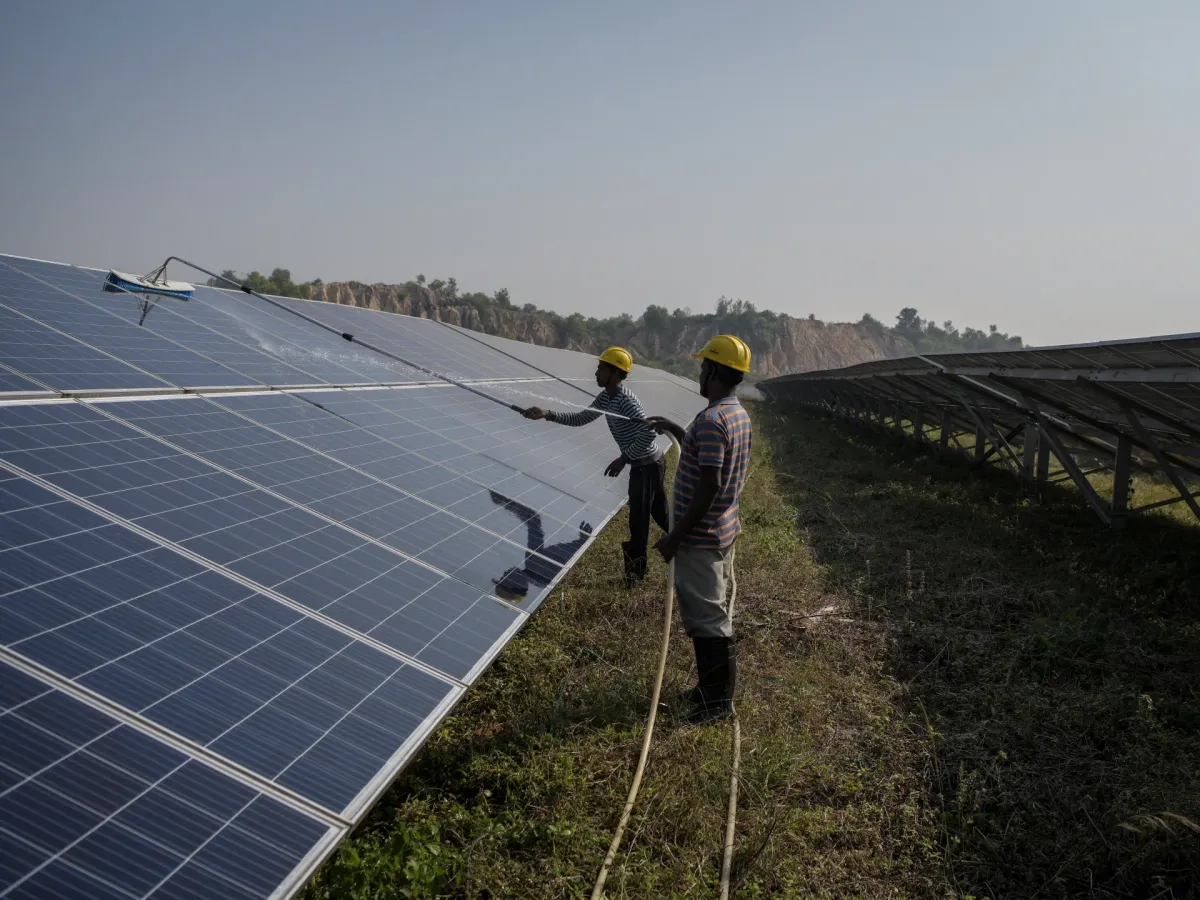
Solar power, the undisputed superstar, handled a whopping three-quarters of that new demand. Wind picked up almost all the rest. Suddenly, the future's looking a bit brighter, literally.
Overall, these low-emissions sources, which also include biofuels, hydropower, and nuclear, powered a record 42.6% of the world's electricity in 2025. That's out of a staggering 31,779 TWh consumed globally. Yes, fossil fuels still carry the majority, but Ember is calling 2025 the turning point. Their share, the report suggests, is about to start shrinking.
We're a new kind of news feed.
Regular news is designed to drain you. We're a non-profit built to restore you. Every story we publish is scored for impact, progress, and hope.
Start Your News DetoxThe Clean Energy Takeover?
Nicolas Fulghum, a senior energy and climate data analyst at Ember, put it simply: clean power is now strong enough to meet the increase. He expects it to cover all new demand for the foreseeable future, then start actively reducing how much fossil fuel generation we need. Ember even predicts that by 2035, fossil fuels could lose 10-20% of their market share. Clean energy, they say, is on its way to becoming dominant.
Not everyone's popping champagne just yet. Rahmat Poudineh, head of electricity research at the Oxford Institute for Energy Studies, is a bit more cautious. He points out that one year doesn't make a permanent trend, especially when you need to meet peak demand during extreme weather, not just average use. Ember concedes that 2025's demand growth was typical, not extreme. They'd actually expected 2024 to be the turning point, but a summer of record heat meant more air conditioning, boosting both fossil fuels and renewables.
Still, the world has been exceeding expectations. Russia's invasion of Ukraine in 2022, for instance, spurred a 5% annual increase in European renewable energy. Last year, Europe got a remarkable 71% of its electricity from clean sources. Meanwhile, China and India, two of the biggest emitters, both reduced their fossil-generated electricity last year — the first time they've done that together this century.
Even the International Energy Agency (IEA) reported that oil and gas demand slowed in 2025. And the current conflict in the Gulf could further accelerate the shift, as governments are advised to shield only the most vulnerable from price hikes, not everyone.
Ember also highlights the sheer speed of renewable growth. A staggering 81% of all wind and solar generation growth since 2000 has happened in the last decade alone, compared to just 27% for fossil fuels. It's like comparing a rocket launch to a particularly slow tractor.
Bumps in the Road
Of course, it’s not all smooth sailing. Some hydrocarbon experts, like Yannis Bassias from Amphore Energy, argue that while renewables can meet new demand, they can't yet guarantee stability without serious upgrades to storage and grids. The Gulf crisis, he notes, showed that high prices don't erase the technical need for gas in power systems, especially for baseload electricity. Europe, Japan, and Korea are still very much reliant on imported LNG to keep their systems stable.
Poudineh from OIES is a bit more open, suggesting that fossil fuel shocks often do change energy policy. He sees a high chance this current situation will too, though it’s not a done deal yet.
Is Fast Enough, Fast Enough?
While impressive, this clean energy boom might not be quite fast enough to hit the Paris Agreement's goal of limiting global warming to 1.5 degrees Celsius. The IEA says fossil-generated electricity needs to drop by 25% by 2030, while Ember's prediction is 10-20% by 2035. A bit of a gap, there.
However, the good news is that emissions per average kilowatt-hour fell to 458g of CO2-equivalent in 2025, down from 543g a decade ago. The IEA expects that to drop to 400g next year. Plus, overall emissions grew by only 0.4%, while the economy grew by 3.1%. The world is slowly, but surely, decoupling its growth from its carbon footprint.
And here’s a kicker: if solar and wind hadn't grown the way they did, the world would have released an additional 4 billion tonnes of CO2 into the atmosphere last year. Four billion. Suddenly, all that solar on your neighbor's roof feels a little less like an eyesore and a lot more like a global effort. You're welcome, planet.