Thailand's coral reefs are in flux. A sweeping new survey of the country's underwater ecosystems—the most comprehensive assessment to date—reveals that these reefs are losing the structural diversity that keeps them alive.
Marine scientists spent nearly two years diving across eight provinces along the Gulf of Thailand and Andaman Sea coasts, documenting what they found in fringing reefs and offshore pinnacles. The picture that emerged is sobering: while Thailand's reefs still harbor over 300 species of reef-building corals, they're becoming simpler, less varied in shape and form.
Why structure matters
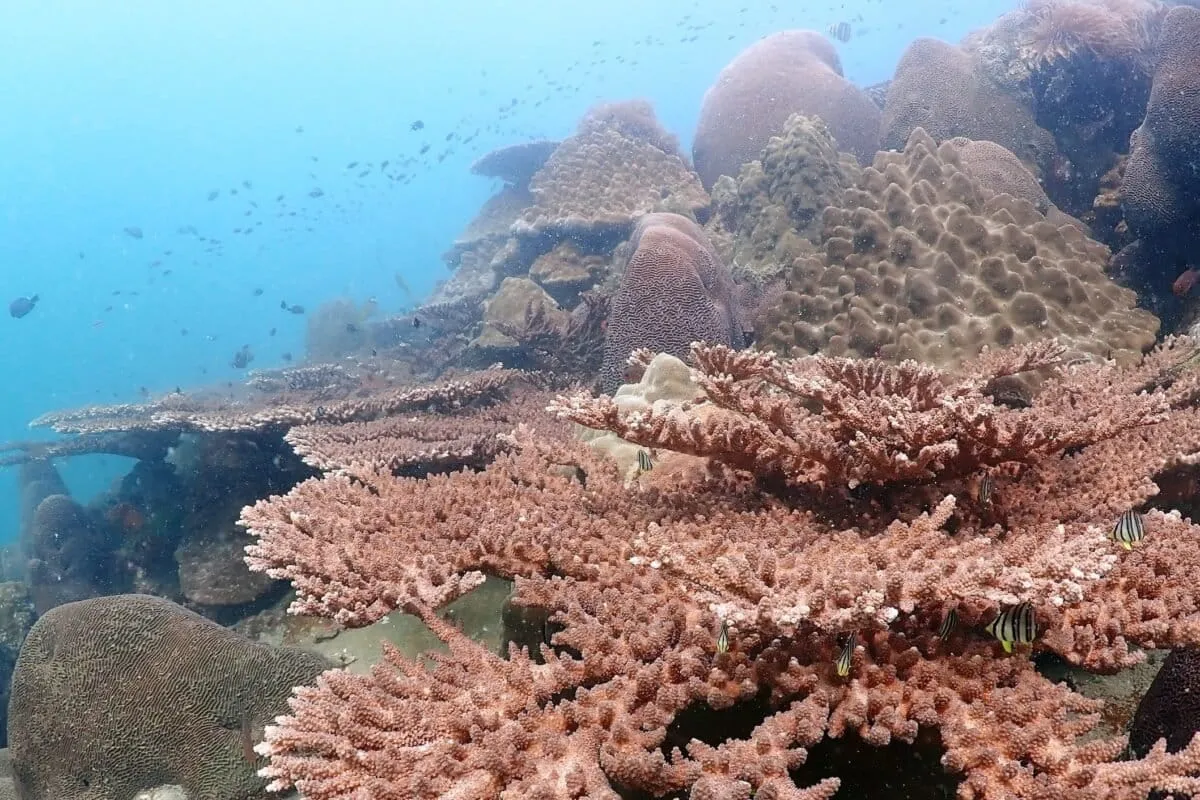
Structural complexity sounds technical, but it's fundamental to how a reef works. A healthy reef looks like an underwater apartment building—branching corals create corridors, massive boulder-shaped corals form walls, encrusting corals fill the gaps. Fish shelter in the branches. Invertebrates hide in the crevices. The whole system supports thousands of species that depend on that three-dimensional maze.
We're a new kind of news feed.
Regular news is designed to drain you. We're a non-profit built to restore you. Every story we publish is scored for impact, progress, and hope.
Start Your News DetoxAs reefs flatten and simplify, that biodiversity collapses. "Structural complexity is really important for the overall health and function of coral reef ecosystems," explains Rahul Mehrotra, research director at the Aow Thai Marine Ecology Center and one of the study's lead researchers. "As reefs lose this complexity, we see cascading impacts on the biodiversity and productivity of these systems."
The culprit is familiar: marine heat waves. Thailand's reefs have been hammered by repeated mass bleaching events over the past decade—and 2024 brought another one. When water temperatures spike, corals expel the symbiotic algae living in their tissues, turning white and struggling to survive. The stress shifts which species dominate, favoring hardy species over the branching corals that build the reef's architecture.
A baseline for the future
What makes this new survey significant isn't just what it found—it's that it provides something researchers have lacked: a clear, coast-to-coast baseline. Previous studies were scattered and localized, snapshots from a few monitoring sites. This is the first time scientists have mapped coral communities across Thailand's entire reef system at once.
"Having this map of what corals are represented across the region gives us a starting point for conservation," Mehrotra says. "We hope that this baseline will motivate more nuanced assessments."
That baseline matters because it lets reef managers and policymakers measure whether their conservation efforts are actually working. Without knowing where you started, you can't tell if you're moving forward or backward. Now, when the next survey happens in five or ten years, scientists will have a real point of comparison.
The researchers acknowledge the 2024 bleaching event will have taken a toll that won't be fully quantified for months. But the work itself—the act of mapping, measuring, and documenting—is part of what keeps these reefs from becoming forgotten ecosystems. The next phase is translating this baseline into action: targeted marine protection, restoration efforts, and the harder work of addressing the climate change driving the heat waves in the first place.