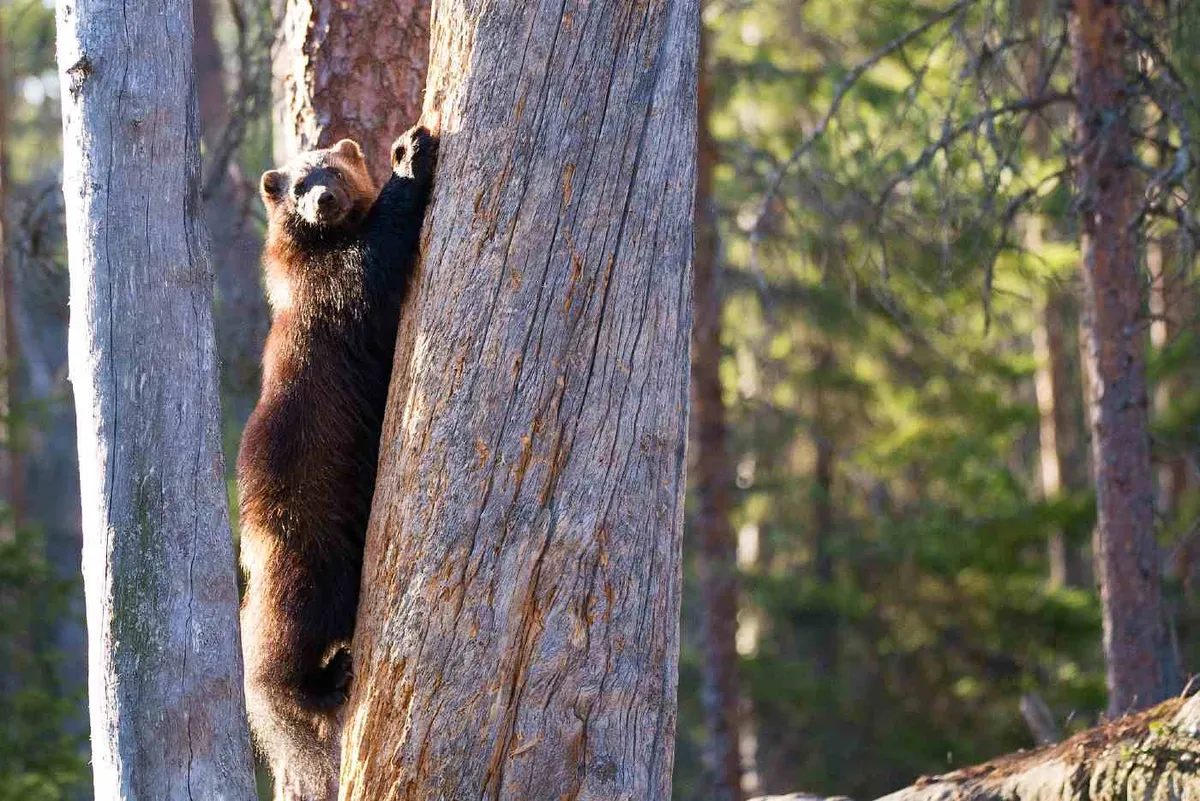
Colorado wildlife officials are moving forward with a plan to reintroduce wolverines to the state, ending a century-long absence. The solitary scavengers were hunted to extinction across Colorado by the early 1900s, but small populations survived in the northern Rockies and Canada. Now, as those populations have gradually expanded southward into Utah and Wyoming, Colorado Parks and Wildlife (CPW) is preparing to establish them back home.
The effort follows legislation passed in 2024 that mandated the state develop a restoration plan. CPW is now gathering public comment and stakeholder input before moving ahead with what could become one of the most significant carnivore reintroductions in the West.
A plan built for wolverine reality
Unlike gray wolves—which Colorado attempted to reintroduce amid significant livestock concerns—wolverines present a different conservation puzzle. These weasel-family members weigh only 20 to 35 pounds and are primarily scavengers rather than active hunters. That means ranchers and farmers shouldn't face the same predation pressures that made wolf reintroduction controversial. CPW is still planning compensation programs for any livestock losses, but the risk profile is fundamentally different.
We're a new kind of news feed.
Regular news is designed to drain you. We're a non-profit built to restore you. Every story we publish is scored for impact, progress, and hope.
Start Your News DetoxThe plan would establish three separate wolverine populations at high elevations across the state: north of Interstate 70 in the Rocky Mountain region, in the central Elk and West Elk Mountains, and in the San Juan Range of southwest Colorado. This geographic spread matters. Adult male wolverines maintain territories spanning up to 500 miles, so establishing multiple populations across different mountain ranges gives the species room to exist as it naturally would.
CPW estimates Colorado could ultimately support around 100 wolverines—which sounds modest until you consider the context. Dr. Robert Inman, CPW's Wolverine Coordinator, notes that 50 to 100 animals would match the historical population that existed before hunting eliminated them. It would also represent roughly a quarter of all wolverines currently in the Lower 48 states, making Colorado's alpine habitat genuinely significant for the species' survival.
The initial reintroduction would bring in approximately 45 wolverines with diverse genetic backgrounds. This approach—rather than releasing just a breeding pair—substantially increases the chances of establishing a stable, long-term population that can sustain itself.
Ski resorts have already signaled support for the plan, recognizing that wolverines are part of the high-elevation ecosystem Colorado's outdoor economy depends on. The broader question now is whether rural communities and the public will embrace sharing their landscape with a predator that's been absent for generations. That's where the comment period matters. Colorado has the habitat. It has the legal framework. What comes next depends on whether the state's residents decide they want their wolverines back.