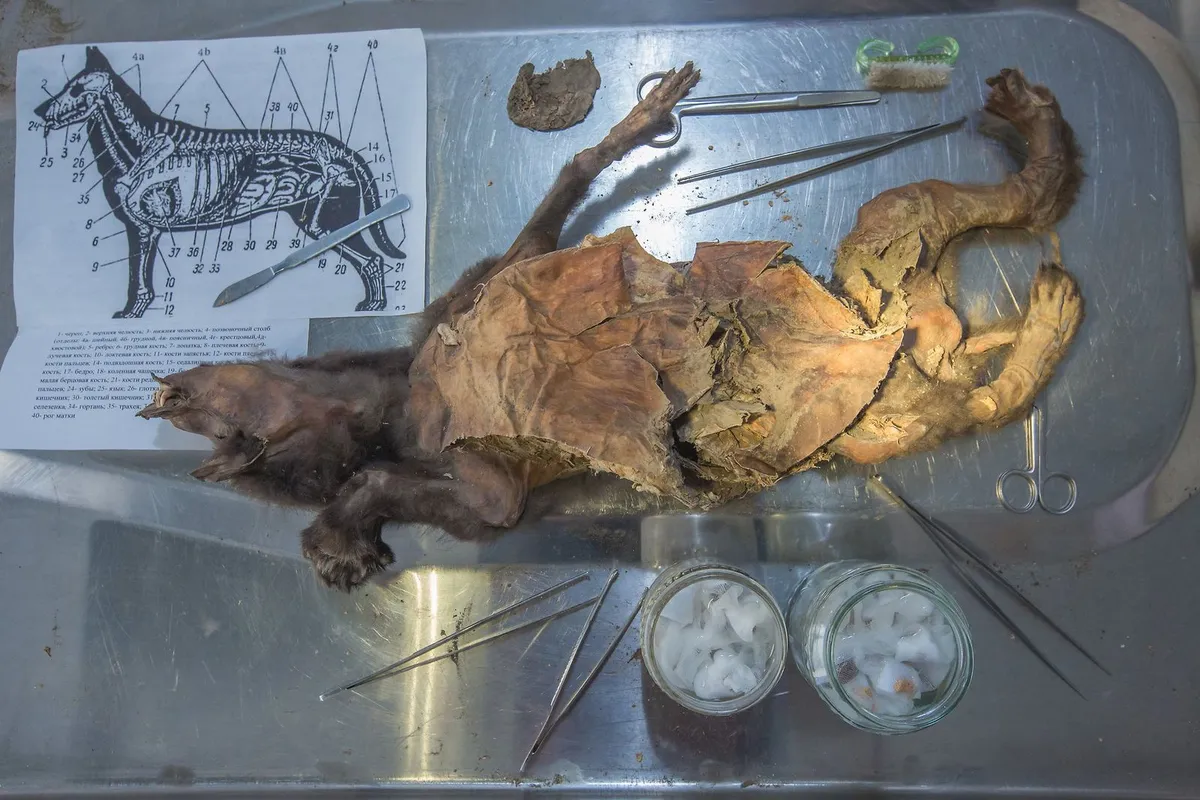
Roughly 14,400 years ago, a two-month-old wolf pup in what's now northern Siberia ate her last meal: a scrap of wagtail, some woolly rhinoceros flesh, a few tufts of arctic bluegrass. Not long after, she and her sister died—possibly when a landslide collapsed their den. Their bodies froze in the permafrost and stayed that way until researchers found them in the 21st century.
Now scientists have done something remarkable: they've reconstructed the complete genome of the woolly rhinoceros that pup ate, using DNA preserved inside her stomach for 14,000 years. The findings, published in Genome Biology and Evolution, are rewriting what we thought we knew about why these Ice Age giants disappeared.
A meal frozen in time
Researchers discovered the first wolf pup in 2011 near the settlement of Tumat in Siberia. They found the second in 2015. Both were mummified so completely that their skin, fur, and teeth remained intact. When scientists opened their stomachs, they found food still there—including a chunk of woolly rhino flesh with yellowish hair still attached.
We're a new kind of news feed.
Regular news is designed to drain you. We're a non-profit built to restore you. Every story we publish is scored for impact, progress, and hope.
Start Your News Detox"The tissue was so intact, it looked like the wolf had just swallowed it before it died," says Camilo Chacón-Duque, an evolutionary geneticist at Uppsala University who led the analysis.
Woolly rhinos vanished just centuries after these wolf pups died, but the reason has remained a puzzle. Climate change, inbreeding, human hunting—scientists have debated which factor, or combination, sealed their fate. The stomach contents offered a chance to test one crucial theory: was the species already in genetic decline when it disappeared.
The team compared the rhino DNA they recovered with two previously sequenced genomes—one from 18,000 years ago and another from 49,000 years ago. The female rhino eaten by the wolf pup showed no signs of inbreeding or genetic deterioration compared to the older specimens. She was genetically healthy.
That's the key finding. The woolly rhino wasn't weakened by its own biology. It was thriving right up until it wasn't.
A species that looked fine until it vanished
"Just because a living species on the surface looks OK genetically doesn't mean it's not vulnerable," says Mick Westbury, an evolutionary biologist at the Technical University of Denmark. The implication is stark: something external changed, and the rhinos couldn't adapt fast enough.
A few centuries after the wolf pups died, the northern hemisphere entered a period of rapid warming called the Bølling–Allerød interstadial. The climate shift didn't necessarily kill the rhinos directly. Instead, it transformed their habitat—the grasslands they depended on, the availability of food, the conditions they'd evolved to survive in. The species was caught between two worlds.
Illustration of a woolly rhinoceros by Mauricio Antón, PLOS Biology, 2008
Human hunting and habitat loss may have played a role too. Or perhaps a virus or catastrophic event delivered the final blow—similar to what may have happened to the last woolly mammoths. The point is: the rhinos didn't fail because they were weak. They failed because the world changed.
For conservationists, the lesson cuts close. A species can look completely stable, genetically sound, thriving—and still vanish within a few centuries. Even successful animals are only a few generations away from extinction if the conditions around them shift too fast. The woolly rhino didn't see it coming. Neither might we.