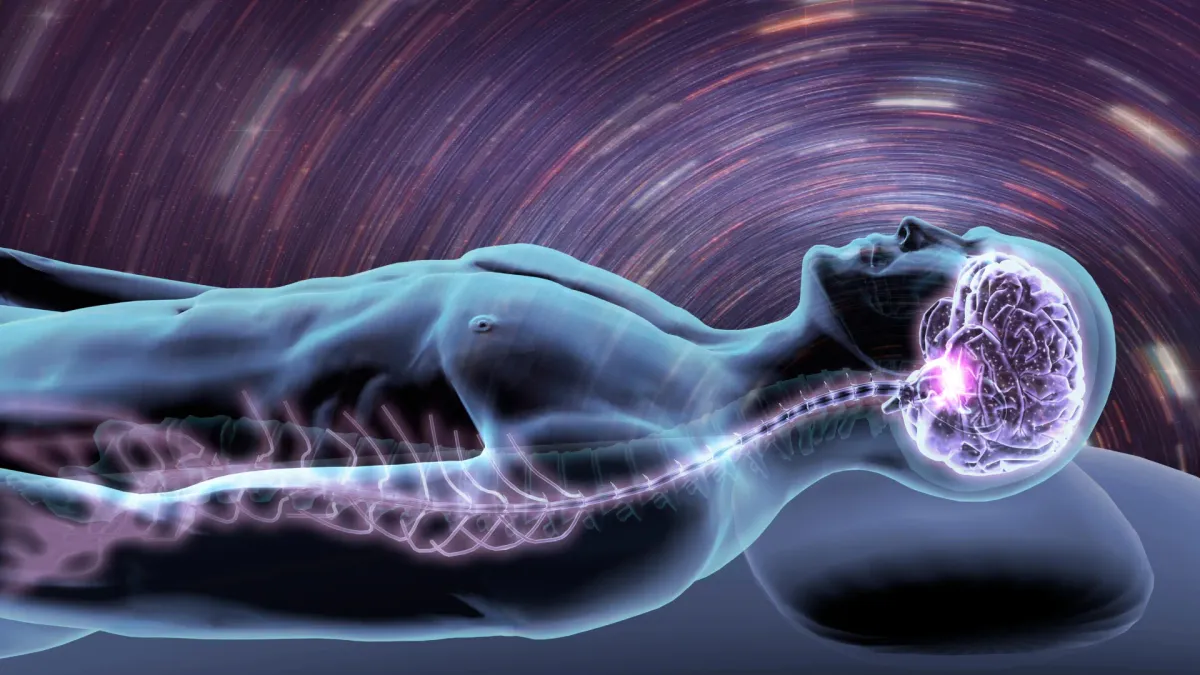
A single night's sleep generates a staggering amount of data — brain waves, heart rhythms, muscle twitches, oxygen levels, breathing patterns. For decades, sleep clinics have captured all of it during polysomnography tests, then looked at only a fraction of what the machines recorded.
Now researchers at Stanford have trained an AI system called SleepFM to read the full picture. And what it's finding is striking: sleep data alone can predict whether someone will develop Parkinson's disease, dementia, heart disease, or certain cancers — sometimes years before symptoms appear.
The Untapped Signal
Emmanuel Mignot, a sleep medicine researcher at Stanford, describes polysomnography as "a kind of general physiology that we study for eight hours in a subject who's completely captive." The test records everything simultaneously — a data-rich snapshot that traditional analysis has barely scratched.
We're a new kind of news feed.
Regular news is designed to drain you. We're a non-profit built to restore you. Every story we publish is scored for impact, progress, and hope.
Start Your News DetoxThe breakthrough came when researchers realized AI could handle what humans couldn't: finding patterns across hundreds of thousands of hours of sleep recordings. SleepFM was trained on 585,000 hours of polysomnography data from patients at Stanford's sleep clinic, learning how different physiological signals interact and what combinations matter.
Think of it like learning a language. The AI doesn't just memorize words; it grasps grammar, context, and meaning. "SleepFM is essentially learning the language of sleep," explains James Zou, co-senior author of the study.
What the Data Revealed
When researchers tested SleepFM against over 1,000 disease categories, it identified 130 conditions that could be predicted from sleep patterns alone. The strongest predictions came for cancers, circulatory diseases, pregnancy complications, and mental health disorders.
For specific conditions, the accuracy was remarkable. The model predicted Parkinson's disease with 89% accuracy, dementia at 85%, heart attacks at 81%, and breast cancer at 87%. These aren't rough guesses — they're probabilities that outperform most existing screening tools.
What made the difference wasn't any single signal. Instead, it was the contrast between them. When different physiological systems fell out of sync — when the body's various rhythms stopped talking to each other — that discord predicted trouble ahead.
The Next Phase
Researchers are now working to make SleepFM's predictions even sharper and to understand why certain sleep patterns signal future disease. Future versions may incorporate data from consumer wearables like smartwatches, which could eventually bring this kind of early warning system beyond sleep clinics.
The implication is quietly transformative: a routine test that people already get could become a window into health years before a diagnosis would otherwise appear.