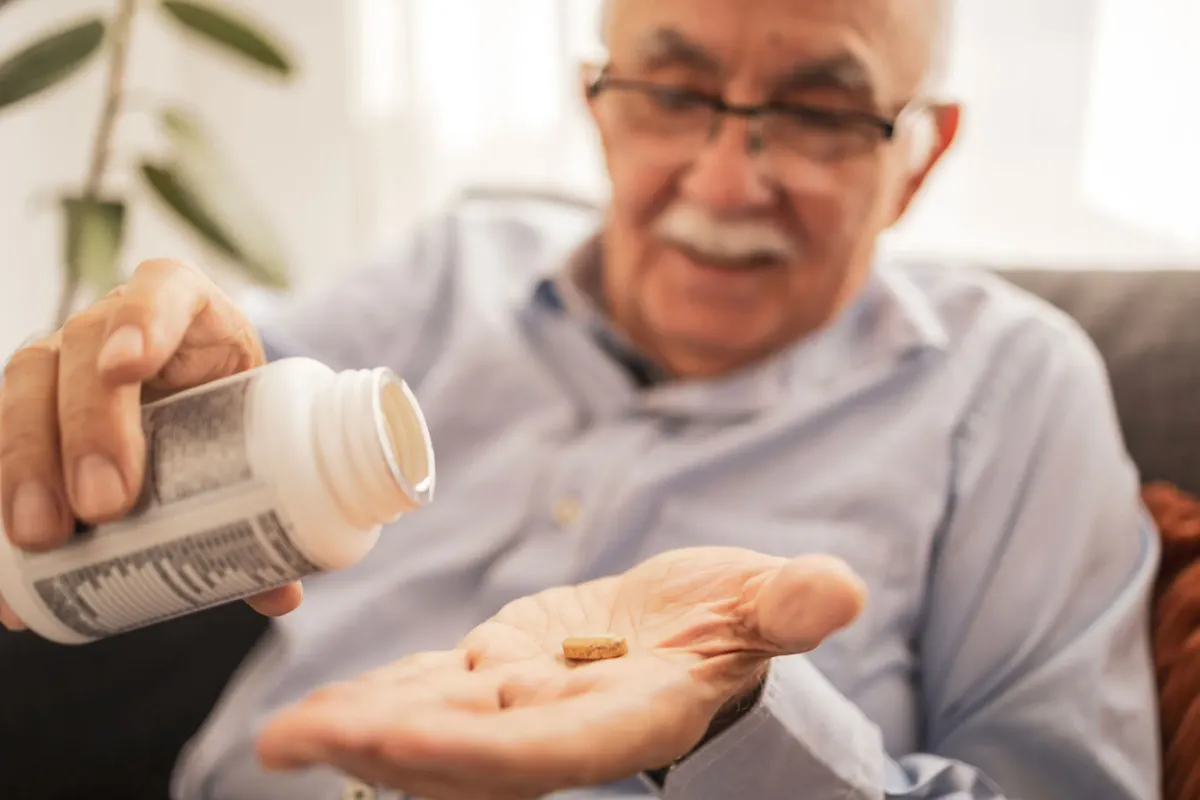
Your cells age on their own timeline — and it doesn't always match the number of candles on your birthday cake. Some people's bodies are biologically younger than their years suggest. Others are older. A new study from Harvard and Mass General Brigham found that taking a daily multivitamin for two years can actually slow that cellular aging clock, at least by a measurable amount.
Researchers analyzed data from nearly 1,000 older adults (average age 70) who participated in a randomized trial. Half took a daily multivitamin; half took a placebo. After two years, the multivitamin group showed biological aging that was about four months slower than the placebo group — measured through five different "epigenetic clocks" that track tiny changes in DNA.
Here's the kicker: people who started out biologically older than their actual age benefited the most. If you're 72 but your cells were acting like they belonged to an 80-year-old, the multivitamin seemed to help reset that gap.
We're a new kind of news feed.
Regular news is designed to drain you. We're a non-profit built to restore you. Every story we publish is scored for impact, progress, and hope.
Start Your News DetoxHow researchers measured this
Epigenetic clocks work by examining specific sites in DNA that control how genes turn on and off — a process called DNA methylation. These sites naturally change as we age, and scientists can use them to estimate how fast your body is actually aging at the cellular level, independent of your birth certificate.
The study, published in Nature Medicine, used blood samples from the COSMOS trial (Cocoa Supplement Multivitamins Outcomes Study). Participants were split into four groups: multivitamin plus cocoa extract, multivitamin plus placebo, cocoa extract plus placebo, or placebos only. Researchers checked DNA methylation at the start, after one year, and after two years.
Compared to the placebo-only group, the multivitamin group showed slowing across all five epigenetic clocks. Two of those clocks are particularly predictive of mortality — and both showed statistically significant improvements in the multivitamin group.
Why this matters: Most people take multivitamins without really knowing if they do anything. "There is a lot of interest today in identifying ways to not just live longer, but to live better," said Howard Sesso, a preventive medicine specialist at Mass General. "It was exciting to see the benefits of a multivitamin linked with markers of biological aging."
The effect size — four months over two years — is modest but real. It's not a fountain of youth, but it's also not nothing. For context, that's roughly equivalent to your cells aging at a slightly slower pace than they otherwise would have.
Researchers plan to follow up to see if these benefits persist after people stop taking the multivitamin, and whether other epigenetic clocks show similar patterns. The next question isn't whether multivitamins are magic — they're not. It's whether this particular intervention, combined with other healthy habits, might nudge the needle on how we age.