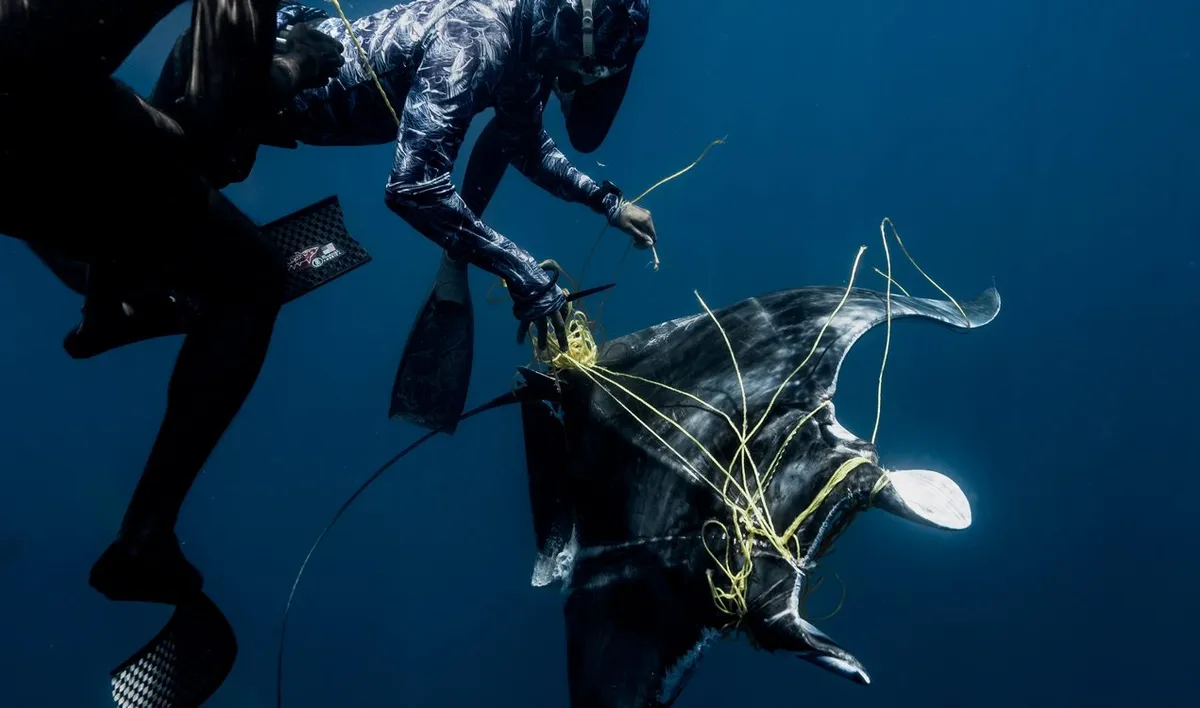
A mobula ray trapped in fishing line 30 feet below the surface off Baja California got an unexpected rescue—and then came back to say thank you.
Underwater photographer Andre Smits and his team were on an ocean safari when their guide spotted something caught in a shark fisherman's buoy line. What they found was a ray completely wrapped in rope, panicked and struggling. Three 8-foot silky sharks circled nearby, adding urgency to what became a seven-person rescue operation.
"The rope was going around almost every part of the ray," Smits said. "The animal was in freak mode, starting to swim around to try to get free."
We're a new kind of news feed.
Regular news is designed to drain you. We're a non-profit built to restore you. Every story we publish is scored for impact, progress, and hope.
Start Your News DetoxThe team worked with deliberate care. One free-diving trainer descended to cut the line below the ray while others held the animal steady from above, using knives to slice through the synthetic rope. The stakes felt real—if the ray panicked and bolted while someone was gripping too tightly, the rope itself could cut like a blade. And with blood in the water, those circling sharks weren't just background detail.
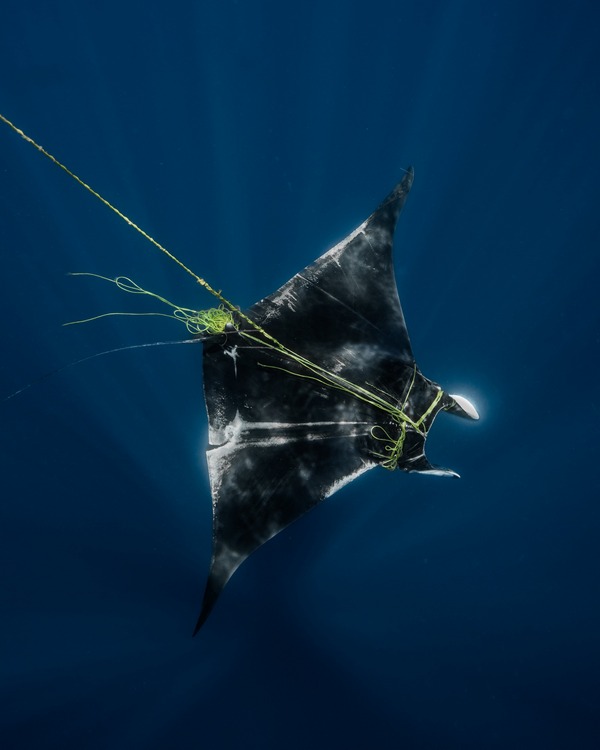
They freed her. The injured ray swam away, disappearing into the deeper water about 30 meters out. Then something unexpected happened.
"She really swam back to us and did a 'thank you' circle," Smits said. "She came right between us to our faces, almost giving us a grateful hug."
It's easy to dismiss animal behavior as projection—to see what we want to see in a wild creature's movements. But Smits and his team were there, underwater, in the moment. What they witnessed felt like recognition. Whether the ray was genuinely grateful or simply following some instinct to investigate her rescuers, the gesture landed. She had survived because seven people decided that rope-tangled wildlife mattered enough to risk their own safety.
This kind of rescue is becoming more common as divers and ocean lovers document the hidden toll of fishing gear. Ghost nets, buoy lines, and discarded equipment trap marine life constantly—unseen, mostly unreported. What makes this story stick is the visibility: the rescue was documented, the outcome was clear, and the animal's return turned a rescue into something that felt like reciprocal recognition.