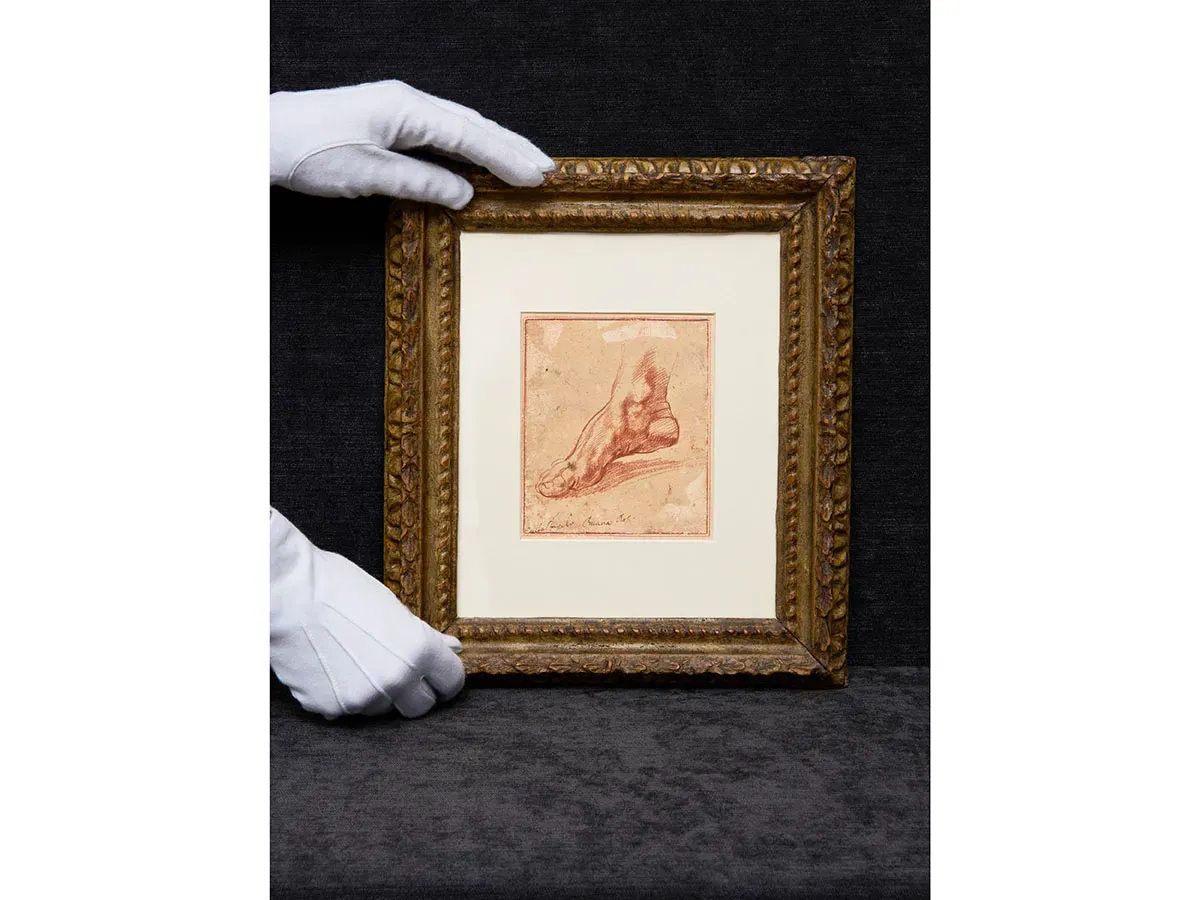
Someone's grandmother had a Michelangelo on her wall for years, sealed in a frame with duct tape, and nobody knew.
Last March, an anonymous person uploaded a photograph of a small red-chalk drawing to Christie's online estimate portal. It showed a foot—carefully rendered, anatomically precise, the kind of study an artist makes before painting something larger. The back of the frame had a handwritten note: "Michelangelo."
Christie's specialists took it seriously. After months of authentication work, they confirmed what the duct-taped frame had quietly suggested: this was genuine. The drawing was a preparatory study for the Libyan Sibyl, one of the prophetic figures Michelangelo painted across the Sistine Chapel ceiling.
We're a new kind of news feed.
Regular news is designed to drain you. We're a non-profit built to restore you. Every story we publish is scored for impact, progress, and hope.
Start Your News DetoxWhen it went to auction on Thursday in New York, the bidding lasted 45 minutes. The hammer fell at $27.2 million—more than thirteen times the high estimate of $2 million. It set a new record for any Michelangelo work sold at auction, surpassing a drawing that had held the title since 2022.
How authentication works in practice
The authentication itself reveals something worth knowing about how we verify old art. Giada Damen, Christie's specialist, used infrared reflectography to see underdrawings beneath the surface—marks only visible to the right technology. She cross-referenced the style and technique against roughly 50 other authenticated Michelangelo drawings related to the Sistine Chapel, finding a close match at the Metropolitan Museum of Art. The quality mattered too. "Often what we receive are reproductions or copies, or drawings that are not of the highest quality," Damen noted. This one was undeniably the work of someone who knew exactly what they were doing.
What makes this story compelling isn't just the price. It's the rarity. Only about 600 Michelangelo drawings are known to exist anywhere in the world. Finding one hanging in someone's home, unrecognized, suggests there may be others still waiting in attics and frames and sealed storage.
The buyer remains anonymous, though Christie's specialists speculate the work was acquired by a collector or institution in the Gulf region, which has become a significant player in high-profile art acquisitions over the past decade. The drawing itself will likely disappear into private ownership or a museum collection, seen by far fewer people than the original Libyan Sibyl continues to attract in Rome.
But for one moment, a foot that Michelangelo sketched five centuries ago became the most valuable drawing ever sold at auction—because someone's grandmother had good taste and kept it safe.