Researchers at Penn have developed a system that lets driverless cars detect obstacles they can't see directly — using radio waves instead of light.
The system, called HoloRadar, works by bouncing radio signals off walls and other flat surfaces to reconstruct what's happening around a corner or beyond a building edge. A pedestrian stepping into the road. Another vehicle approaching an intersection. A cyclist hidden by a parked car. The robot knows it's there before its cameras or laser sensors do.
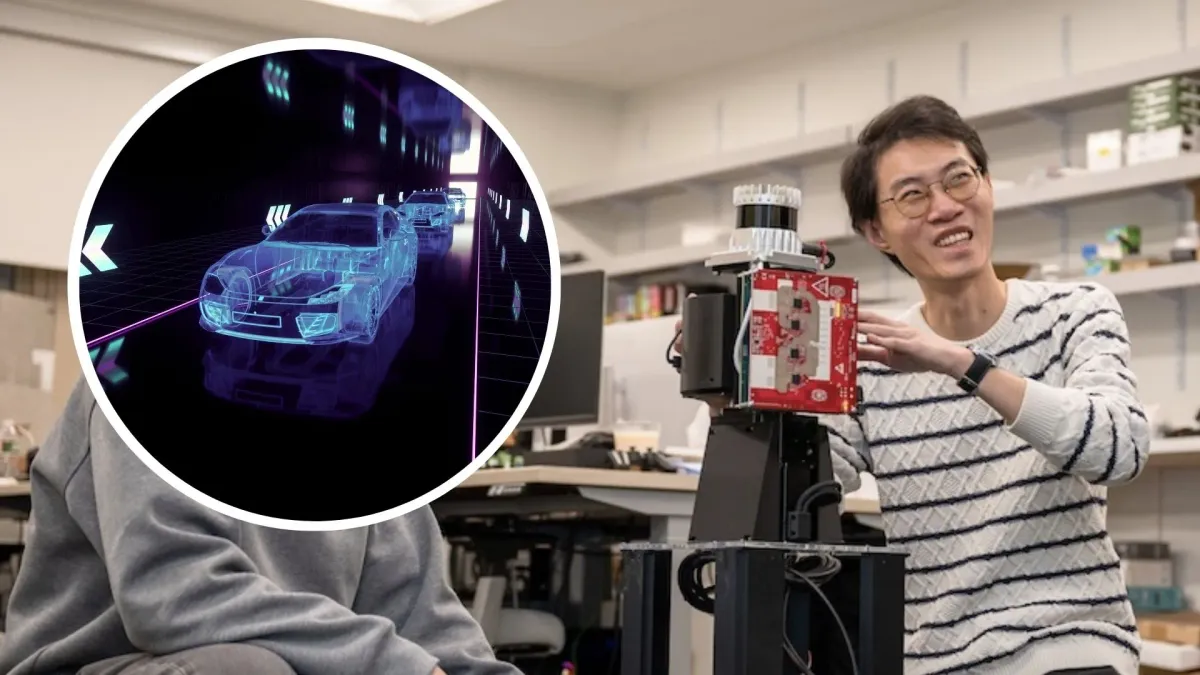
"Robots and autonomous vehicles need to see beyond what's directly in front of them," says Mingmin Zhao, the assistant professor who led the research. "This capability is essential to help them make safer decisions in real time."
We're a new kind of news feed.
Regular news is designed to drain you. We're a non-profit built to restore you. Every story we publish is scored for impact, progress, and hope.
Start Your News DetoxThe insight is counterintuitive: radio waves, which are much longer than visible light waves, actually become better at imaging around obstacles. Because they're so much larger than the tiny surface variations on a wall, those walls act like mirrors, bouncing the signals back predictably. Light waves are too small to work this way — they scatter and absorb. Radio waves just reflect.
Why This Matters Now
Autonomous vehicles already use multiple sensors — cameras, lidar (laser detection), radar. Each has blind spots. A camera can't see in darkness. Lidar works in a straight line of sight. HoloRadar fills a gap none of them cover: it reveals what's hidden entirely.
In testing, the system successfully reconstructed walls, corridors, and even human subjects positioned completely outside the robot's line of sight, working reliably in darkness and variable lighting. It's not replacing existing sensors; it's augmenting them, giving the vehicle more time to react when something unexpected appears.
The researchers tested HoloRadar on mobile robots indoors first — the controlled environment where the physics are clearest. The next phase is harder: outdoor scenarios with longer distances, more interference, and the unpredictability of city streets. Weather, traffic, building materials that don't reflect radio waves the same way — all of that will matter.
But the principle has already proven sound. And for autonomous vehicles, even a few extra milliseconds of warning before an obstacle appears can be the difference between a smooth stop and a collision.