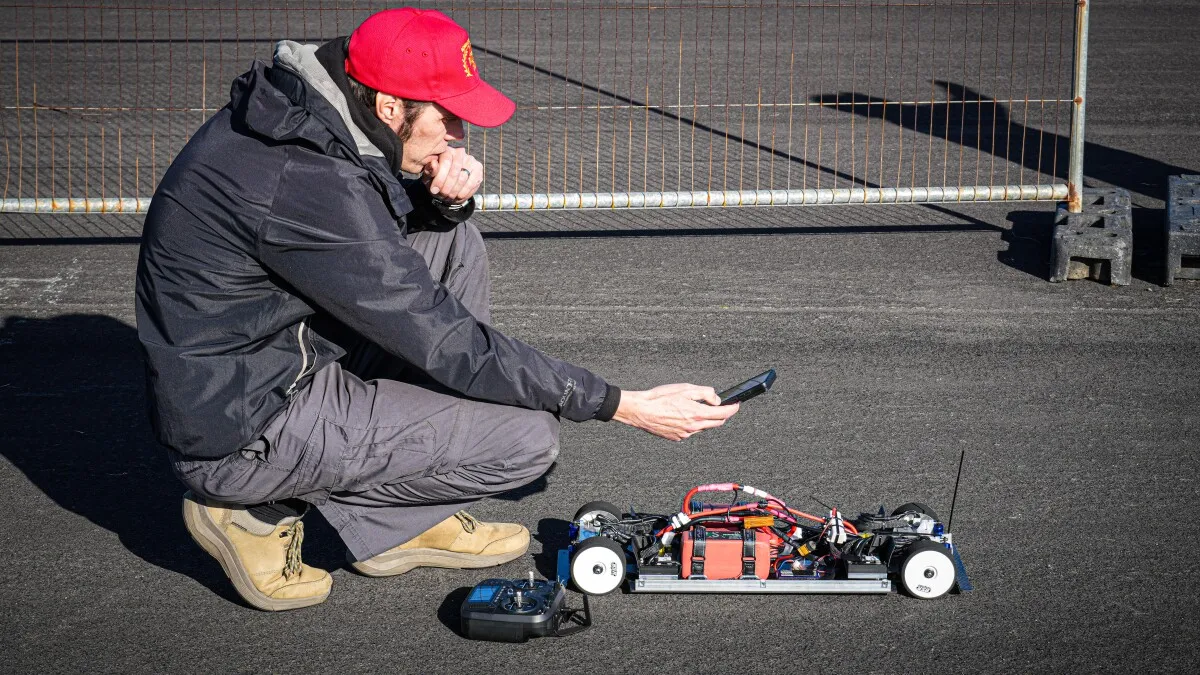
Stephen Wallis had a simple idea: what if you could make a radio-control car faster by making it simpler.
The British engineer spent two decades tinkering with high-performance RC vehicles, but it wasn't until he borrowed thinking from quadcopter drones that everything clicked. Instead of the traditional transmission and steering complexity that other speed-focused builders relied on, Wallis replaced a drone's vertical propellers with horizontal wheels mounted directly on the motor shafts. No gearbox. No mechanical steering. Just motors, wheels, and a flight control system.
The Beast Takes Flight
That flight control system is the clever bit. The same accelerometers and gyroscopes that keep a drone steady in turbulent air now keep Wallis's machine—called "The Beast"—stable at velocities that would normally shake a car apart. The system makes thousands of micro-adjustments to each motor every second, effectively treating the ground like just another medium to navigate.
We're a new kind of news feed.
Regular news is designed to drain you. We're a non-profit built to restore you. Every story we publish is scored for impact, progress, and hope.
Start Your News DetoxFor the record attempt in September 2025, Wallis went all-in on power. He stacked three 6S battery packs in series for a peak of 75.6 volts, then made a counterintuitive choice: he reduced the wheel diameter from 99 to 94 millimeters. At those speeds, the foam tires generate centrifugal forces so extreme they try to tear themselves off. Smaller wheels meant less material fighting physics.
At the Radio Operated Scale Speed Association event in Wales, despite rainy conditions that would have derailed most attempts, The Beast clocked 234.71 mph—a new Guinness World Record. That's not just a new number. It's a statement. Only six RC cars had ever officially broken 200 mph. The previous record sat at 218.53 mph. Wallis didn't just edge past it—he demolished it by 16 mph.
"I wanted to go down on tire diameter to reduce the amount of foam trying to rip itself off the wheel," Wallis said, matter-of-factly describing the kind of engineering problem most people will never face.
He's already planning the next push. With even more powerful motors in the pipeline, he's targeting 250 mph. For someone who's spent two decades in this particular rabbit hole, the finish line keeps moving further away—and that's exactly how he likes it.