The steam boiler has powered global manufacturing for over 200 years. Today, producing steam by burning fossil fuels accounts for more than 5% of global energy-related emissions — roughly 2.2 gigatons of CO2 each year. It's one of those invisible problems hiding in plain sight: nearly every factory, pharmaceutical plant, and paper mill on Earth relies on it, yet almost no one has tried to fundamentally reinvent how it works.
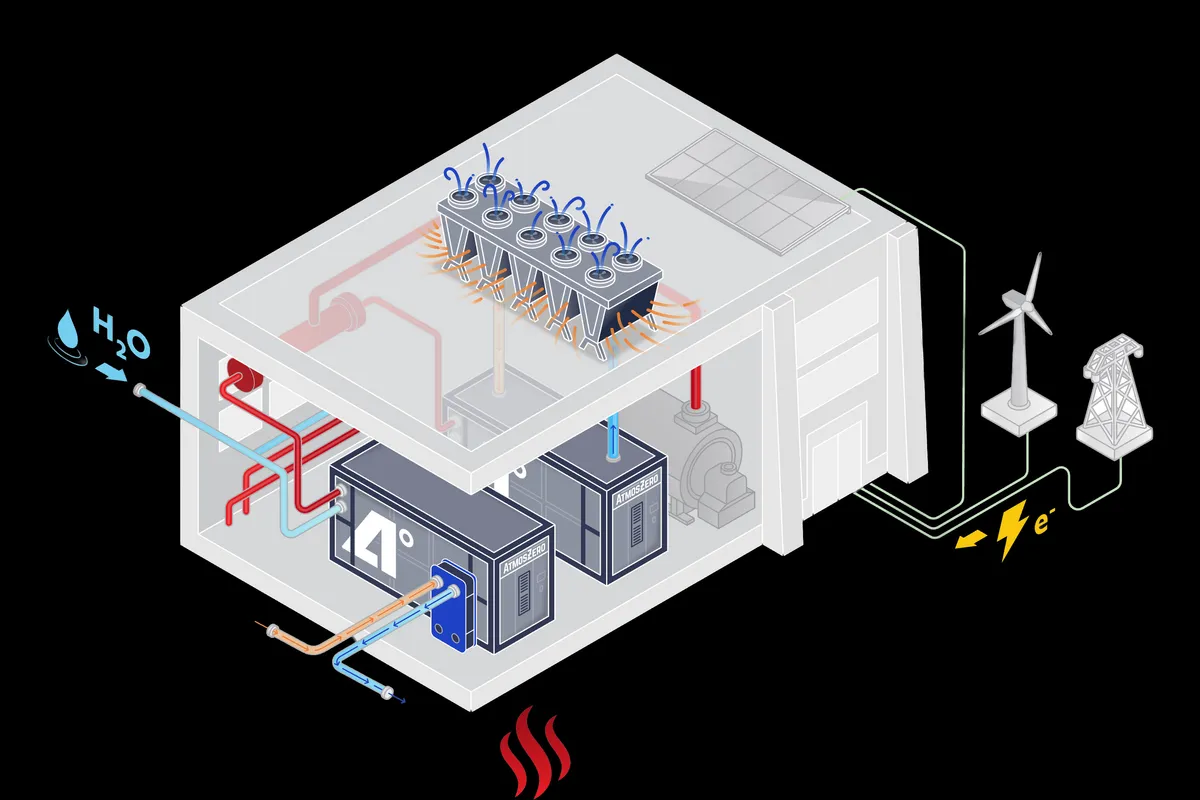
That's changing. AtmosZero, a startup founded by MIT researchers Addison Stark, Todd Bandhauer, and Ashwin Salvi, has built an electric heat pump that can replace traditional combustion boilers as a direct swap. The system delivers industrial steam at temperatures up to 150 degrees Celsius — hot enough for most manufacturing processes — while using 50% less electricity than conventional electric boilers.
The breakthrough lies in the compressor technology. Rather than fighting thermodynamic limits head-on, Stark and his team designed their compressor stages to maximize efficiency within the specific temperature ranges that matter for industrial steam production. "The compressor is the engine of the heat pump," Stark explains. "By designing for optimum efficiency in the operational windows that matter, we're able to maximize each stage of compression."
We're a new kind of news feed.
Regular news is designed to drain you. We're a non-profit built to restore you. Every story we publish is scored for impact, progress, and hope.
Start Your News DetoxWhat makes this genuinely different from other electric boiler attempts is simplicity. Most alternatives require expensive retrofits to capture waste heat from facilities — adding complexity, cost, and installation headaches. AtmosZero's system works with ambient air alone. It draws heat from the surrounding air, uses it to evaporate a refrigerant, compresses that refrigerant through a series of stages, and recovers the heat to boil water. No special infrastructure needed.
"Customers don't want to change how their manufacturing facilities operate in order to electrify," Stark says. "You can't increase complexity on-site." The system can be installed in an afternoon and deployed within days, with zero factory downtime. It also ramps up and down seamlessly, matching the rhythm of existing industrial processes.
Stark didn't set out to start a company. After earning his PhD in mechanical engineering at MIT, he spent years at the Department of Energy's Advanced Research Projects Agency studying industrial heat and electrification. When a 2020 paper he co-authored on decarbonizing industrial heat gained attention, he realized the findings would sit on a shelf unless someone actually built the thing. "The only path to seeing this invention brought out into the world was to found and run the company," he says.
AtmosZero already has a 650-kilowatt pilot system running at a customer facility near its Colorado headquarters. The company is currently proving year-round reliability before scaling production. Their target market is the majority of U.S. manufacturing plants — those using under 10 megawatts of thermal energy at peak demand. The plan is to deliver a handful of units over the next year or two, then ramp to hundreds annually.
Stark points out something crucial: steam isn't going anywhere. Industrial processes designed over the last 160 years are built around it. The question isn't whether to remove steam from manufacturing — it's how to deliver it without carbon. With electric heat pumps finally becoming cost-competitive with combustion boilers, that question suddenly has an answer.