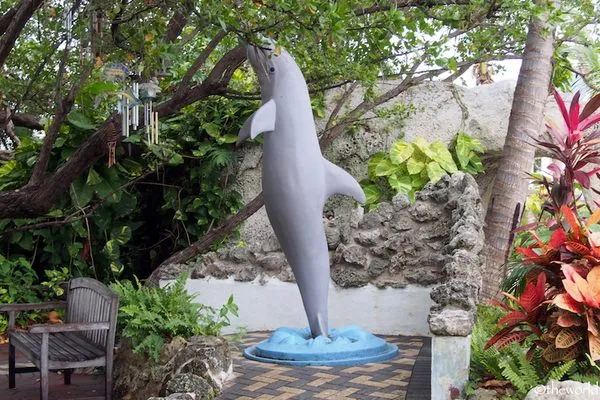
Beneath a life-sized dolphin statue at the Dolphin Research Center in Marathon, Florida, lies Mitzi—the animal who became a household name when she starred as Flipper in the 1960s TV series.
Her grave, marked by a simple plaque reading "The Original Flipper," has become the spiritual center of the facility. Visitors step off the tour bus and walk straight to her memorial, a pilgrimage that happens dozens of times a day. There's a bench there, weathered by sun and salt spray, where people sit in quiet reflection.
But what makes this spot matter isn't the statue or the plaque. It's what's alive around it.
We're a new kind of news feed.
Regular news is designed to drain you. We're a non-profit built to restore you. Every story we publish is scored for impact, progress, and hope.
Start Your News DetoxWhen Mitzi was performing on screen, most people had never seen a dolphin up close. The series was a revelation—suddenly these creatures weren't abstract; they were intelligent, playful, capable of connection. The show sparked something in the collective consciousness. Aquariums became destinations. Marine biology became a career path kids actually dreamed about. Conservation movements found their mascot.
The Dolphin Research Center itself exists because of that momentum. Founded in 1984, it became a place where the descendants of Mitzi's co-stars now live in a thriving sanctuary. Researchers study dolphin behavior, cognition, and welfare. Visitors come not just to see animals perform, but to understand them. The facility has evolved into something Mitzi's handlers in the 1960s couldn't have imagined—a place where the line between entertainment and genuine scientific work has blurred into something more honest.
That transformation matters. One animal's moment in the spotlight didn't just create nostalgia; it created infrastructure. It shaped how an entire generation thought about marine life. The bench by her grave isn't just a place to rest. It's a marker of a specific cultural shift—the moment when dolphins stopped being props and became beings worth protecting.
For anyone visiting in 2026 or beyond, Mitzi's grave tells a story that goes deeper than celebrity. It's a reminder that sometimes the most lasting impact comes not from what we accomplish in the spotlight, but from what we inspire others to do after the cameras stop rolling.