Tony Hawk retired from professional skateboarding with a question: what if the sport that gave him freedom could do the same for kids growing up in conflict zones and poverty.
Through his nonprofit, The Skatepark Project, Hawk has funded nearly 700 public skateparks across the US since 2002—$13 million worth of concrete and rails. But his real ambition was never just to build more parks. It was to show young people that they could build them themselves.
"We're not just helping to build skateparks," Hawk said in a video for the organization. "We're also working to build community in entirely new ways." The nonprofit now runs fellowships and advocacy training programs that prepare diverse skate advocates to create spaces in their own neighborhoods. That model has traveled—to Afghanistan, Cambodia, South Africa, and far beyond.
We're a new kind of news feed.
Regular news is designed to drain you. We're a non-profit built to restore you. Every story we publish is scored for impact, progress, and hope.
Start Your News DetoxWhen a Board Becomes Freedom
In Gaza, a nonprofit called SkatePal has spent 11 years doing something quietly radical: offering free skateboarding lessons and community to young people living under occupation. They've built four skateparks, run summer camps, and created programs specifically for girls to join the sport.
Malak, a volunteer in Ramallah, puts it simply: "Skateboarding is not for a specific type of person. Skateboarding is for everyone, no matter what religion, color, or place."
Mahmoud Kilani, 23, founded skateboarding.ps in Gaza. He describes the board as escape—not from the place itself, but from the weight of it. "It's the feeling of freedom," he told DAZED Magazine, "having this board under your feet that you can do whatever you want with. Because we don't have freedom here. We are surrounded by walls." In recent months, as the crisis deepened, SkatePal shifted much of its resources toward basic survival—gathering food, medical supplies, and gear for partner organizations and the skaters themselves.
A Teenager's Vision in Uganda
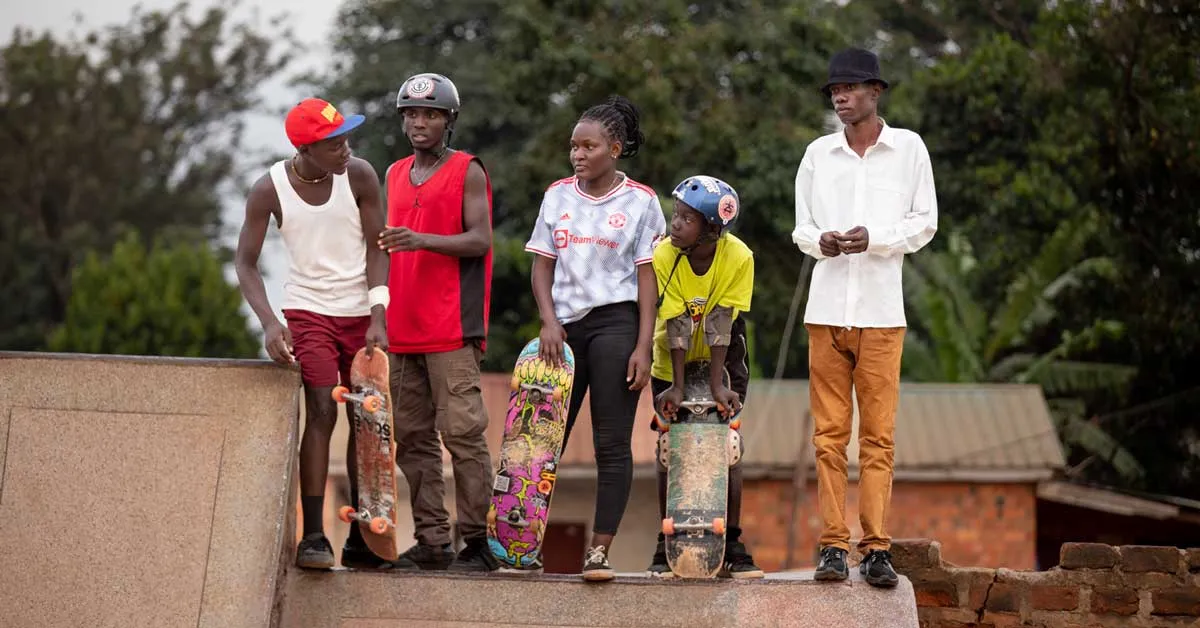
In Mukono, Uganda, a teenager founded the Uganda Skateboard Society with a similar conviction: that a skateboard could be a gateway to safety, community, and possibility. The organization builds parks in impoverished neighborhoods and offers free lessons and equipment to hundreds of young people.
What moves Gerald Gose, the organization's co-founder and now head coach of Uganda's Olympic skateboarding team, isn't just the skating itself. It's what happens around it. When one skater couldn't afford school fees, the community raised the money. The skatepark became a reason to stay out of criminal activity, to invest in something that was theirs.
"When I leave here, I hope to be able to look around and say we have done a good job and made a good foundation for the future," Gose said. "I believe Ugandan skateboarders have the potential, and we have set goals for what we intend to achieve."
What ties these stories together—from Gaza to Uganda to skateparks across America—is a recognition that young people don't need charity. They need a space to belong, a tool to express themselves, and the belief that they can build something for others. A skateboard, it turns out, can be all three.