
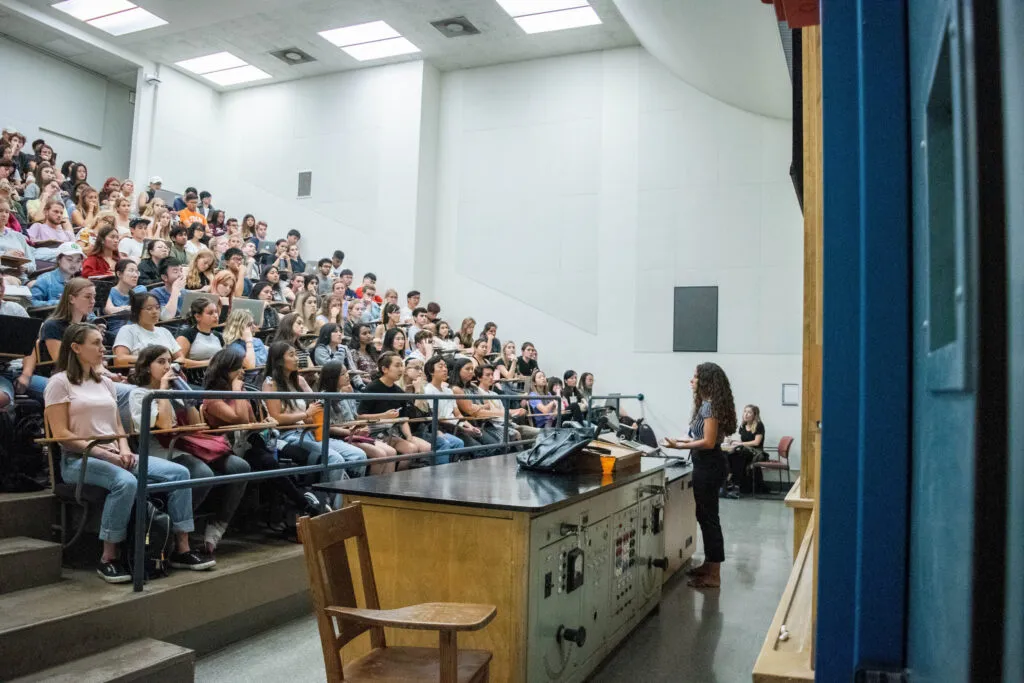
This fall, UC Berkeley students are starting new classes designed to help them understand a changing world. Some courses look into the past, like 14th-century Chinese horror stories. Others focus on the future, exploring Octavia Butler's work or programming robots.
Students will learn to pitch startup ideas, discuss Nobel Prize-winning economics, and tackle ethical questions. Here are some of the new courses available to students.
Afrofuturism in Music
Afrofuturism combines the Black American experience with ideas about future or alternate realities. Composer Matthew Taylor teaches this music class. Students will listen to and analyze songs from artists like Janelle Monáe, OutKast, and Prince.
We're a new kind of news feed.
Regular news is designed to drain you. We're a non-profit built to restore you. Every story we publish is scored for impact, progress, and hope.
Start Your News DetoxThe class will look at visions of the future from the Great Depression, like Skip James’ “Hard Time Killing Floor Blues.” It also covers recent Afrofuturism, such as the Black Panther soundtrack by Kendrick Lamar. Jimi Hendrix’s Woodstock performance and interviews with science fiction writer Octavia Butler will also be discussed.
Modern Applications of Plant Biotechnology
This Plant and Microbial Biology course covers 10,000 years of plant science. Professors Becky Bart and Patrick Shih will teach students about early crop domestication in Southwest Asia. By December, they will reach modern agricultural technology.
Students will learn how scientists create disease-resistant crops. They will hear from local biotech startup founders and discuss the ethics of these technologies. For a final project, students will pitch a product or company using plant biology.
Preparing for Community Engaged Research
Geography lecturer Chase Hobbs-Morgan explains that academic research can support wider communities. His class teaches students how to do community-engaged research. This means working with communities, not just studying them.
Students will leave the classroom to explore the Bay Area. They will attend public events hosted by local organizations and reflect on them. A walking tour of Alcatraz is a possible field trip. This would accompany a module on Native American activism and the Indigenous occupation of the island from 1969 to 1971.
The East Asian Ghost Story
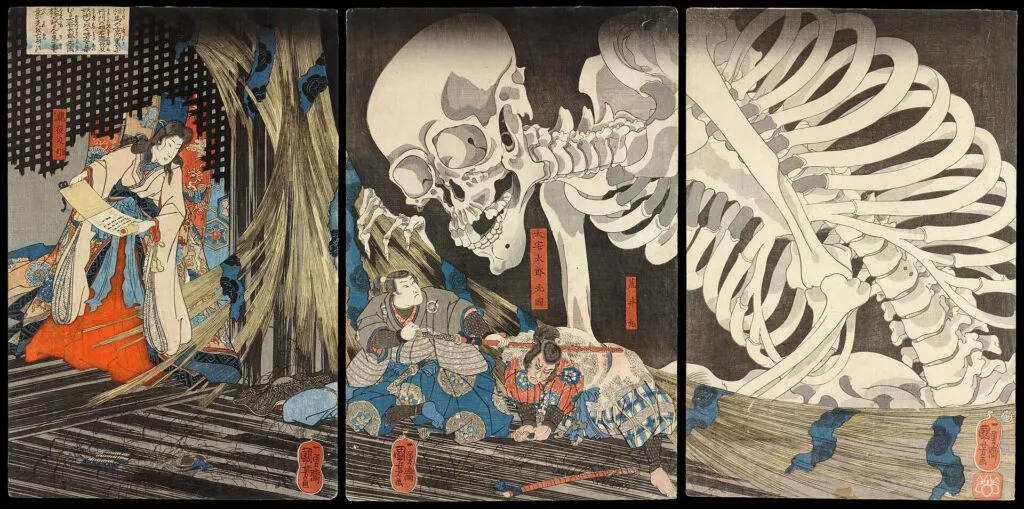
Kevin Shadel’s class is for those who enjoy spooky tales. It explores the "strange tale" or chuánqí literary genre, which began in 14th-century China. The class traces how these stories developed into modern horror.
Students will read old tales from China, Korea, and Japan. They will encounter creatures like rokurokubi, humanoids with detachable or long, stretchy necks, and shapeshifting serpent women. Students will record reflections on readings as podcasts. Their final project will be an original ghost story.
This course counts towards the new Korean language and culture major and other East Asian Languages and Cultures majors.
Climate-Positive Ventures: Turning Environmental Challenges into Market Opportunities
This College of Engineering class is project-based. Students from various majors will act as startup founders. They will work in teams to create a business idea that addresses an environmental problem. Bay Area climate entrepreneur Nathan Sedlander will coach the groups.
Coursework includes conducting interviews to find opportunities, checking ideas, and building a prototype. Teams will pitch their ideas to instructors and industry experts. The winning team will advance to the Collider Cup, the Sutardja Center for Entrepreneurship and Technology’s version of Shark Tank. Students will also act as venture capitalists, evaluating peer business proposals.
Us and Them: The Psychology of Prejudice Through Fiction and Science
This psychology course uses both fiction and science to understand prejudice. Each week, students will watch a film or TV episode, like Get Out or an episode of Black Mirror. They will also read fiction by authors such as Ursula K. Le Guin and Flannery O’Connor, which depicts prejudice.
At the same time, students will review academic studies in social and personality psychology. This helps them understand what science reveals about prejudice and what it cannot fully explain. Professor Rodolfo Mendoza-Denton notes that the goal is to use both heart and head to understand the human condition.
Data and the Body
This seminar, taught by new faculty member Kate Metcalf, is fully waitlisted. It is relevant to anyone who uses wearable tech like an Oura ring or Fitbit. The class will examine the history and impact of body data. This includes how early medicine and epidemiology shaped modern information practices. It also covers how data and psychology have been used to create consumer profiles and influence behavior.
As a graduate-level course in the School of Information, it helps students discuss complex academic texts. It provides full context for modern uses, such as consumer genetics, facial recognition, and self-optimization.
Probabilistic and Learning-Based Navigation for Physical AI
This Electrical Engineering and Computer Sciences course explores how driverless cars and robots know their location. It covers complex AI calculations that answer this question.
Students will learn to combine data from camera feeds with other sensors, like accelerometers. They will also tackle how robots navigate unknown spaces while building a map of them. Three hours of lab time each week allow students to test their programming on real and simulated robots. Instructor Giuseppe Loianno leads the Agile Robotics and Perception Lab, which focuses on this fast-growing field.
The Economics of Gender and Discrimination
Gendered wage and employment gaps are well-known. Nina Buchmann’s economics course examines the factors contributing to the 85 cents to a dollar statistic. These factors include behavior, gender norms, household responsibilities, and employer discrimination. The graduate-level course syllabus includes papers by Harvard economist Claudia Goldin, who won a Nobel Prize in 2023 for her work on this topic.
Other readings cover gender differences in being asked to do unwanted, low-reward tasks. They also explore how property-division divorce laws affect women’s employment. The material spans the globe, looking at attitudes about women’s employment in Saudi Arabia. It also examines how cash transfers have reduced intimate partner violence in Kenya and Ecuador.