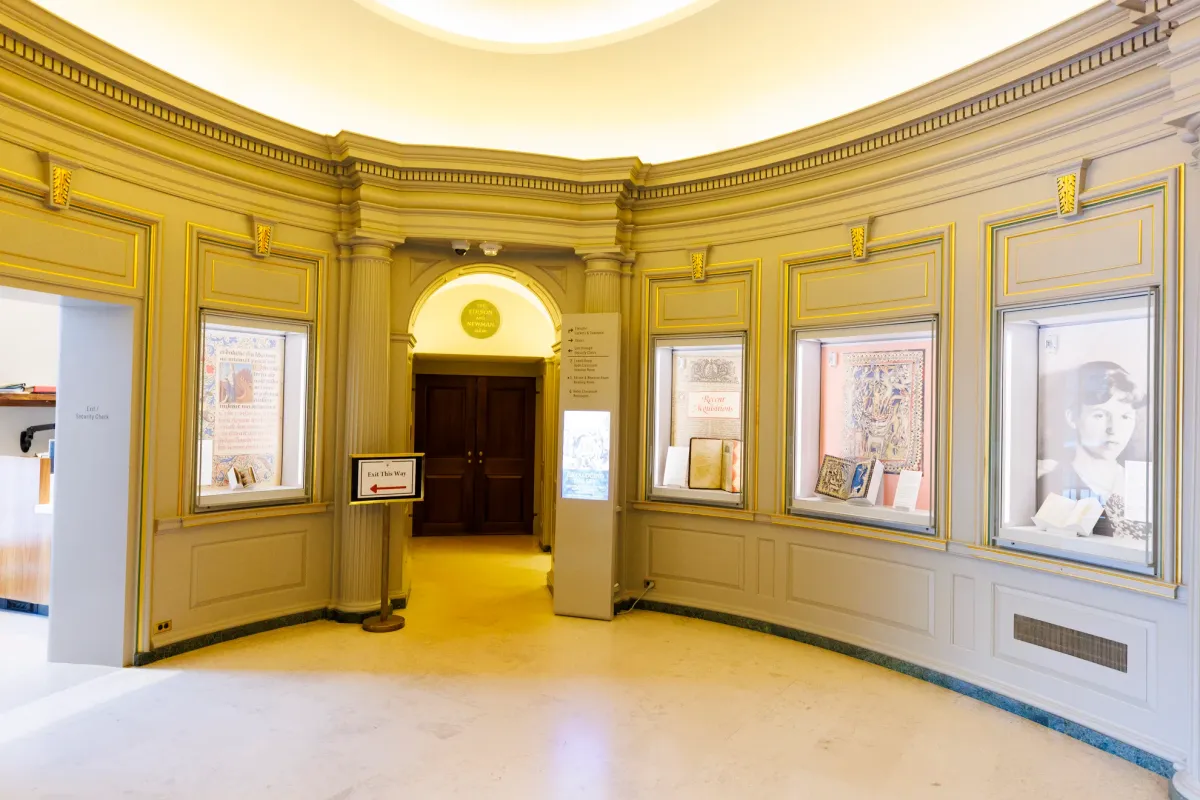
Harvard's Houghton Library quietly holds over half a million books, manuscripts, and documents — the kind of place where you could spend a lifetime and still find something you've never seen. This spring, the library's curators decided to pull ten of their most recent acquisitions out of the vault and display them together in their lobby, creating an unexpected collision of moments across time.
The collection reads like a scavenger hunt through human experience. There's a 15th-century prayerbook created for a middle-class French woman, its pages filled with prayers about pregnancy and motherhood, margins recording the births and marriages of the Bernachier family across generations. It's intimate in a way that most historical documents aren't — you're looking at someone's actual spiritual life, annotated with the milestones that mattered to her.
Sylvia Plath's personal copy of Thomas Hardy's "Far from the Madding Crowd" sits nearby, likely read in 1957 or 1958 while she was teaching at Smith College. Her handwritten notes in the margins reveal how closely she engaged with the text, including a line about "misery for women always" in the act of loving. It's the kind of artifact that makes you realize how much of a writer's thinking happens in the margins before it reaches the page.
We're a new kind of news feed.
Regular news is designed to drain you. We're a non-profit built to restore you. Every story we publish is scored for impact, progress, and hope.
Start Your News DetoxObjects as windows
Other pieces open entirely different worlds. An 1743 Georgian translation of the Bible and the Apocrypha — one of the few complete copies to survive Russia's 19th-century annexation of the region — speaks to how language and survival are tangled together. An English edition of Mexican novelist Gregorio López y Fuentes' "El Indio," illustrated by muralist Diego Rivera, captures violence and resistance through bold, simple drawings.
The exhibition includes records from early 20th-century Kabuki tours of the United States, complete with illustrated programs and English captions — evidence of how a highly stylized Japanese theater form was translated (and sometimes mistranslated) for Western audiences. There are letters from Kōzō Uenishi, a Japanese American community leader arrested by the FBI during World War II and held in separate prison camps away from his family, documenting an experience that American textbooks often gloss over.
A striking chromolithograph poster features Esther Louise Georgette Deer, a performer of Kanien'kehá:ka (Mohawk) descent who became famous in 19th-century Wild West shows. The poster itself is a document of that fame — but Deer's later life tells the more important story. She rejected the romanticized depictions of Native people that made her famous and used her platform to advocate for civil rights instead.
What makes this collection work isn't that each piece is rare (though many are). It's that together they suggest something about how history actually happens — not in grand narratives, but in the margins of books, in family records kept in prayerbooks, in letters written from prison camps, in the moment a performer decides to tell a different story about themselves.