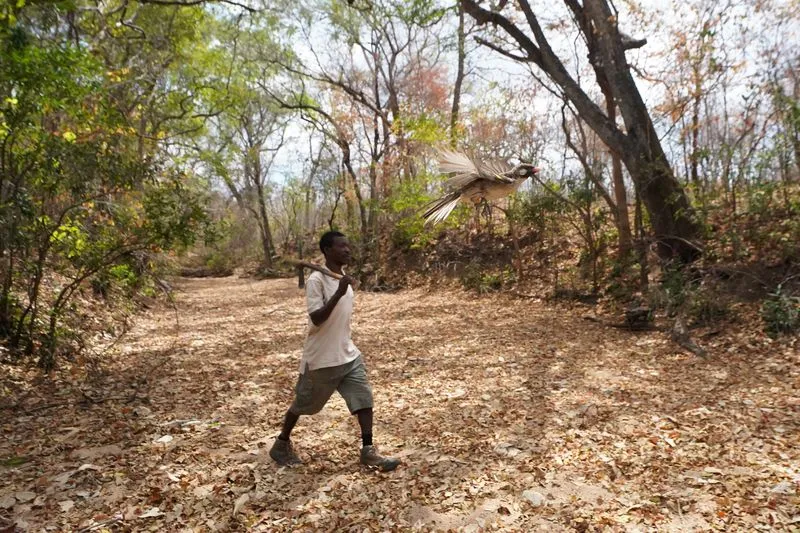
In the Niassa Special Reserve in northern Mozambique, something remarkable happens every time a honey-hunter steps into the bush: a small brown bird recognizes their voice and decides whether to help.
For centuries, greater honeyguides and local people have worked as partners. The birds, barely larger than a sparrow, spot wild bee nests from the air—a view humans can't manage from the ground. They lead the hunters to the hives. The hunters use tools to crack open the nest, harvest the honey, and leave behind the wax and larvae, which is what the birds actually want. It's a trade that works.
But here's what researchers recently discovered: these birds don't just respond to any human call. They've learned the specific dialects of their region.
We're a new kind of news feed.
Regular news is designed to drain you. We're a non-profit built to restore you. Every story we publish is scored for impact, progress, and hope.
Start Your News DetoxScientists analyzed recordings from 131 honey-hunters across 13 villages in the 42,000-square-kilometer reserve. The hunters use three distinct calls—combinations of shrill whoops, low trills, grunts, and whistles. Two calls function as invitations, grabbing the birds' attention. A third keeps them engaged once the hunt is underway. The calls vary noticeably between villages, and the further apart two villages are, the more different their calls become. It mirrors how human languages drift across geography.
What's striking is that when a honey-hunter moves to a new village, they learn the local calls. They adapt. And so do the birds—they recognize the new dialect and continue the partnership.
"If a certain village is using a different call, it probably means that's the call to get the honeyguides' attention in that area," explains Jessica van der Wal, the behavioral ecologist who led the study.
This isn't just a curiosity about bird intelligence. It reveals something deeper: the honeyguides have maintained their ability to learn and respond to human variation across an entire region. In a landscape where so many wild partnerships have collapsed, this one persists. The birds haven't abandoned their human partners even as those partners' voices shift and change. They've kept up.
The Niassa reserve is one of the last places on Earth where this ancient cooperation still thrives at scale. As honey-hunting practices and land use continue to evolve, understanding how flexible these birds are—how willing they are to learn—might be what keeps the partnership alive.