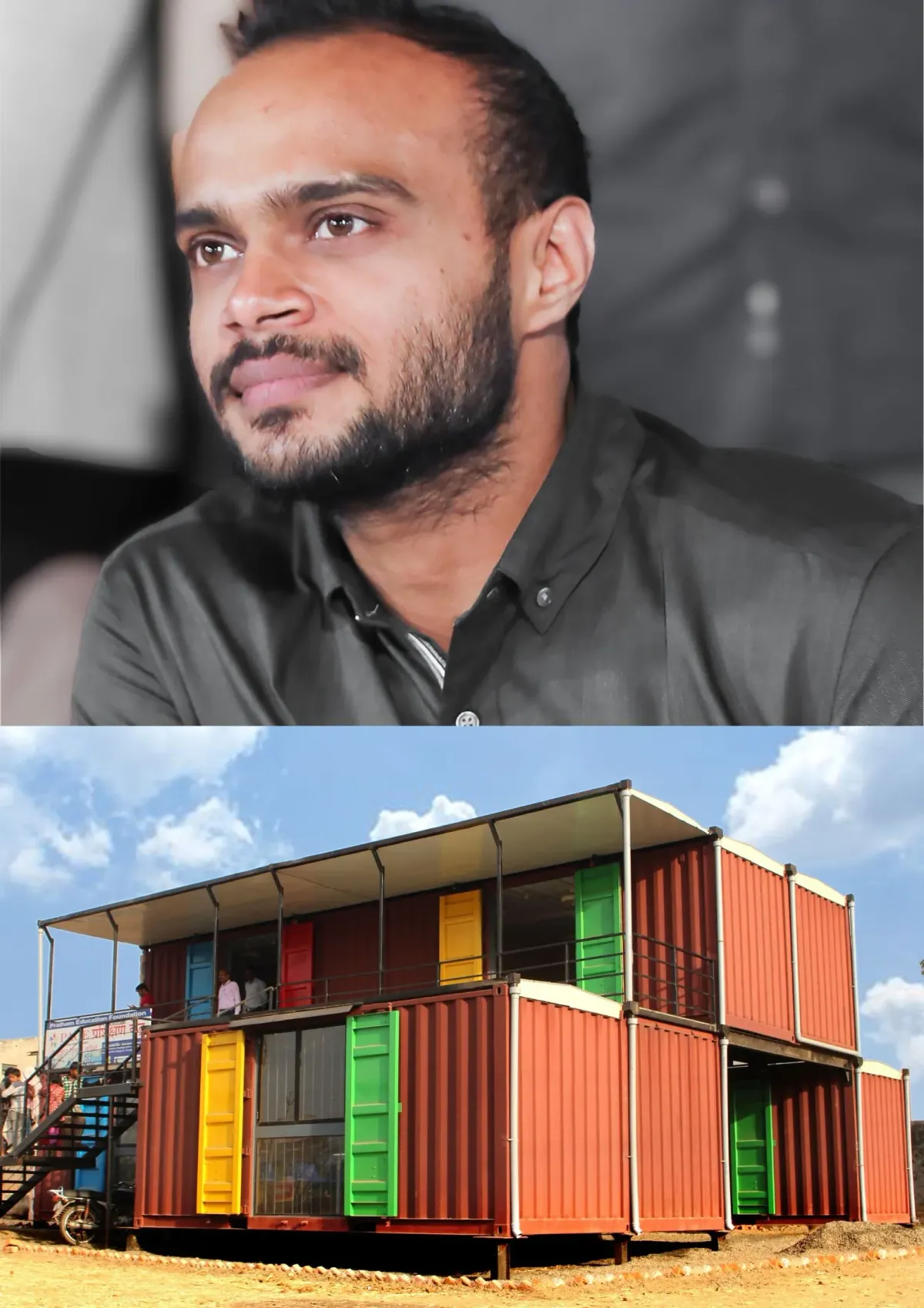
Akash Dudhe had a straightforward insight: shipping containers are already engineered to move across oceans. Why not move them across cities to become classrooms and cafes.
Since 2014, his Mumbai firm SAGI Architects has been testing this premise on real projects. The most visible proof sits in Aurangabad, where a vocational learning centre built from stacked containers now hosts skill-training workshops for Pratham, an NGO focused on educational equity across India. In Khopoli, Maharashtra, a restaurant rises as a 40-foot A-frame made entirely from containers — a structure that looks nothing like the industrial boxes it's built from.
The appeal is practical. Unlike traditional construction, a container building can be disassembled and relocated if circumstances change. Schools can move closer to students. Pop-up cafes can test new neighbourhoods. This flexibility matters in a country where land use and community needs shift faster than permanent buildings can adapt.
We're a new kind of news feed.
Regular news is designed to drain you. We're a non-profit built to restore you. Every story we publish is scored for impact, progress, and hope.
Start Your News DetoxMaking Containers Liveable
The hard part isn't sourcing the material — Dudhe pulls containers from Mumbai's Nhava Sheva Port, India's largest container terminal, where thousands arrive empty after unloading cargo. The engineering challenge is making them habitable.
Metal conducts heat aggressively. A container in the Indian sun becomes an oven without intervention. Dudhe's solution involves two layers of insulation: rockwool (a matted fibre made from rock) wrapped in an MS steel framework, then finished with gypsum sheets on the interior. The roof requires the same treatment, plus meticulous sealing to prevent water seepage during monsoons. It's not revolutionary, but it's methodical — the kind of detail work that separates a functioning space from a failed experiment.
Gaining regulatory acceptance took time. Municipal authorities weren't accustomed to approving container buildings. But Dudhe found that once inspectors saw the finished structures — functional, durable, built to code — resistance softened. The material's longevity helps. Shipping containers are designed to withstand years of salt air and rough handling at sea. A properly insulated container building doesn't age like temporary architecture. It ages like infrastructure.
What started as an unconventional material choice has become a repeatable system. Schools that need to expand can add containers. Communities without permanent building budgets can access educational space. The containers themselves — which would otherwise rust in ports or landfills — get a second life with genuine utility.
Dudhe's work suggests a broader pattern: sometimes progress isn't about inventing new materials. It's about redirecting materials already in circulation toward problems they can actually solve.