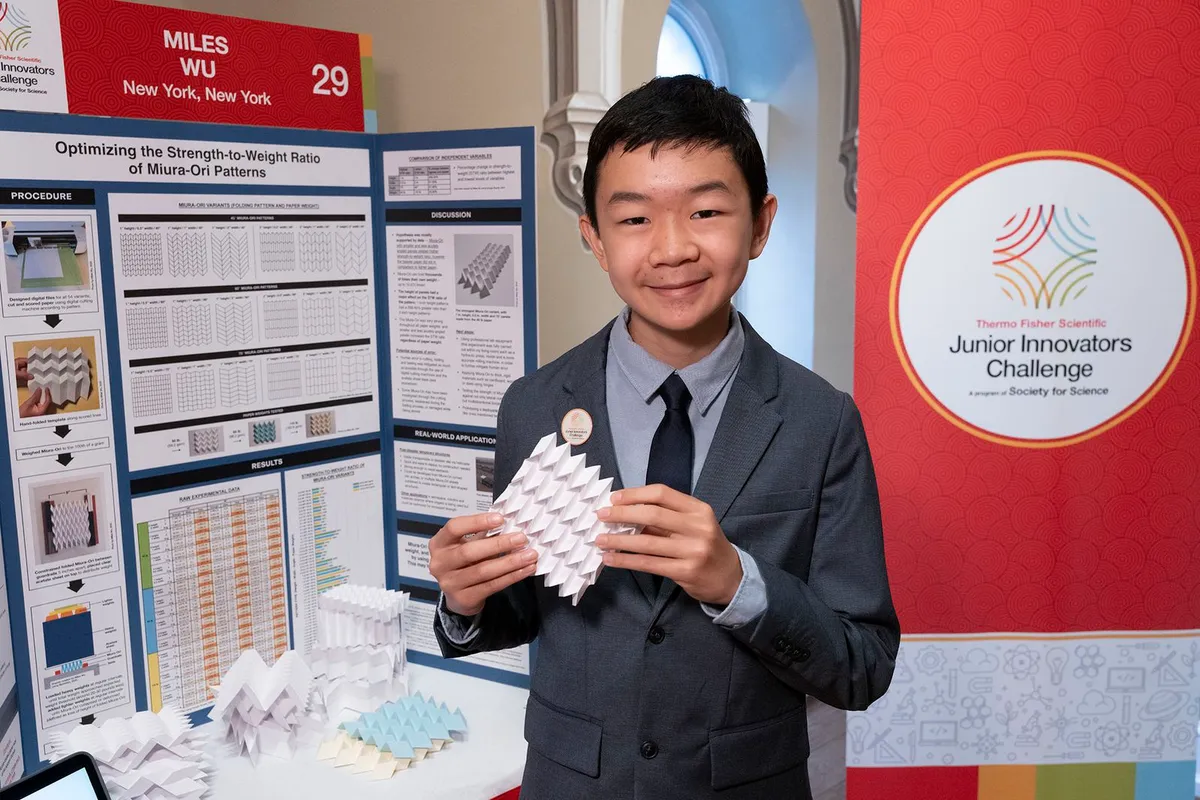
Miles Wu was sitting in his New York City living room when a piece of folded paper stopped him cold. A simple sheet, creased into a Miura-ori pattern—a geometric design of interlocking parallelograms—could somehow support 10,000 times its own weight. To put that in perspective: if a New York taxi cab could do the same, it would hold up 4,000 elephants.
But Wu wasn't just playing with paper tricks. He was working on a problem that matters when hurricanes hit or wildfires spread: how to build emergency shelters that are strong, cheap, and fast to set up all at once. At 14, a ninth-grader at Hunter College High School, he'd already spent 250 hours designing, folding, and testing variations of the Miura-ori pattern to see if it could work.
The Problem in Three Parts
Wu noticed something practical while researching the pattern—named after Japanese astrophysicist Koryo Miura, who invented it decades ago. Existing emergency shelters always seemed to sacrifice something. They could be sturdy but expensive. Cheap but flimsy. Easy to deploy but fragile. "During emergencies, you need all three," Wu explains. "You need to produce them quickly, set them up easily, and have them actually withstand what nature throws at them."
We're a new kind of news feed.
Regular news is designed to drain you. We're a non-profit built to restore you. Every story we publish is scored for impact, progress, and hope.
Start Your News DetoxHe'd been interested in origami since childhood, but about six years ago he started wondering whether the ancient Japanese art could solve modern engineering problems. Then Hurricane Helene hit Florida and wildfires raged in California. The timing crystallized his thinking: what if these collapsible, geometric patterns could become tents?
To test the idea, Wu created 54 different Miura-ori variations on a computer, adjusting the height, width, and angles of the parallelograms. He then folded two versions of each design from three types of paper—copy paper, light cardstock, and heavy cardstock. That meant 108 separate tests. For each one, he placed the folded pattern between guardrails and stacked weights on top until it broke.
The best performers held their ground at ratios that surprised even him. "I was really shocked by how much weight these simple pieces of paper could hold," Wu says.
The work caught the attention of judges at the 2025 Thermo Fisher Scientific Junior Innovators Challenge, a national STEM competition for middle school students. Wu won the top prize: $25,000. Glaucio Paulino, an engineer at Princeton University, noted that Wu's approach—tuning the fold angle and cell size to maximize strength-to-weight ratio—demonstrates something engineers have long known matters: geometry itself can be a structural tool.
"His results show that by adjusting those variables, you can meaningfully increase the properties that make deployable systems practical," Paulino says.
Wu is clear that this is just the beginning. His next phase involves building an actual prototype shelter and testing how the Miura-ori holds up against forces coming from multiple directions—not just downward weight. The geometric patterns that worked in his living room tests will need to prove themselves in the real world, where wind and uneven ground create more complex stresses than stacked books.
That's the work ahead. But he's already shown something worth noting: sometimes the most practical solutions come from looking at old techniques with fresh eyes, and sometimes they come from someone young enough to ask questions that experts stopped asking long ago.