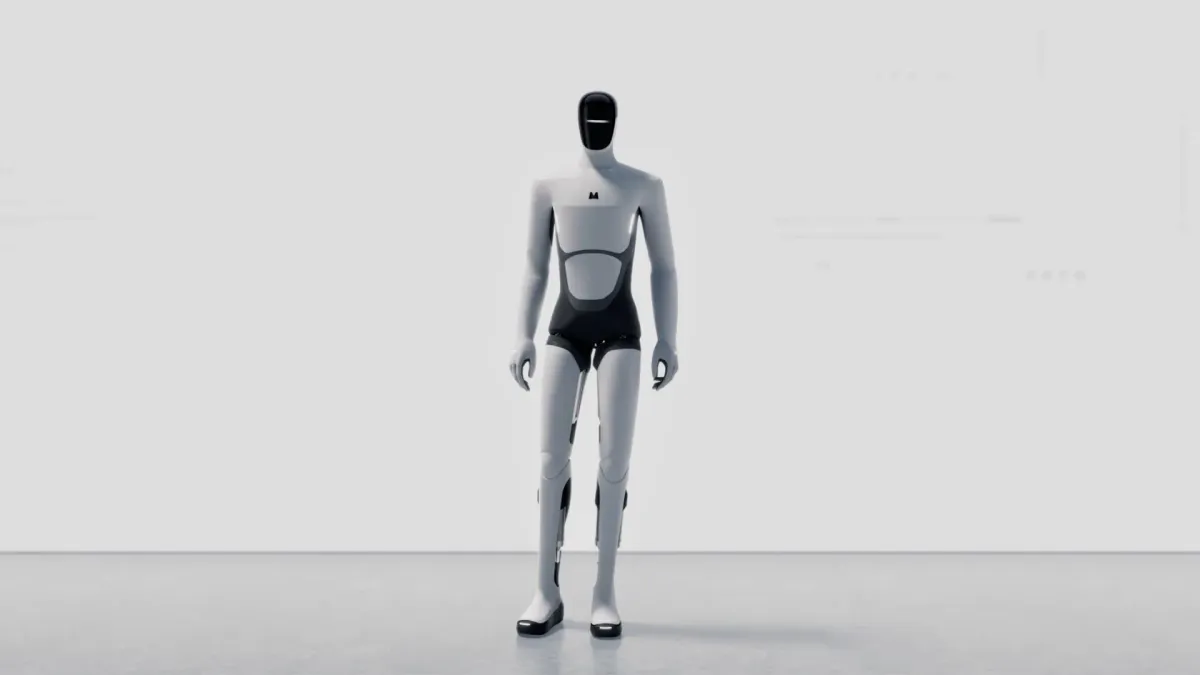
Matrix Robotics has unveiled MATRIX-3, a humanoid robot that represents a meaningful shift in how machines interact with the physical world. Unlike earlier generations built for rigid, repetitive industrial tasks, this third-generation platform is designed to adapt in real time—understanding new instructions, adjusting its grip on fragile objects, and navigating unpredictable environments without being explicitly programmed for each scenario.
The breakthrough sits in three interconnected systems. First, the robot's "skin" isn't just protective—it's sensory. A three-dimensional woven fabric wraps the chassis while embedding a distributed network of touch sensors beneath the surface. The fingertips carry high-sensitivity tactile arrays that can detect pressure as light as 0.1 newtons (roughly the weight of a grain of rice). Combined with an upgraded vision system, this creates a visual-tactile feedback loop that lets the robot assess material properties and grip stability in real time. In practical terms: it can handle a raw egg without crushing it, manipulate fabric without tearing it, and know when it's about to drop something before it does.
Movement comes from a 27-degree-of-freedom dexterous hand that mirrors human anatomy more closely than previous designs. The hand uses lightweight, cable-driven actuation to move quickly and precisely—fast enough to use standard tools, delicate enough to operate surgical instruments. The robot's full-body mobility is generated by a general motion control model trained on extensive human motion-capture datasets, producing a gait that looks and moves more naturally than the mechanical walking patterns of earlier humanoids.
We're a new kind of news feed.
Regular news is designed to drain you. We're a non-profit built to restore you. Every story we publish is scored for impact, progress, and hope.
Start Your News DetoxUnder the surface is a cognitive core that enables what researchers call "zero-shot learning." Rather than requiring thousands of labeled examples to learn a new task, MATRIX-3 can understand basic physical principles and execute new instructions from natural language without task-specific training. The robot autonomously plans how to grasp objects, adjusts grip force in real time, and coordinates hand and eye movement to navigate obstacles.
It's worth noting that these capabilities remain demonstrated in video footage, and independent verification of real-world performance is still pending. The speed and sensitivity shown in controlled demonstrations would indeed represent a genuine breakthrough if replicated reliably outside the lab.
Matrix Robotics has announced an early access program for selected industry partners, with pilot deployments scheduled to begin in mid-2026. The company positions MATRIX-3 for commercial, medical, and home environments—a significant expansion from the factory floors where most humanoid robots currently operate.