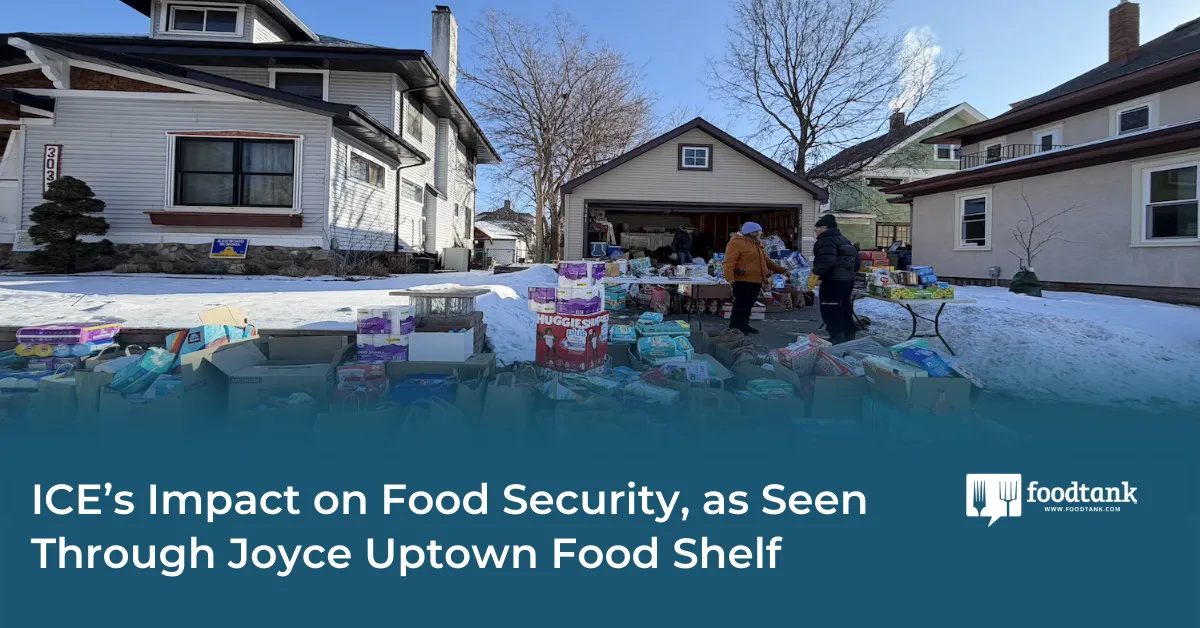
When ICE operations intensified in Minneapolis last winter, families stopped coming to Joyce Uptown Food Shelf. The Ecuadorian families who'd been regular visitors for two years simply disappeared from the neighborhood, frightened enough to skip meals rather than risk being seen outside.
Matthew Ayres, the food shelf's executive director, watched his client numbers drop months before Operation Metro Surge officially launched in December. By February, the organization was running at 130 percent capacity—120,000 pounds of food moving out the door—but something had shifted. "We started getting money and attention and volunteers and donations," Ayres told Food Tank. "Everything changed for us, but not for the people that were getting food."
Located within two miles of where federal agents killed two Minneapolis residents during the operation, Joyce Uptown became a focal point for donations and national attention. But the crisis revealed a fundamental problem: a food shelf is only useful if people feel safe walking through its doors.
We're a new kind of news feed.
Regular news is designed to drain you. We're a non-profit built to restore you. Every story we publish is scored for impact, progress, and hope.
Start Your News DetoxMeeting People Where Fear Lives
So the organization rebuilt itself from the ground up. Instead of waiting for clients to shop, they started filling emergency bags with essentials—apples, potatoes, eggs, chicken, rice, beans, pasta, milk, canned goods—and bringing the food to families unable or unwilling to leave home. Teachers now pick up bags for their students. Volunteers deliver directly to households. The food shelf itself was redesigned to move people through in one to two minutes instead of five to eight, making it less attractive as a staging ground for federal agents.
This wasn't a minor tweak. Joyce's volunteer coordinator built an entire delivery system that didn't exist before the crisis. The partnership with local schools became the backbone of a new model—one that acknowledged the real constraint wasn't food supply but human safety.
Even after Operation Metro Surge officially ended, families haven't fully returned. "Classroom chairs are still empty, and people are still pretty reluctant to get out," Ayres says. The deliveries and school pickups remain steady or growing, suggesting that fear persists even when the immediate threat recedes.
What's notable here is how quickly mutual aid organizations professionalized their response. Within weeks, dozens of groups moved from emergency scrambling into sustainable systems. They found their lanes—Joyce handles bulk staples, schools focus on produce—and built infrastructure that could outlast the crisis itself.
For food pantries elsewhere facing similar pressures in coming months, Ayres's advice is practical: connect deeply with schools, listen to mutual aid groups already working in the community, and define clear roles so resources don't scatter. The lesson isn't just about food distribution. It's about recognizing when the barrier to help isn't supply but access—and being willing to completely reimagine how you operate.
The food shelf that was once a place where neighbors shopped together has become something else: a delivery network, a school partner, a lifeline that comes to you. Whether that transformation persists depends on whether the fear that demanded it does.