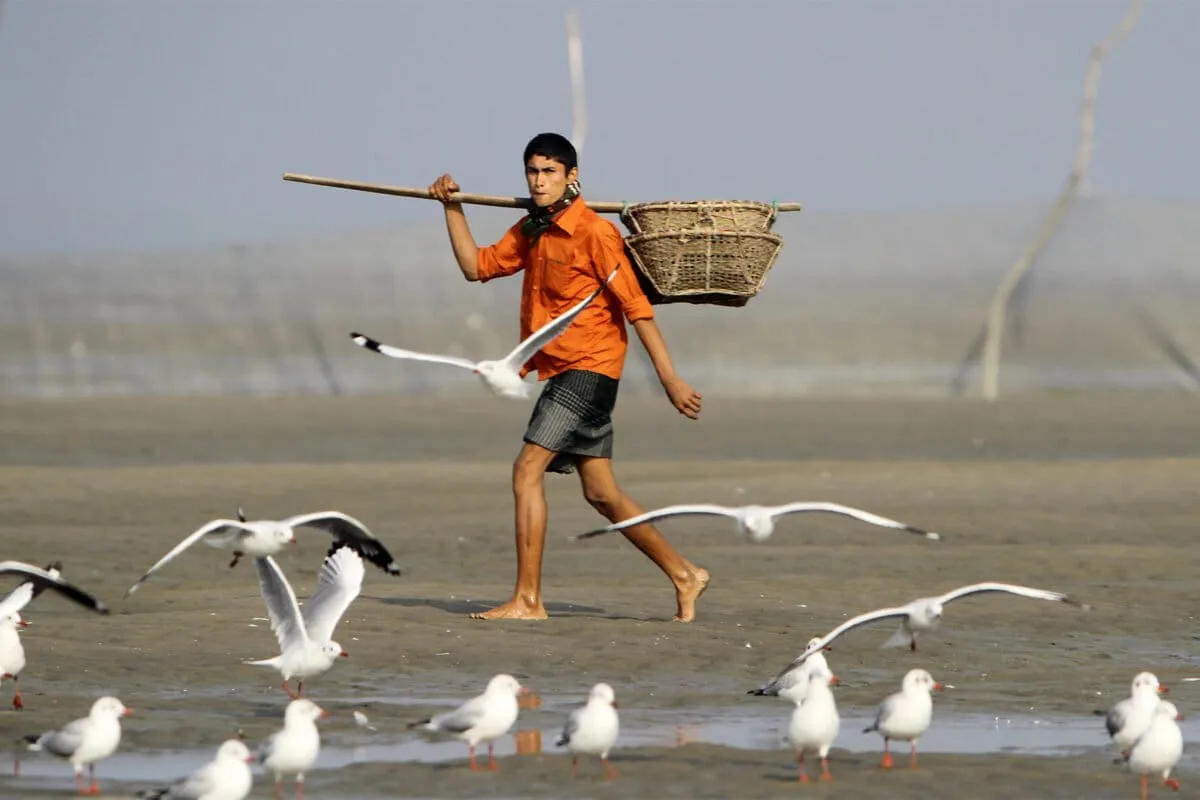
Every winter, millions of birds undertake one of nature's most demanding journeys: flying thousands of kilometers from Siberia and Central Asia down through South Asia toward warmer grounds. They follow two ancient routes — the Central Asian Flyway and the East Asian-Australasian Flyway — stopping along the way at wetlands, river deltas and coastal mangroves to rest and refuel. Except those stopover sites are disappearing.
Researchers across Bangladesh, Nepal, Pakistan, India, the Maldives, Bhutan and Sri Lanka have documented a consistent pattern: wetlands are being converted to farmland, rivers are being polluted, coastal mangroves are shrinking, and fishing practices are disrupting the food chains these birds depend on. The result is a chain of intact ecosystems that's breaking link by link.
The birds that need shallow water
When ornithologist Sayam U. Chowdhury at Cambridge's Conservation Research Institute talks about migratory waterbirds, he's not talking about birds that hunt fish. Most of the species making this epic journey — ducks, geese, shorebirds — are looking for something else entirely: shallow wetlands and mudflats where they can find aquatic vegetation, seeds and invertebrates. They need specific habitats, and they need them to be intact.
We're a new kind of news feed.
Regular news is designed to drain you. We're a non-profit built to restore you. Every story we publish is scored for impact, progress, and hope.
Start Your News Detox"When waterbodies are drained, polluted or heavily altered, it destroys the habitats and food resources these birds depend on during their non-breeding season," Chowdhury explains. The math is straightforward: no shallow wetland means no place to stop. No place to stop means birds arrive at their destination exhausted, malnourished, or don't arrive at all.
Bangladesh alone hosts around 310 migratory bird species — it sits right in the middle of both major flyways, making it a crucial corridor. But Bangladesh is also one of the world's most densely populated countries, with rapid urbanization and agricultural expansion reshaping its landscape at breakneck speed.
The pressure is visible across the region. Wetlands that functioned as bird refueling stations for millennia are now being drained for rice paddies or converted into shrimp farms. Rivers that once provided abundant food sources are now choked with pollution. Coastal mangroves, which offer both shelter and feeding grounds, are being cleared for development.
What makes this crisis particularly urgent is that birds can't simply find new routes or new stopover sites. Their migration patterns are encoded across generations — they return to the same wetlands year after year. A bird arriving at a wetland it remembers only to find it drained or poisoned faces an impossible choice: exhaust itself flying further to find an alternative, or perish.
The research shows this isn't speculation. It's happening now, measured across seven countries, documented by scientists watching populations decline. The question facing South Asia isn't whether these birds can adapt — it's whether the region's wetlands can be restored fast enough for the birds to survive the journey.