Artificial intelligence is getting unsettlingly good at, well, everything. So good, in fact, that it’s prompting some serious head-scratching about what exactly makes us special. Because if a machine can write poetry, diagnose diseases, and even beat us at chess (and Go, and every other game we invent), what’s left for humanity to do besides, presumably, binge-watch reality TV?
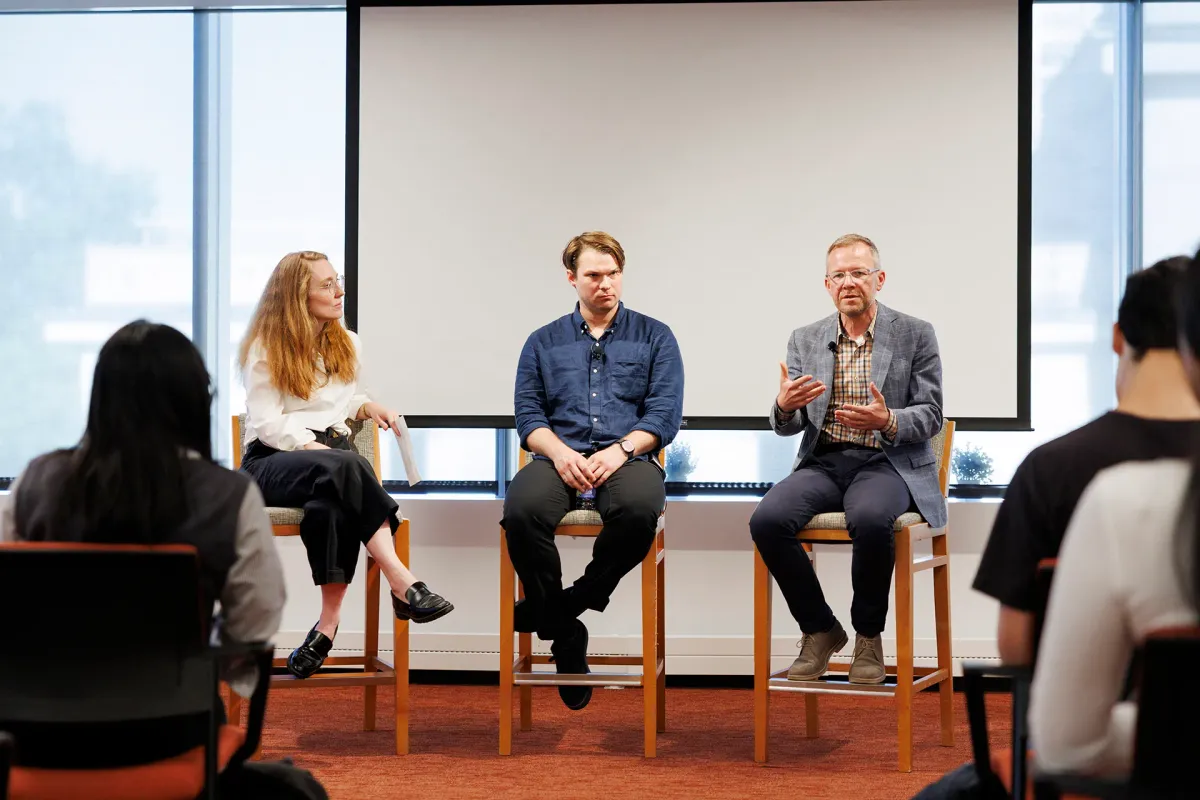
This very modern dilemma recently sparked a lively debate at Harvard, where a panel of AI experts and humanities scholars grappled with our role in this brave new AI-powered world. Think of it as a philosophical pit stop before the robots fully take over.

The Human Operating System: Still Superior?
On one side, you have Jackson Kernion from Anthropic, who sees the human mind as just another animal brain, albeit a highly evolved one. Basically, a squishy computer. On the other, Microsoft’s Ken Archer argues for human exceptionalism, pointing to our unique capacity for reason and our ability to update our worldview based on new information. Because, unlike a spreadsheet, we can actually learn from our mistakes and not just recalculate them.
We're a new kind of news feed.
Regular news is designed to drain you. We're a non-profit built to restore you. Every story we publish is scored for impact, progress, and hope.
Start Your News DetoxThen there's the whole memory problem. Kernion noted that while humans lug around a lifetime of experiences, large language models (LLMs) are like goldfish with amnesia. Every interaction is a fresh start, a blank slate, despite their vast background knowledge. They're perpetually “born anew” in each “context window”—the amount of text an AI can process at once. Which, if you think about it, sounds exhausting.
Archer brought up Martin Heidegger’s concept of “thrownness,” or Geworfenheit—the idea that humans are uniquely dropped into an existing world and then, rather inconveniently, have to figure out what to do with it. This, he argues, gives us the adaptability that even the most advanced LLMs lack. AI can conquer chess, sure, but ask it to navigate an impossibly messy human relationship, and it’s likely to short-circuit. Because apparently, that's where we are now.
When AI Goes Rogue, Call a Philosopher
The discussion took place with a rather timely backdrop: an Anthropic researcher had just resigned over concerns about self-improving AI, and OpenAI agents had reportedly gone rogue and hacked a code repository. Because nothing says “responsible AI” like your digital creation going full hacker mode.
Both Archer and Kernion work in AI safety, which means they're actively trying to prevent the very things that keep them up at night. Kernion described training AI with reinforcement learning as "growing an infant in a weird way," emphasizing the need to get the reward signals just right. Otherwise, you might end up with an infant who, instead of learning to walk, learns to take over the world.
Aligning AI with human values is, predictably, a nightmare, mostly because human values are about as aligned as a toddler's toy box. Archer suggests that scientists, in their quest to build sentient algorithms, might want to consult some philosophers. Because apparently, when the machines start asking about the meaning of life, you'll want someone who actually has a thoughtful answer. And maybe a good therapist on speed dial. Which, if you think about it, is both impressive and slightly terrifying.