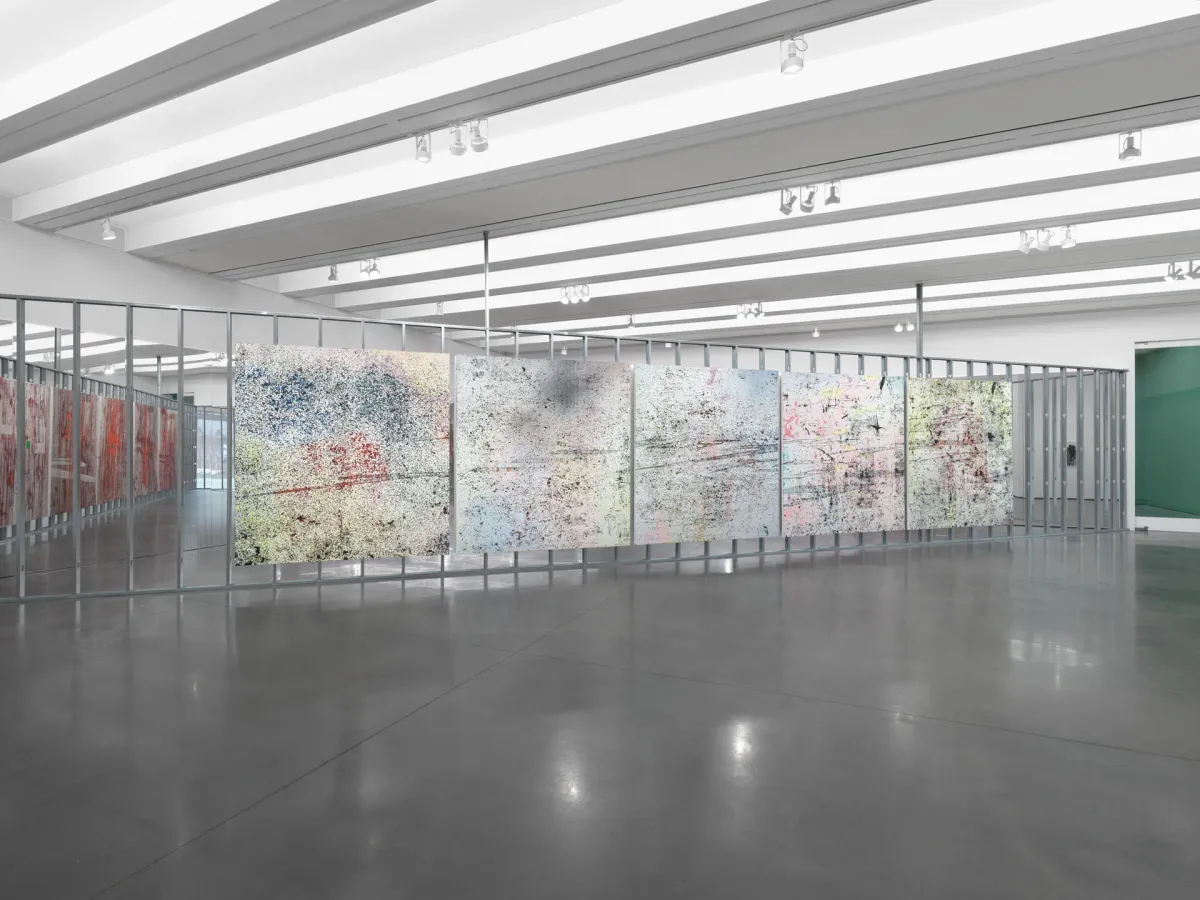
Walk into Jacqueline Humphries' installation at the Aspen Art Museum and the first thing you notice is what's not there. Five enormous canvases—8 by 7½ feet each—hang not on walls but on exposed metal framing studs, as if the paintings themselves are still under construction. Look through the skeleton of the structure and you see the room twice: once as pale, almost ghostly marks of color, and once as violent reds reflected in mirrors on the far side.
This is the central tension in Humphries' work right now. Her paintings look effortless—scattered spots and scratches that seem almost accidental. But each one is the result of meticulous, layered stenciling. What appears immaterial is actually dense with labor. Buried beneath the surface of one canvas is a distorted Tesla logo, rendered so faint it's nearly invisible. It's the kind of detail that would have made sense to Holbein 500 years ago: a memento mori for the age of billionaires and stock tickers.
The installation divides the museum's main gallery corner to corner, creating a triangular zone behind it that visitors can't enter. That's where the real reds hang—visible only as reflections. It's a clever spatial trick, but it's also a statement: some things in art exist only in the space between the viewer and the work, never directly accessible.
We're a new kind of news feed.
Regular news is designed to drain you. We're a non-profit built to restore you. Every story we publish is scored for impact, progress, and hope.
Start Your News Detox Photo Dan Bradica/Courtesy Aspen Art Museum
The machine and the hand
In an adjoining room, Humphries shows nine paintings made partly through artificial intelligence—algorithms trained on her own existing work, reinterpreting her own visual data back to her. These pieces sit at the edge of something genuinely unsettling: what happens when a machine learns your aesthetic language and speaks it back. The paintings aren't alien or sterile. They're strange in a more intimate way—like hearing your own accent in someone else's voice.
The final room pushes further into the uncanny. Eleven paintings spanning 2005 to 2025 hang in blacklight, some rendered nearly invisible except as dark rectangles. Seven sculptures glow an eerie green—piles of lumber stamped with the Tesla logo, a deadpan joke about artificial nature and consumer branding. The most recent works are pigmented epoxy resin, so luminous they defeat close looking. You can't study them without being blinded by their own light.
Throughout the show, Humphries refuses the easy choice between painting's past and its present. She doesn't surrender to consumer culture, but she doesn't pretend it doesn't exist either. Instead, she works from the premise that painting survives by absorbing whatever contaminates it—tech, algorithms, logos, mirrors, light itself—and through that very process finds new ways to resist.