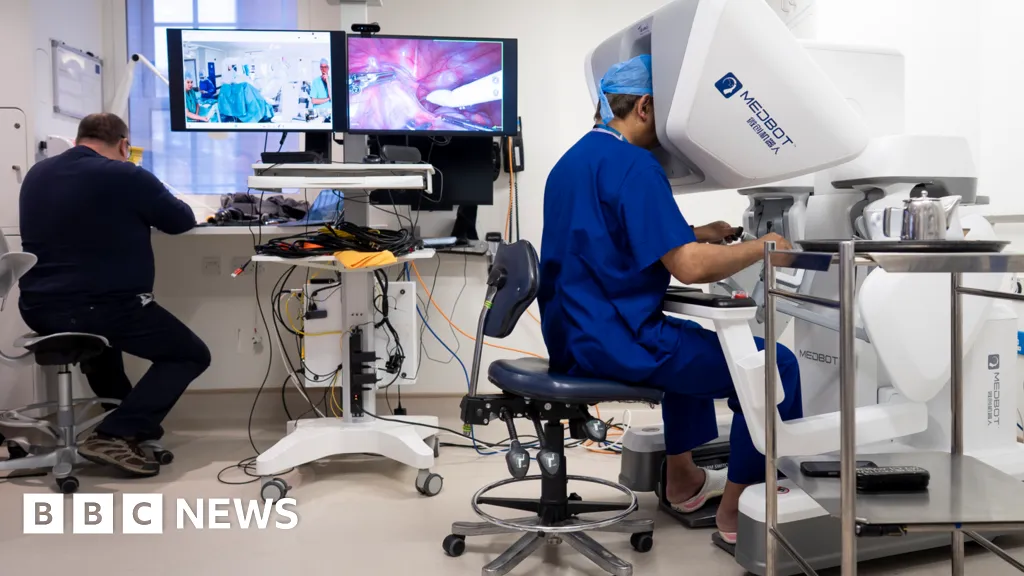
A surgeon in London has successfully removed a patient's prostate from 1,500 miles away in Gibraltar — a first for the UK and a glimpse at how future cancer care might work across borders.
Professor Prokar Dasgupta controlled a robotic surgical system from The London Clinic while operating on Paul Buxton, a 62-year-old cancer patient in Gibraltar. The connection held steady through fibre-optic cables with only 0.06 seconds of delay — fast enough that Dasgupta said it felt "almost as if I was there." For Buxton, a transport company owner who'd lived in Gibraltar for 40 years, the choice was straightforward: undergo pioneering surgery at home or fly to London, join an NHS waiting list, and spend three weeks away from his business. He called it a "no-brainer."
Gibraltar, a British overseas territory with a single hospital, sits in an awkward position. Residents needing complex care have historically faced the "vast expense and inconvenience" of traveling abroad — usually to the UK — for treatment. A prostate cancer diagnosis just after Christmas would normally have meant exactly that journey for Buxton. Instead, he became part of a clinical trial that could reshape how remote communities access specialist surgery.
We're a new kind of news feed.
Regular news is designed to drain you. We're a non-profit built to restore you. Every story we publish is scored for impact, progress, and hope.
Start Your News Detox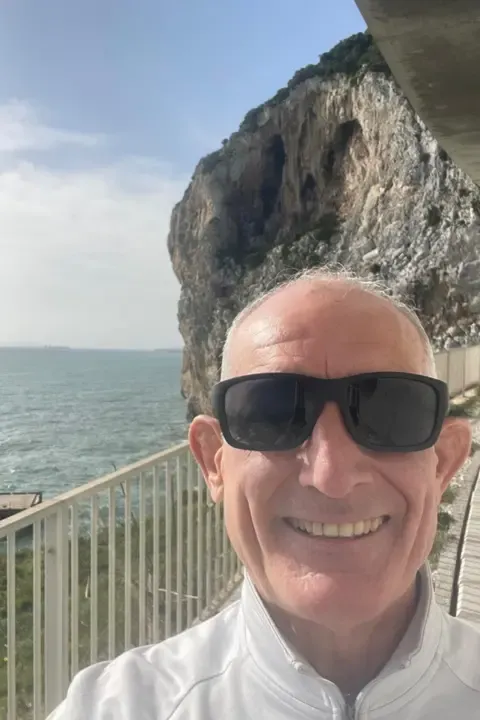
What made this work
The Toumai Robotic System, equipped with a 3D HD camera and four articulated arms, sits in Gibraltar under the surgeon's control in London. A team remained on standby in the operating theatre in case the connection failed, but it never did. The backup 5G link stayed unused. The entire setup — the technical precision, the human oversight, the redundancy — worked as designed.
What's striking here isn't just the distance. It's the implication. If a surgeon in London can operate on a patient in Gibraltar with minimal delay, the same principle applies to rural Scotland, the Shetland Islands, or anywhere else where specialist expertise is geographically distant. The technology doesn't solve the problem of having only one hospital in a territory — but it does solve the problem of that hospital being isolated from world-class surgical skill.
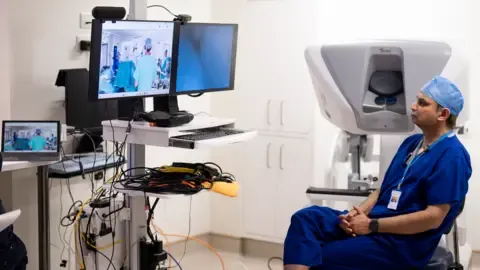
Dasgupta is performing a second procedure on 14 March, which will be livestreamed to 20,000 urological surgeons at a European conference. This isn't just a one-off demonstration. It's a proof of concept being broadcast to the specialists who'll decide whether to adopt it.
UK surgeons have tested long-distance surgery before — a transatlantic robotic stroke procedure on a cadaver proved the concept was technically possible. But this is the first time it's happened between two living people in real clinical conditions, with a real patient's cancer at stake and no safety net of being in the same building.
Buxton recovered well after surgery and described feeling "fantastic." More important than one patient's outcome, though, is what this trial signals: specialist surgery no longer has to mean leaving home.