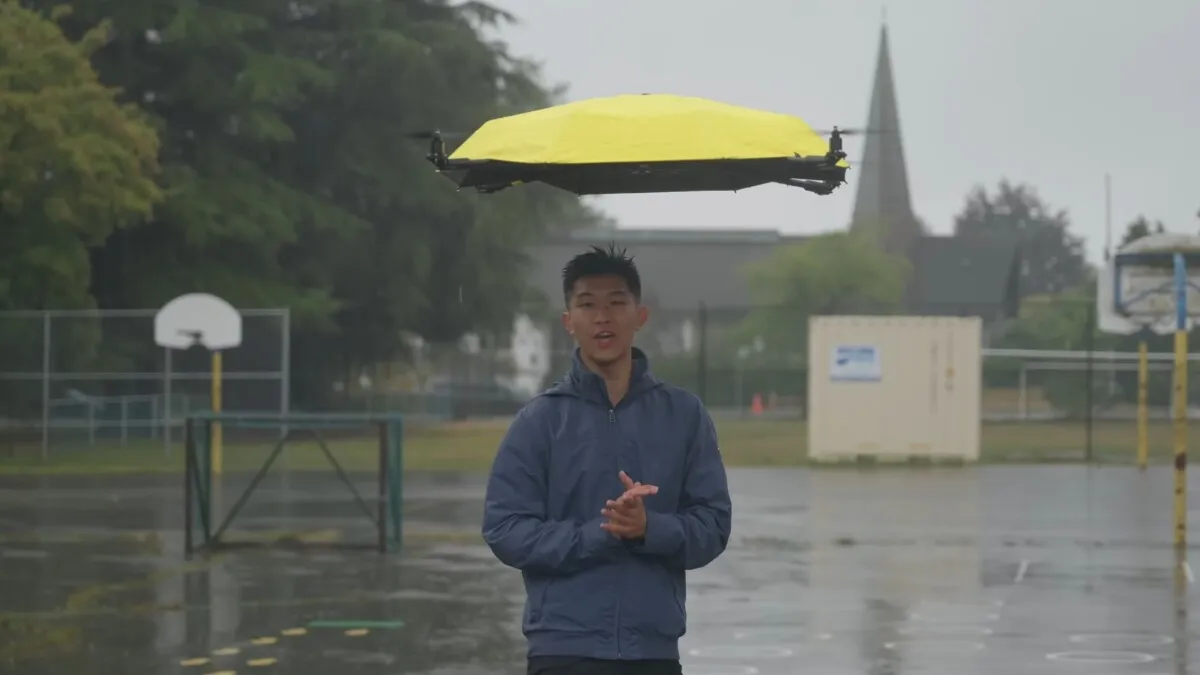
Walking in the rain means choosing: grip an umbrella with one hand, or keep your phone free. Strong wind turns both into a losing battle anyway. YouTuber John Xu spent two years solving a problem most of us accepted as unsolvable—what if the umbrella just followed you.
Xu first built a drone-powered umbrella in 2024, which was technically impressive. But YouTube viewers spotted the catch immediately: it needed a handheld controller. The comments were direct—cool, but impractical. He listened.
The breakthrough came from a time-of-flight camera, the kind that measures distance by sending out light and timing its return. This let the umbrella track Xu's movements autonomously, even in darkness. It wasn't perfect—it drifted sometimes, never stayed perfectly centered overhead—but it worked well enough to transform the whole project from novelty into something genuinely useful.
We're a new kind of news feed.
Regular news is designed to drain you. We're a non-profit built to restore you. Every story we publish is scored for impact, progress, and hope.
Start Your News DetoxThe Practical Questions
Of course, a flying umbrella raises immediate concerns. Wind and heavy rain can destabilize a lightweight drone. Battery life is limited—maybe 20 minutes before it needs charging. There's the noise of spinning rotors, and the safety question of propellers whirring above people on a crowded street.
Xu didn't pretend these problems away. He was clear: this wasn't an attempt to replace umbrellas. It was an experimental personal drone, a proof of concept.
What matters about this project isn't whether flying umbrellas will ever show up in stores. It's what they signal about where technology is heading. As sensors get cheaper and autonomy improves, we're seeing more devices that adapt to us rather than forcing us to adapt to them. The umbrella is playful, even silly—but it's a genuine glimpse of what becomes possible when someone asks "what if we didn't have to hold onto this?"
The next question might be something more useful than rain protection. But the pattern is worth noticing: familiar problems, unexpected solutions, and the quiet reminder that even the oldest tools can surprise us.