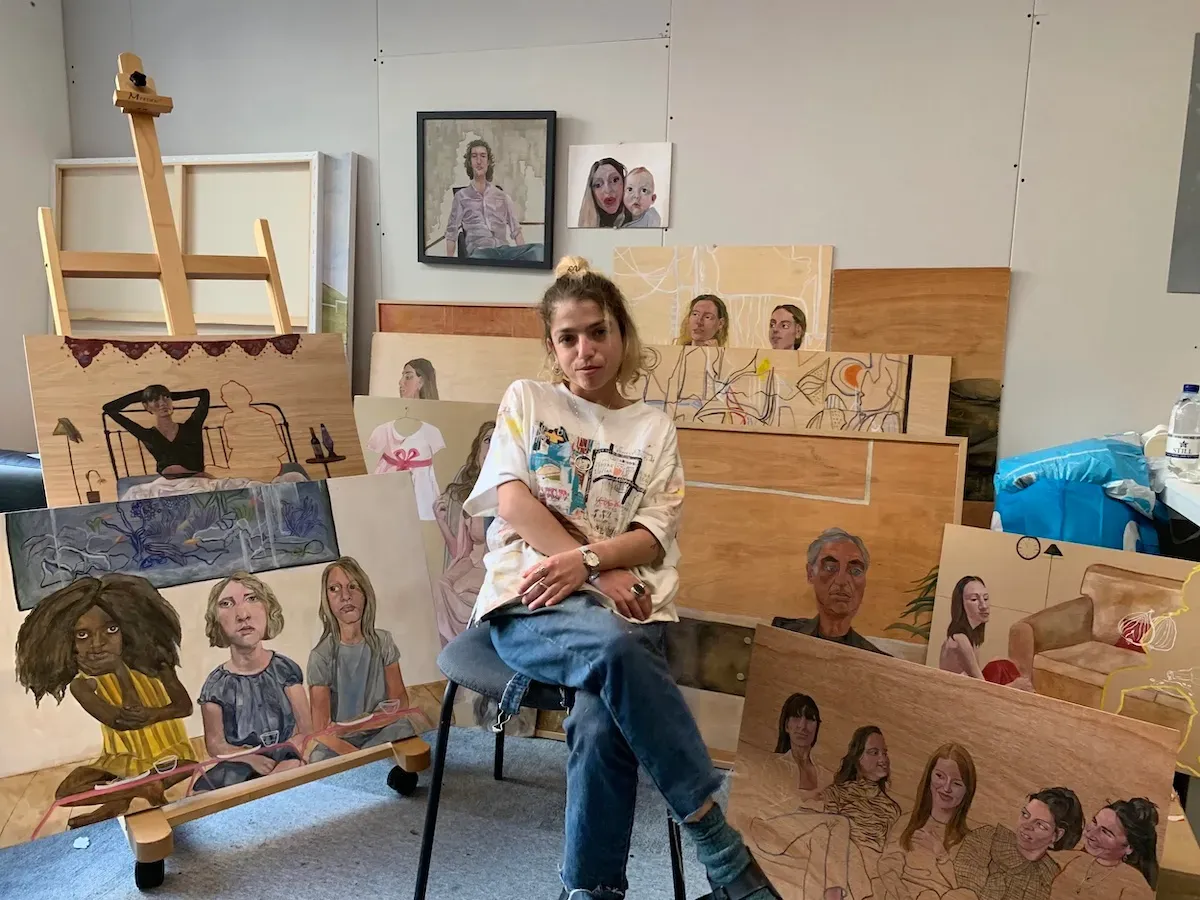
Lorena Levi painted people the way most of us never see them—caught between moments, suspended in the grain of wood, their stories hanging in the air like something half-remembered. She died on January 8 from pancreatic cancer. She was 29.
In just a few years, Levi had built something remarkable. Marlborough Gallery added her to its roster in 2023. Her work entered the British government's national collection. She'd shown in Milan with M+B, the Los Angeles gallery, and participated in V.O. Curations, the London-based program that has supported artists like Emma Prempeh and Cajsa von Zeipel. For someone still in her twenties, the momentum was undeniable.
What Made Her Work Distinct
Levi called what she did "narrative portraiture"—portraits of everyday people that captured a single, loaded moment. A gesture. A glance. The way someone held their body in a room. She was drawn to Paula Rego, Alice Neel, Frida Kahlo, and Chantal Joffe, artists who refused to make their subjects comfortable or pretty.
We're a new kind of news feed.
Regular news is designed to drain you. We're a non-profit built to restore you. Every story we publish is scored for impact, progress, and hope.
Start Your News DetoxShe painted directly onto wood, leaving the grain visible. This wasn't decoration—it was intention. "On a wood background the painting flattened," she explained, "making the composition almost dreamscape-like and distorting perspective." You could never quite tell how close the figures were to the edges of their world. That uncertainty was the point.
Born in Istanbul in 1997, Levi moved to Tel Aviv as a toddler, then to the UK at three. She was born with cystic fibrosis. Art became her way out—not escape, exactly, but expression. "So I could express my emotions and avoid sinking into boredom and depression," she said. She studied at Art & Guilds in London, then completed a masters at Edinburgh College of Art in 2021.
Art as Witness
Her later work grew more explicitly rooted in her own body and its struggles. For one series, she interviewed men from Reddit's r/IncelExit community about how they saw women, then painted their testimonies—a magazine with a nude woman on the floor, sneakered feet nearby. The work was unflinching, almost anthropological.
When she was treated for cystic fibrosis and later pancreatic cancer, she painted through it. A 2024 show at Incubator gallery featured Barbies—not the idealized plastic versions, but flesh-toned, imperfect, scarred. Her own experience made visible through theirs.
Two self-portraits hung in that same show. One from 2019: a mostly nude body covered in scars, the face hidden beneath swirls of red. Another from 2025, painted while she was undergoing chemotherapy: her gaunt head, eyes open, looking out into black void.
She was still making work. Still looking. Still refusing to look away.