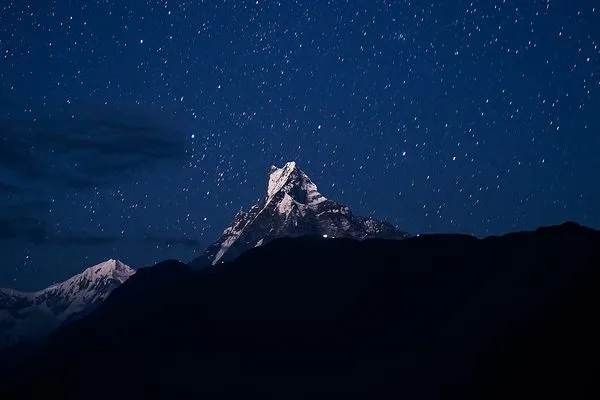
Machhapuchhare doesn't need to be summited to matter. The 6,997-meter peak in Nepal's Annapurna range has never been officially climbed, and that's entirely by design—a rare case where a mountain's power comes from what people choose not to do.
The name means "Fishtail Mountain," and the reason becomes clear when you see it from the west: two sharp summits that split the sky like a fish's tail. It's striking enough to draw trekkers from around the world, but they come to walk around it, not up it. Since 1970, climbing Machhapuchhare has been explicitly banned in Nepal.
The restriction exists because the mountain is sacred. Hindu tradition holds that Shiva, one of the religion's most important deities and the protector of this region, makes his home on Machhapuchhare's slopes. To climb it would be a desecration—treating a holy site as a trophy.
We're a new kind of news feed.
Regular news is designed to drain you. We're a non-profit built to restore you. Every story we publish is scored for impact, progress, and hope.
Start Your News DetoxThis wasn't always the case. In 1957, a British team led by mountaineer Jimmy Roberts got within 50 meters of the summit before turning back. Roberts apparently requested the King of Nepal to issue a climbing ban afterward, though historians still debate his exact reasons. The king agreed, and the restriction has held for over five decades.
There's one footnote of uncertainty. In 1983, New Zealand climber Bill Denz—known for ignoring climbing bans—may have reached the summit. But Denz died in an avalanche on Makalu later that year, and without witnesses or documentation, the claim remains unverified. The mountain's official status as unclimbed has never been challenged.
The combination of the ban and Machhapuchhare's brutal technical difficulty has kept the peak untouched. The vertical rock is steep enough to deter even experienced climbers, and the mountain guards itself as much as any law does.
What makes this story relevant isn't just the prohibition—it's what it represents. In an era when climbers race to summit everything, Machhapuchhare shows that some places gain more meaning when left alone. The mountain draws thousands of trekkers annually not because they can reach the top, but because they respect that they shouldn't. It's become a quiet argument for restraint, for recognizing that not every peak needs a flag planted on it.