A Dutch Lego enthusiast just did what the official Lego typewriter couldn't: made one that actually writes.
When Lego released its 2,079-piece typewriter kit in 2021, it was a marvel of mechanical design—you could press the keys, watch the arms move, feel the satisfying click. But there was a catch. It didn't actually put anything on paper. For Koenkun Bricks, a Netherlands-based Lego YouTuber and tinkerer, that was the problem worth solving.
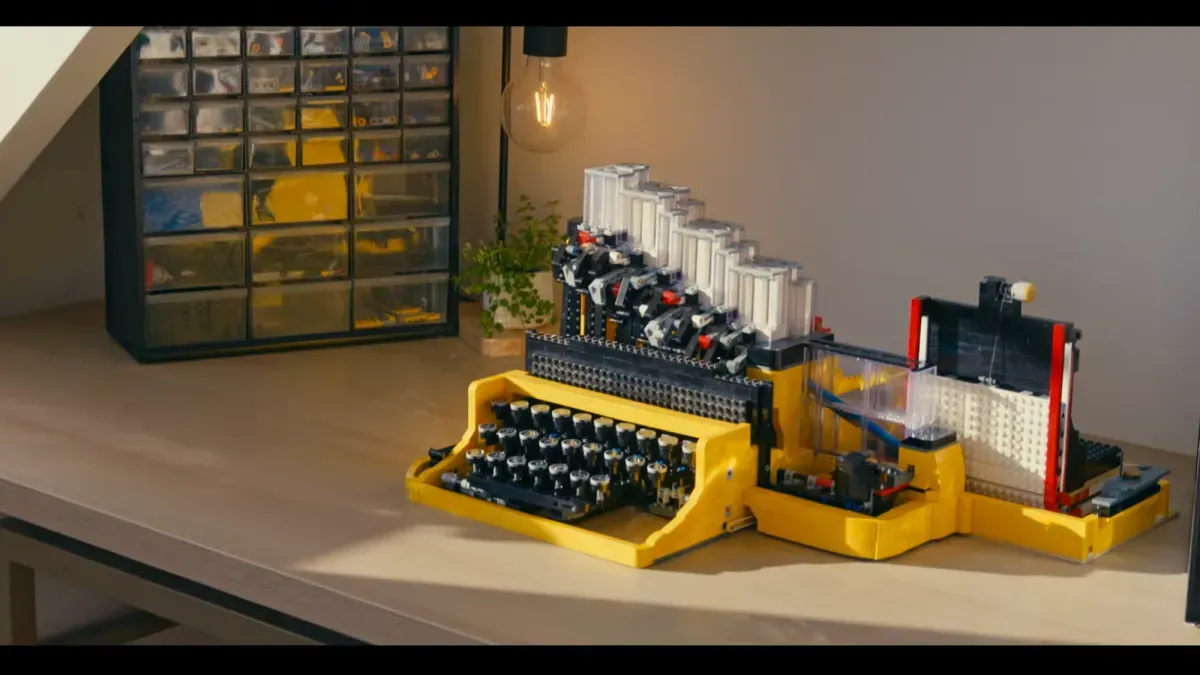
His solution took months of experimentation, dozens of failed prototypes, and enough rubber bands to make any engineer wince. The final machine looks less like a typewriter and more like something Dr. Seuss might have sketched on a napkin—all exposed gears, precarious angles, and mechanical improvisation. But it works.
We're a new kind of news feed.
Regular news is designed to drain you. We're a non-profit built to restore you. Every story we publish is scored for impact, progress, and hope.
Start Your News DetoxHere's what had to happen for each letter to make it onto the page: a tiny Lego brick letter had to be selected from a dispenser, roll down an incline toward a hammer mechanism, get struck with enough force to leave an impression on a sheet made from strips of Lego tiles, and then the whole paper had to shift one position to the left for the next character. Multiply that by dozens of moving parts, each one needing to sync perfectly, and you start to understand why this took so long.
The Engineering Rabbit Hole
What's remarkable isn't just that Koenkun Bricks pulled this off—it's what the project reveals about constraint-based creativity. He was working within the rules of a toy system designed for something entirely different. Every solution had to be built from bricks and standard Lego connectors. No 3D printing. No custom parts. Just the brick.
That's the opposite of how most engineering works. Usually you design the solution first, then manufacture it. Here, the available tools came first, and the solution had to fit inside them. It's the kind of limitation that either crushes you or forces you to think sideways.
The machine technically behaves more like a printing press typesetter than a traditional typewriter—but that distinction feels almost pedantic when you watch it actually produce text. Each letter leaves a tiny, visible mark on the Lego paper. It's slow. It's clunky. It's inefficient by any practical measure. And it's completely mesmerizing.
What Koenkun Bricks demonstrated is something that gets lost when we talk about "innovation"—the gap between what a product is designed to do and what becomes possible when someone refuses to accept those limits. The official Lego typewriter was engineered to be impressive. His version is engineered to actually function, even if function means something different than anyone expected.
The project hints at a broader shift in how people engage with toys and building systems. Lego bricks have become sophisticated enough that the barrier between "toy" and "functional tool" has blurred. What started as a hobbyist's weekend project shows what happens when someone with patience, curiosity, and access to a camera documents the full messy process of making something work.