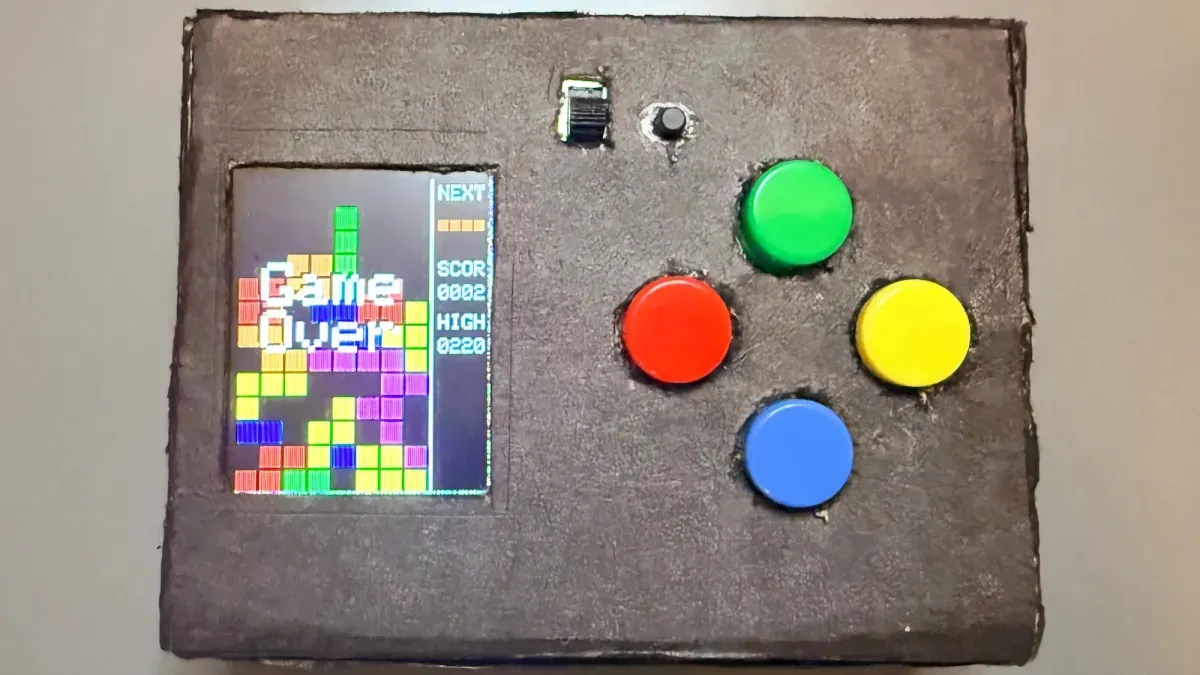
William Gaspar built a working Tetris machine from a cardboard box, an Arduino microcontroller, and a 1.8-inch screen. It runs on three AAA batteries.
There's something quietly satisfying about that constraint. Not because cardboard is trendy or retro—though it's becoming a standard move among DIY hobbyists—but because it strips away the pretense. You're left with: does the thing work? Yes. Can you make it yourself? Also yes. The code and instructions are free on GitHub.
Gaspar's machine plays Tetris and Snake with the same reliability as any commercial handheld. The efficiency comes from a clever power decision: he runs the ATmega328P microcontroller at 8 MHz instead of the standard 16 MHz. That drops the voltage requirement from 5V to 3.3V, which means the LCD screen runs on the same battery supply. Three AAA batteries power the whole thing.
We're a new kind of news feed.
Regular news is designed to drain you. We're a non-profit built to restore you. Every story we publish is scored for impact, progress, and hope.
Start Your News DetoxIt's the kind of optimization that only matters if you're actually building something. You don't read about it in marketing copy. You discover it by trial and error, by asking "what if I just... turned this down?" and realizing it still works.
Cardboard enclosures have become a recurring theme in hobbyist electronics—partly because they're cheap and easy to iterate on, partly because there's something honest about showing the guts of your project. Gaspar's box even comes with a self-aware joke: he chose a zero-calorie soda box, then posted a photo with a note: "And I know you would argue: I can see it says zero calories in the lower right corner! That's just how many calories are in the box."
The project sits at that intersection where technical skill meets playfulness. You need to understand microcontroller power consumption and LCD protocols to build this. But you also need to be willing to put it in a cardboard box and laugh about it.
What started as a single-person project is now available for anyone with basic electronics experience to replicate. That's the real win—not that Gaspar built something cool, but that he documented it in a way that makes it copyable.