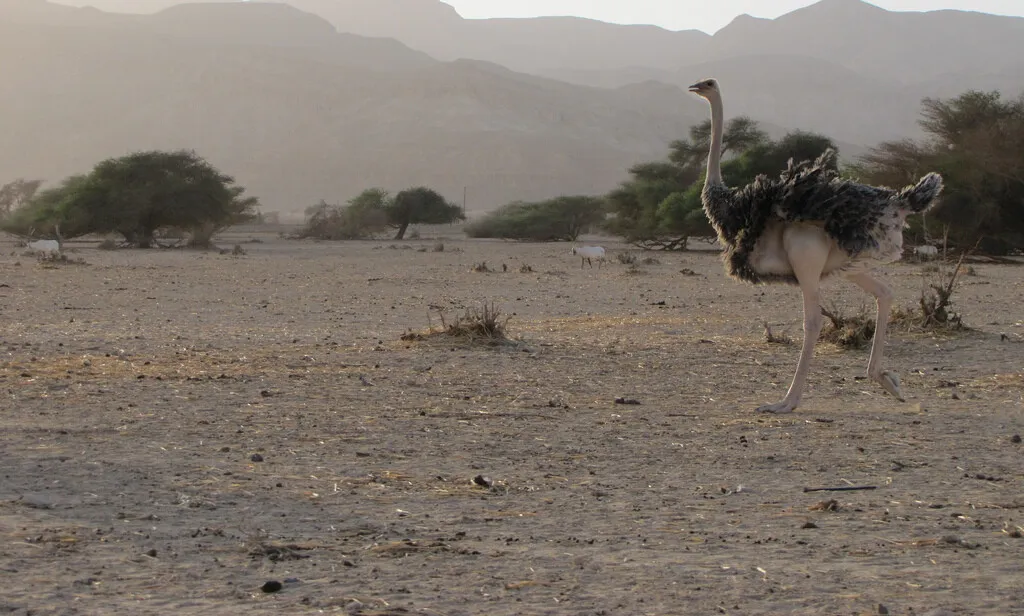
For the first time in 100 years, ostriches are walking across the Arabian Peninsula again. Five red-necked ostriches were released into Prince Mohammed Bin Salman Royal Reserve, a 6-million-acre stretch of Saudi desert, as part of ReWild Arabia—an ambitious program to bring back 23 species of native megafauna that once roamed the region.
The ostrich was chosen carefully. Red-necked ostriches, the closest living relative to the extinct Arabian ostrich, are built for extreme heat and scarcity. They're also critically endangered globally, with only around 1,000 surviving in Africa's Sahel region. The Arabian desert, with its isolation and minimal poaching pressure, offers them something their current habitat doesn't: space to actually recover.
But this isn't sentimental rewilding. The ostrich is what ecologists call a keystone species—remove it, and the whole system suffers. These birds are seed dispersal engines, carrying seeds across vast distances and regenerating plant life in fragmented landscapes. As they forage, they aerate soil and flush out insects, triggering cascades of benefit through the food web. In a desert ecosystem, that matters immensely.
We're a new kind of news feed.
Regular news is designed to drain you. We're a non-profit built to restore you. Every story we publish is scored for impact, progress, and hope.
Start Your News Detox"Returning such an iconic desert species after nearly a century carries deep emotional, ecological, and cultural significance," said Andrew Zaloumis, CEO of the reserve. Ancient neolithic drawings preserved in Arabia's dry climate show ostriches alongside other animals the reserve is working to restore—evidence that this isn't about imposing a new vision, but recovering one that existed for millennia. Arab poets revered the ostrich as a symbol of strength, endurance, and speed. The bird carries history.
A template for restoration
ReWild Arabia represents something larger than five birds in a desert. It's a working model for how to restore entire ecosystems when the pieces still exist somewhere on Earth. The reserve's managers aren't inventing a new Arabia; they're reassembling the old one, species by species. The ostriches are the visible milestone, but they're part of a coordinated effort to rebuild ecological relationships that collapsed over centuries of hunting and habitat loss.
The next phase will be watching whether those five birds establish themselves, breed, and eventually thrive. If they do, it signals that even large, iconic species can be brought back—not to a theme park or a zoo, but to functioning wild landscapes where they reshape ecosystems simply by being present.