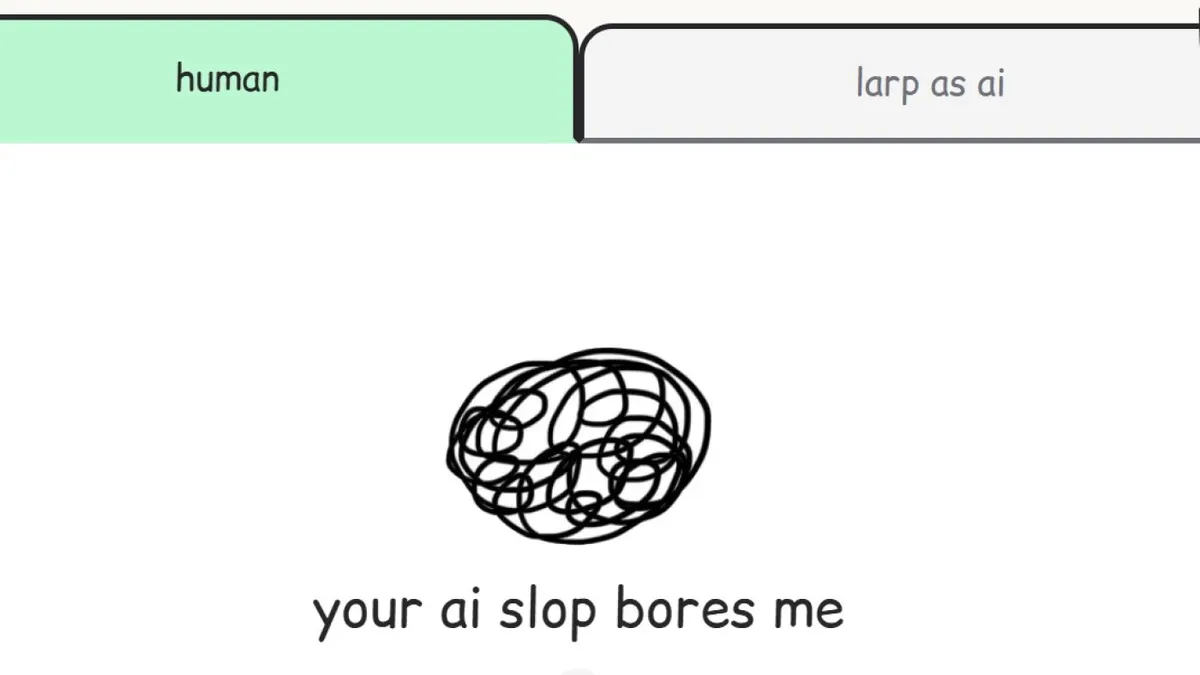
Tired of actual AI? Apparently, millions of people are. A website called "Your AI Slop Bores Me" has racked up 25 million unique visitors and nearly 280 million hits in a month by doing one thing: letting humans pretend to be AI.
Seventeen-year-old Mihir Maroju, the site's creator, probably didn't expect to ignite a digital movement. Users submit requests for images or info, just like with ChatGPT. The twist? A human, not an algorithm, whips up the response.
The Human Touch in a Robotic World
While a June 2025 Pew Research study found over a third of U.S. adults have used ChatGPT for actual tasks, it seems a significant number just want to be the bot. Cartoonist Amy Kurzweil, for instance, found joy in drawing a bat eating a strawberry on the site. Human users get a brisk 75 seconds to respond, which often leads to delightfully simple, hurried artwork.
We're a new kind of news feed.
Regular news is designed to drain you. We're a non-profit built to restore you. Every story we publish is scored for impact, progress, and hope.
Start Your News DetoxKurzweil also enjoys flipping the script and asking the site questions, once discovering the Twisted romance series. She thinks the site, with its retro Comic Sans MS font, brings back the friendly, slightly chaotic vibe of the early internet. Because apparently, we miss the days before every corner of the web felt like a corporate-optimized content farm.
Her theory? People are fed up with the internet being saturated with non-human content. This is their way of reclaiming the "magic of the early Internet" — purely for the simple, often absurd, joy of human connection. The administrators have even added filters for harmful content, because even fake AI needs some guardrails.
The Art of the Prank Bot
Comedian Ben Palmer took a slightly different, more mischievous route. In a 2023 YouTube skit, he set up fake ChatGPT websites with URLs just similar enough to trick unsuspecting users. Imagine landing on a chatbot site, asking it to write an article on climate change (especially if you're in China, where ChatGPT is banned), only to discover you're talking to a comedian. Awkward, hilarious, and surprisingly helpful, as Palmer ended up using the real ChatGPT to help that user out.
Palmer admits there's a "dark side" — like having to decline requests for sexually explicit content. His main goal, though, is to remind people that the internet should be a lively, unpredictable place, not just a playground for corporations. He's curious to see how people react when they think they're talking to an AI that's, shall we say, a little unhinged.
Even OpenAI, ChatGPT's creator, seems to find the whole thing amusing, noting AI's increasing presence in pop culture. Angel investor Brianne Kimmel calls human impersonation of AI "great sketch comedy," suggesting it's helping us define how we talk to bots versus how we talk to each other. Which, if you think about it, is both impressive and slightly terrifying.